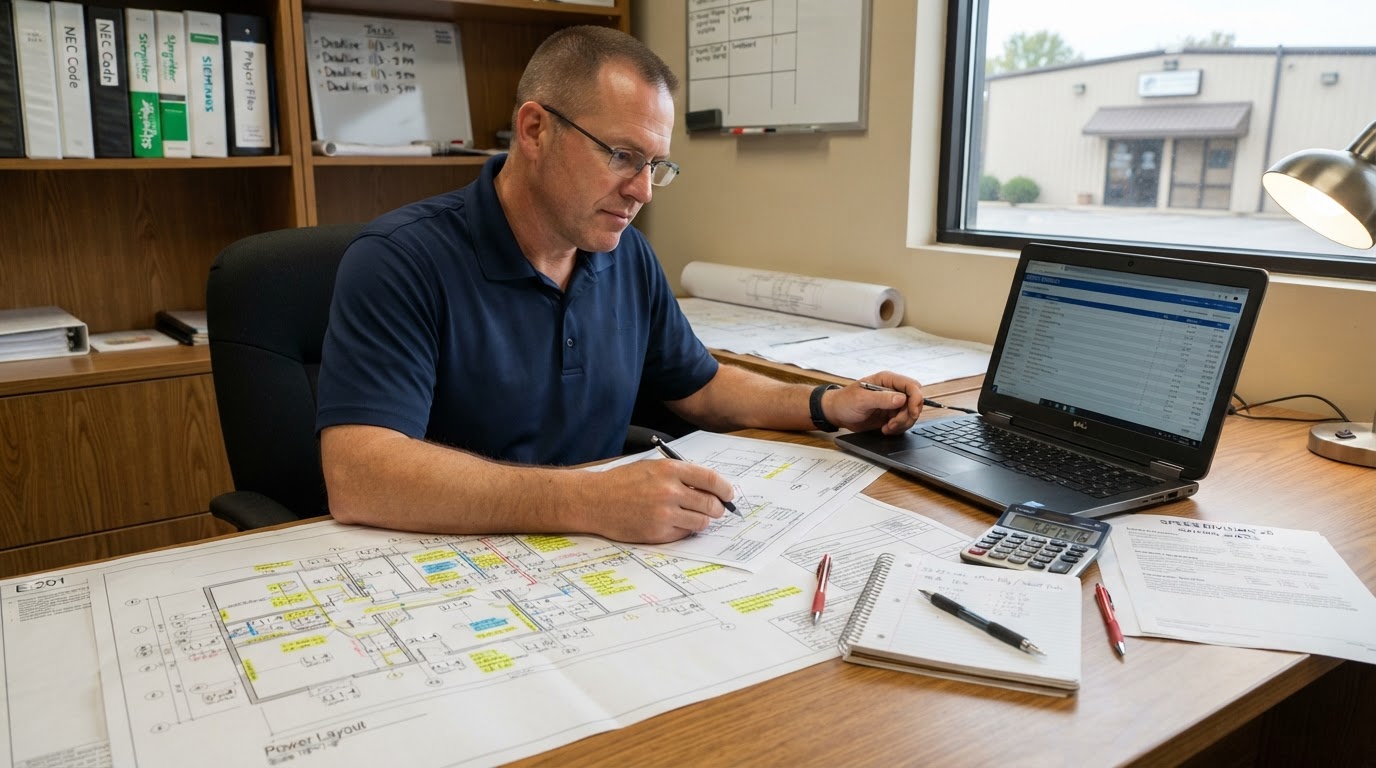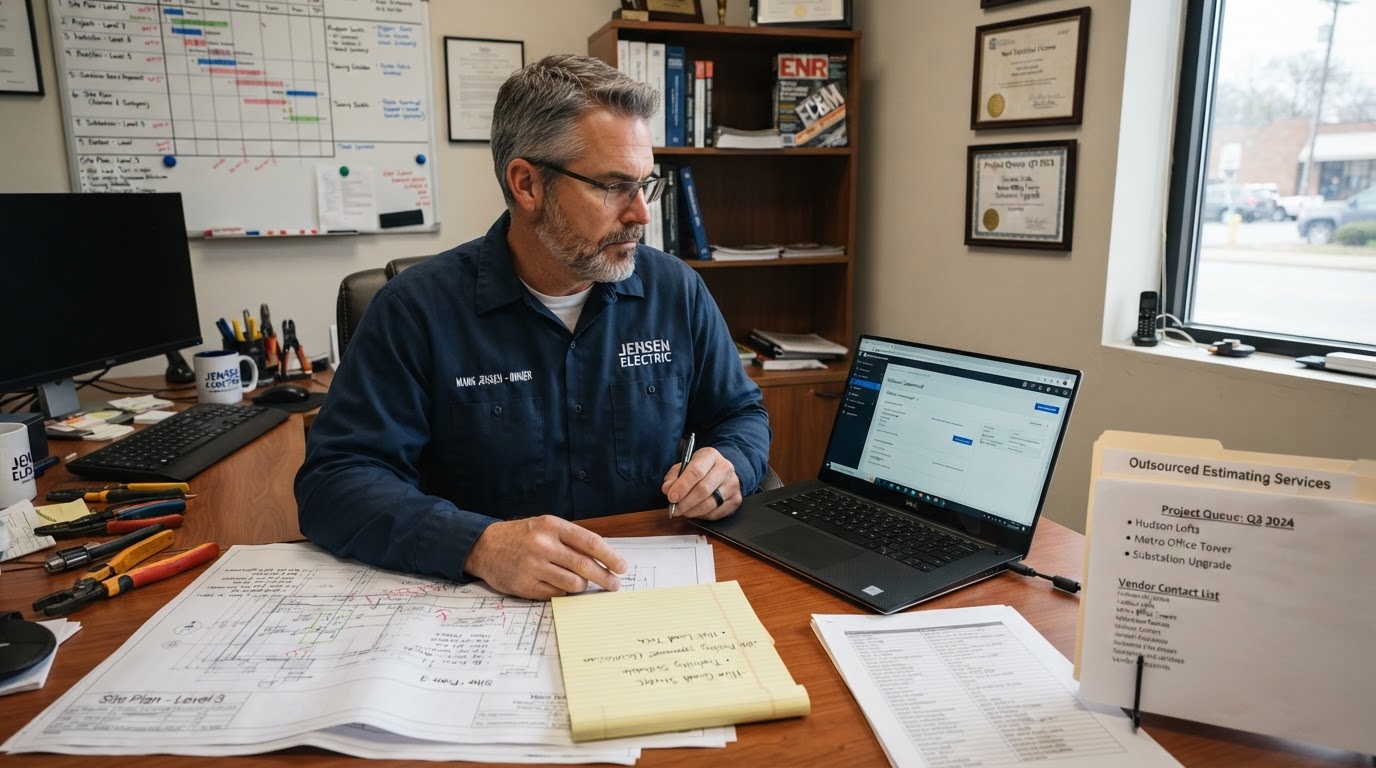
Outsourcing electrical estimating can save an owner a meaningful amount of office time, but many contractors hesitate for one understandable reason: they do not want someone outside the company controlling their prices.
That concern is valid.
Your labor rate, material pricing, markup, margin, scope, warranty language, customer promises, and final selling price are business decisions. An estimating service should support those decisions, not quietly replace them.
The better model is not "send the job away and hope the number comes back right."
It is a controlled estimating workflow where your company defines the rules and retains the approval authority while someone else handles the preparation work.
If estimating is already eating your evenings, you may recognize some of the signs your electrical business has outgrown DIY estimating. The question then becomes how to add capacity without handing your pricing to someone else.
What Electrical Contractors Should Keep Control Of
Outsourcing estimate preparation does not require outsourcing your business judgment.
Your company should continue to control:
- labor rates and approved labor assumptions
- material-cost sources and preferred products
- material markup
- overhead and profit targets
- tax treatment and approved fees
- scope decisions
- allowances and exclusions
- warranty language
- deposit and payment terms
- customer commitments
- final price
- final approval before an estimate is issued
Those inputs are part of how your company protects margin and decides what work is worth taking.
An outside estimating resource can organize and apply those rules consistently, but it should not invent them.
What Can Be Delegated Without Giving Up Pricing Authority
A well-defined estimating support process can take a large amount of administrative production off the contractor's plate.
Tasks that can often be delegated include:
- reviewing a complete estimate request for missing information
- organizing photos, plans, measurements, and technician notes
- building an estimate worksheet from contractor-approved pricing rules
- applying approved material and labor inputs
- formatting assumptions and exclusions
- preparing a client-ready proposal draft
- maintaining version history when revisions occur
- flagging questions that require contractor judgment
The key word is approved.
If a decision affects technical scope, selling price, margin, or a promise to the customer, it should stay with the contractor.
Contractor Control vs. Estimating Support
A good outsourced estimating relationship should make this boundary obvious. The table below summarizes what the contractor typically keeps versus what estimating support can handle.
| Contractor Keeps Control | Estimating Support Can Handle |
|---|---|
| Labor rates and productivity assumptions | Applying approved labor inputs to the estimate |
| Material pricing rules and preferred products | Organizing material costs and quantities |
| Markup, overhead, and margin | Applying the approved pricing profile |
| Technical scope decisions | Drafting the estimate from the submitted scope |
| Exclusions and customer commitments | Formatting approved assumptions and exclusions |
| Final selling price | Producing the pricing worksheet and proposal draft |
| Final authorization | Preparing the document for contractor review |
A good outsourced estimating relationship should make this boundary obvious.
Contractor Keeps Control
- labor rates
- material pricing rules
- markup
- margin
- approvals
- customer commitments
- scope decisions
Estimating Support Handles Preparation
- intake review
- missing-information flags
- estimate worksheet drafting
- proposal formatting
- assumptions and exclusions
- version control
Start With a Contractor Pricing Profile
One of the most important parts of outsourcing estimating is creating a contractor-specific pricing profile before the first real estimate is produced.
That profile can document items such as:
- standard labor rates
- crew assumptions
- common material preferences
- material markup rules
- overhead and profit approach
- minimum project charges where applicable
- permit or utility-cost treatment
- equipment rental treatment
- warranty language
- estimate-validity language
- deposit terms
- standard exclusions
- proposal formatting preferences
This turns outsourced estimating into a repeatable process instead of a new pricing conversation on every job.
It also reduces the risk of a generic estimator applying assumptions that do not match how your company actually operates.
Complete Field Information Matters More Than Most Contractors Expect
Even a strong estimator cannot produce a reliable estimate from weak job information.
If the request is simply "price a 200-amp service" or "quote a kitchen remodel," the estimator still has to know what your field team actually found and what your company intends to provide.
Useful inputs may include:
- written scope
- photos and video
- measurements and run distances
- panel or service information
- equipment make and model when relevant
- plans and specifications when available
- permit or utility assumptions
- customer-selected fixtures or allowances
- technician notes
- known site constraints
The estimator should identify missing information rather than make technical assumptions that were never approved.
That protects both the estimate and the contractor.
Use Approval Gates Instead of Blind Delegation
The safest outsourcing workflow includes clear approval points.
A practical sequence looks like this:
- The contractor submits complete job information.
- The estimating service reviews the package and flags missing information.
- The estimate is prepared using the contractor's pricing profile.
- Questions involving scope or technical judgment go back to the contractor.
- The contractor reviews the estimate worksheet, assumptions, exclusions, and final selling price.
- Only the contractor-approved version becomes the client-ready proposal.
That workflow gives the contractor more capacity without turning pricing authority over to someone else.
Do Not Confuse Outsourcing With Giving Someone Permission to Negotiate
Estimate preparation and price negotiation are different jobs.
An outsourced estimator should not automatically have permission to:
- discount the estimate
- change the scope
- promise a completion date
- waive exclusions
- substitute equipment
- answer technical questions as though they inspected the site
- negotiate contract terms
- commit your crew to a schedule
Those actions can affect margin, liability, and customer expectations.
If you later use a managed follow-up service, the communication rules should still specify which questions can be answered administratively and which ones must be routed back to the contractor.
How Outsourced Estimating Can Protect Margin Instead of Eroding It
Poor estimating support can hurt margin if it uses generic pricing or misses the way your company performs work.
A disciplined system can do the opposite.
Consistency helps because the same approved pricing logic is used across jobs instead of relying on whichever number an exhausted owner remembers late at night.
It can also make it easier to review:
- labor assumptions
- materials
- exclusions
- gross-margin targets
- unusual project risks
- scope changes between versions
The contractor still makes the decision. The estimating process simply makes the decision easier to see and review.
Outsourcing Is Most Useful When the Owner Is the Bottleneck
The strongest case for outsourced estimating is usually not that the contractor cannot estimate.
It is that the owner or senior electrician is the only person who can estimate, and that person is already running jobs, answering calls, solving field problems, ordering material, and managing the company.
The U.S. Bureau of Labor Statistics reported a May 2025 median annual wage of $78,740 for cost estimators and $80,330 within specialty trade contractors. A small electrical company may not have enough steady estimating volume to justify a dedicated full-time estimator, even though estimate preparation is consuming owner time every week.
That is where a per-estimate or monthly estimating-support model can create capacity without adding another full-time office position.
For a broader comparison of capacity options, see our article on outsourced electrical estimating vs. hiring a full-time estimator.
Questions to Ask Before Hiring an Electrical Estimating Service
Before outsourcing estimates, ask how the service handles control and approvals.
Useful questions include:
- Who defines labor rates, markups, and margins?
- How are material prices sourced?
- What happens when information is missing?
- Who makes technical scope decisions?
- Can the estimator change pricing without written approval?
- How are revisions documented?
- What does the contractor review before the proposal is finalized?
- How is contractor-specific pricing information protected?
- Can the service work inside the contractor's existing workflow?
If the answers are vague, the workflow is probably not ready.
OTBSE Estimating Support Keeps the Contractor in Control
On The Bright Side Electric's contractor estimating services are designed around an approval-gated process.
The contractor remains responsible for the technical scope, labor assumptions, pricing rules, margin, final selling price, customer commitments, and final approval.
OTBSE's role is to help turn complete contractor-supplied project information into a consistent estimate package that is ready for the contractor to review.
That can include intake review, estimate preparation, assumptions and exclusions, and a client-ready proposal draft based on the contractor's approved rules.
The goal is not to take pricing control away from the electrical contractor.
The goal is to give the contractor back time while making the estimating process more consistent.
For contractors pricing residential or light-commercial work specifically, see OTBSE's residential electrical estimating and light commercial electrical estimating pages.
Frequently Asked Questions
Can I outsource electrical estimating and still set my own prices?
Yes. A properly structured estimating-support relationship can use your labor rates, material pricing rules, markup, overhead, profit targets, and approval process. Your company should retain final authority over the selling price.
Should an outsourced estimator decide my markup or margin?
Not unless your company has explicitly authorized a defined rule. Markup and margin are business decisions. The estimator can apply the rule you provide, but should not invent a target for you.
What happens if the estimator finds missing job information?
The estimate should pause or be flagged for clarification rather than filled with unapproved technical assumptions. Missing measurements, equipment details, photos, scope notes, or field conditions can materially change the estimate.
Can an estimating service send the proposal directly to my customer?
That depends on the service agreement and your approval process. A conservative workflow keeps final authorization with the contractor before any client-facing estimate is issued.
Is outsourced estimating only for large contractors?
No. It can be especially useful for owner-operated electrical companies that have a recurring estimate backlog but do not yet need a full-time estimator.
Need More Estimating Capacity Without Giving Up Control?
If estimate preparation is following you home at night, the problem may be capacity rather than estimating ability. OTBSE Estimating Services can help prepare contractor-specific electrical estimates using your approved pricing rules while you keep control of the decisions that affect your business.
Explore OTBSE Estimating Services →