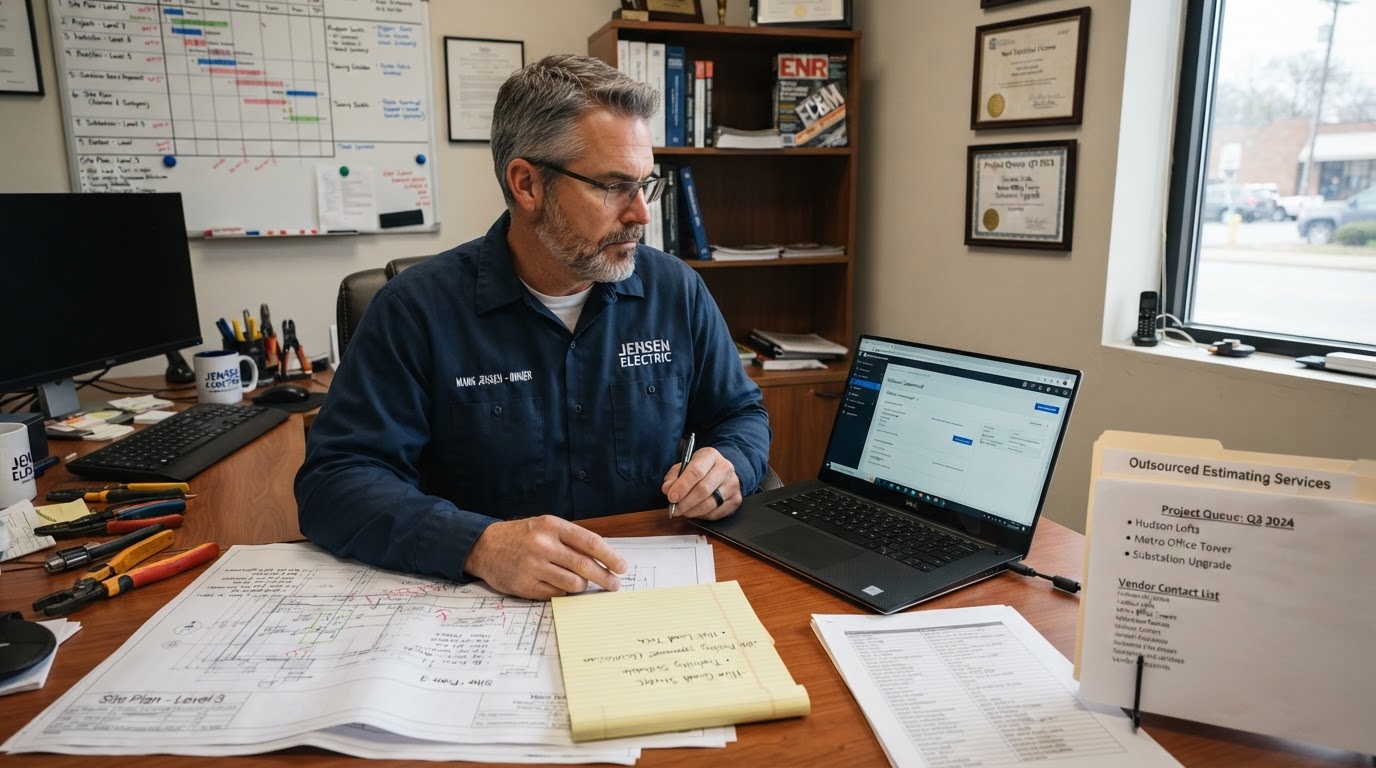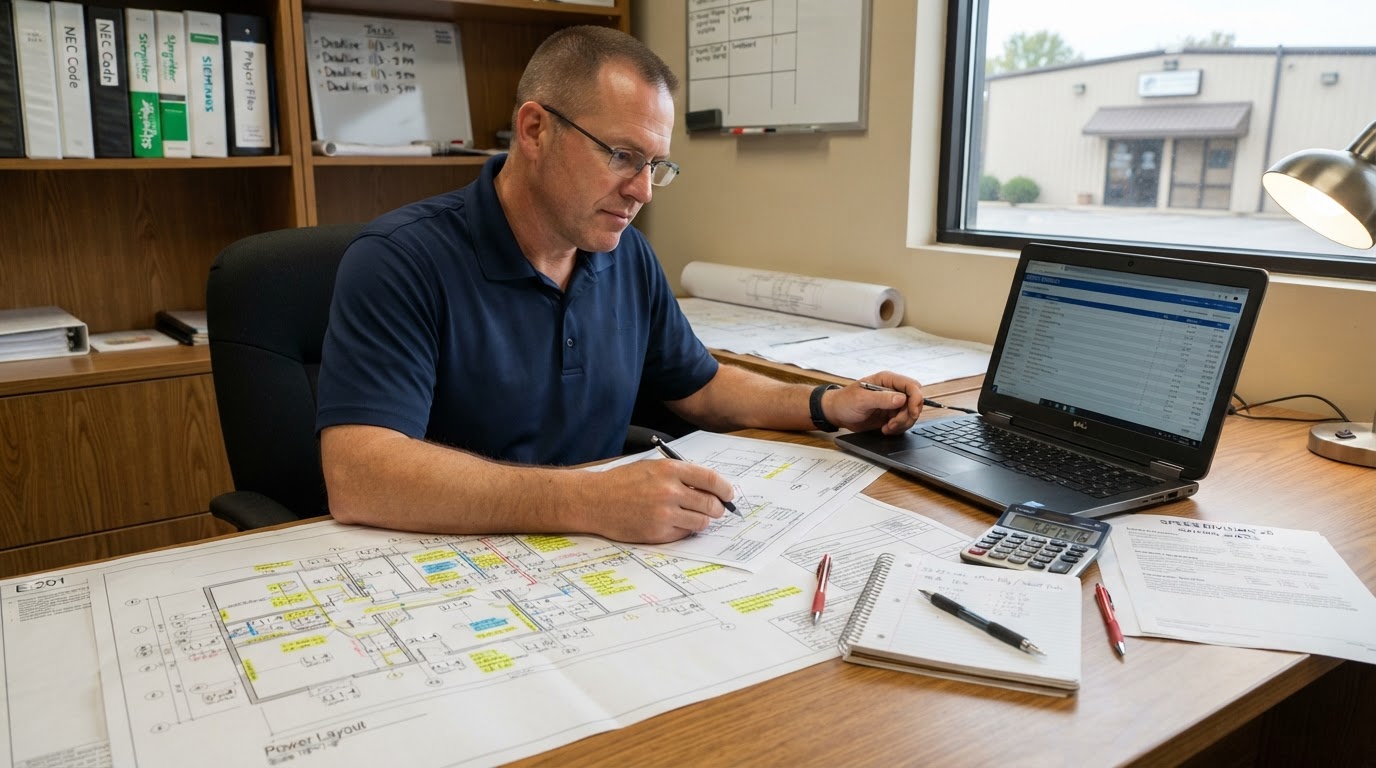
An electrical takeoff and an electrical estimate are closely related, but they are not the same thing.
A takeoff is primarily about identifying and quantifying what the project requires.
Estimate preparation takes the process further by turning the scope, quantities, labor, material costs and contractor-approved pricing rules into a price or proposal the contractor can review and use.
That distinction matters when you are deciding what type of estimating work to outsource.
If you only need quantities from a drawing set, a takeoff service may be enough.
If you already understand the job but need someone to turn your field information, plans, pricing and company standards into a finished estimate, estimate preparation may solve a much bigger bottleneck. If that sounds like your situation, you may have already noticed the signs your electrical business has outgrown DIY estimating.
What Is an Electrical Takeoff?
An electrical takeoff identifies the quantities associated with a project.
Depending on the project and provider, that might include items such as:
- devices
- lighting fixtures
- panels
- feeders
- branch-circuit components
- raceway
- wire or cable
- equipment
- other materials shown in the plans
Some providers also include labor units, marked drawings or other estimating information.
The exact deliverables vary.
The important point is that a takeoff answers a question similar to:
What is in this scope and how much of it is there?
That information can become one of the inputs used to build an estimate.
What Is Electrical Estimate Preparation?
Estimate preparation answers a broader question:
Based on the scope and the contractor's pricing standards, what should this job be estimated at?
A complete estimating workflow may bring together:
- project scope
- field notes
- photos
- plans or specifications
- quantities
- labor requirements
- material pricing
- equipment costs
- permit or outside costs when applicable
- contractor markup
- contractor margin
- allowances
- exclusions
- proposal language
The finished output may include an internal cost worksheet and a customer-facing proposal draft, depending on the service being used.
This is where the contractor's own business rules become extremely important.
Two electrical contractors can review the same project and legitimately produce different selling prices because their labor rates, material sources, overhead, markup, margin expectations and operating models are different.
An outsourced estimator should not quietly replace those decisions with its own.
Electrical Takeoff vs. Estimate Preparation
| Question | Electrical Takeoff | Estimate Preparation |
|---|---|---|
| Main goal | Identify and quantify project components | Build a priced estimate from the defined scope |
| Plans reviewed | Frequently | When applicable |
| Quantities | Core deliverable | Used as an estimating input |
| Labor | May or may not be included | Typically incorporated into pricing |
| Material pricing | May or may not be included | Incorporated according to the estimating method |
| Contractor pricing rules | Usually not the central purpose | Critical |
| Markup and margin | Not necessarily applied | Applied according to contractor-approved standards |
| Customer-facing proposal | Not always | May be included |
| Best fit | Contractor needs quantities | Contractor needs a completed estimate |
These are general distinctions. Individual estimating companies package their services differently, so contractors should always verify the exact deliverables.
When Is a Takeoff Enough?
A takeoff may be exactly what you need when you already have a strong internal estimating process.
For example, you may already have:
- an estimator on staff
- a mature pricebook
- established labor units
- internal estimating software
- standard markup rules
- proposal templates
Your team may simply need someone to extract reliable quantities from plans so your estimator can price the work.
In that situation, outsourcing the takeoff can remove part of the production work without outsourcing the full estimating process.
When Do You Need Estimate Preparation Instead?
Estimate preparation becomes more valuable when the bottleneck is not counting.
The bottleneck is finishing the estimate.
This often happens in owner-operated electrical companies.
You visit the project.
You know what needs to be done.
You take photos.
You make notes.
Then you return to the field, answer calls, deal with employees, order materials and handle the next emergency.
The estimate sits.
That is a different problem than needing a takeoff.
It is an estimating-capacity problem.
If jobs are being looked at faster than estimates are being prepared and sent, outsourced estimate preparation can help turn defined field information into consistent estimate drafts without requiring the owner to perform every administrative estimating step personally.
Residential Electrical Estimating Often Starts in the Field
Traditional construction estimating is often associated with large drawing sets.
Residential electrical service, upgrade and remodel work can look very different.
A project may begin with:
- field notes
- site photos
- measurements
- an inspection report
- equipment specifications
- a clearly defined scope
- a smaller set of plans
That distinction matters.
An owner-operated residential electrical contractor may not need a massive commercial takeoff operation.
The contractor may need a reliable way to turn information already gathered in the field into a professional estimate.
That is the space OTBSE's residential electrical estimating support is designed to fill, while light commercial electrical estimating serves contractors working from larger plan sets.
Your Pricing Should Still Be Your Pricing
Outsourcing estimate preparation should not mean giving up control of your numbers.
At OTBSE, contractor estimating support is structured around contractor-approved pricing standards.
That can include your:
- labor rates
- pricebook
- material pricing
- markup
- margin requirements
- proposal standards
- approved exclusions
- estimate format
The contractor retains control of final pricing, technical decisions, approvals and customer commitments.
The goal is to provide estimating capacity, not take over the contractor's business decisions.
Where the OTBSE Estimating Desk Fits
OTBSE offers different levels of estimating support because not every contractor needs the same thing.
One-Time Estimate Preparation
A contractor with a specific estimating backlog or occasional need can submit a qualifying project for estimate preparation. This is useful when you need help with a particular estimate without committing to a monthly plan.
OTBSE Estimating Desk
The Estimating Desk provides predictable monthly estimating capacity for contractors who regularly need estimates prepared. The focus remains estimate preparation and proposal drafts using the contractor's approved pricing standards.
Estimate Management
Some contractors need more than estimate production. Estimate Management can be scoped to support proposal delivery, estimate tracking, CRM updates, approved follow-up cadence and estimate status management.
Estimate Pipeline Management
For businesses that need broader workflow support, Estimate Pipeline Management can extend into opportunity intake, estimating workflow coordination, proposal delivery, follow-up management, pipeline updates, escalation and reporting based on the agreed scope.
These are different operating problems, which is why they are offered as different service levels.
Questions to Ask Before Hiring an Electrical Estimating Service
Before choosing a provider, ask:
- What information do you need from us?
- Can you work from field notes and photos, or only plans?
- Do you use our labor rates?
- How is material pricing handled?
- Who determines markup and margins?
- Is a customer-facing proposal included?
- How are revisions handled?
- What project types qualify?
- Who approves the final estimate?
- Does your service stop at preparation, or does it include estimate management and follow-up?
The answers will tell you whether you are buying a takeoff, an estimate, administrative support or a broader estimating operation.
Need More Estimating Capacity?
If estimates are piling up because you do not have enough time to turn scopes into finished proposals, the problem may not be takeoff capacity. It may be estimate-production capacity.
Explore Electrical Estimating Services
On The Bright Side Electric offers one-time estimate preparation, the OTBSE Estimating Desk and managed estimating services for electrical contractors.
Explore Electrical Estimating Services →Your pricing stays yours. Your approvals stay yours. Your business decisions stay yours.