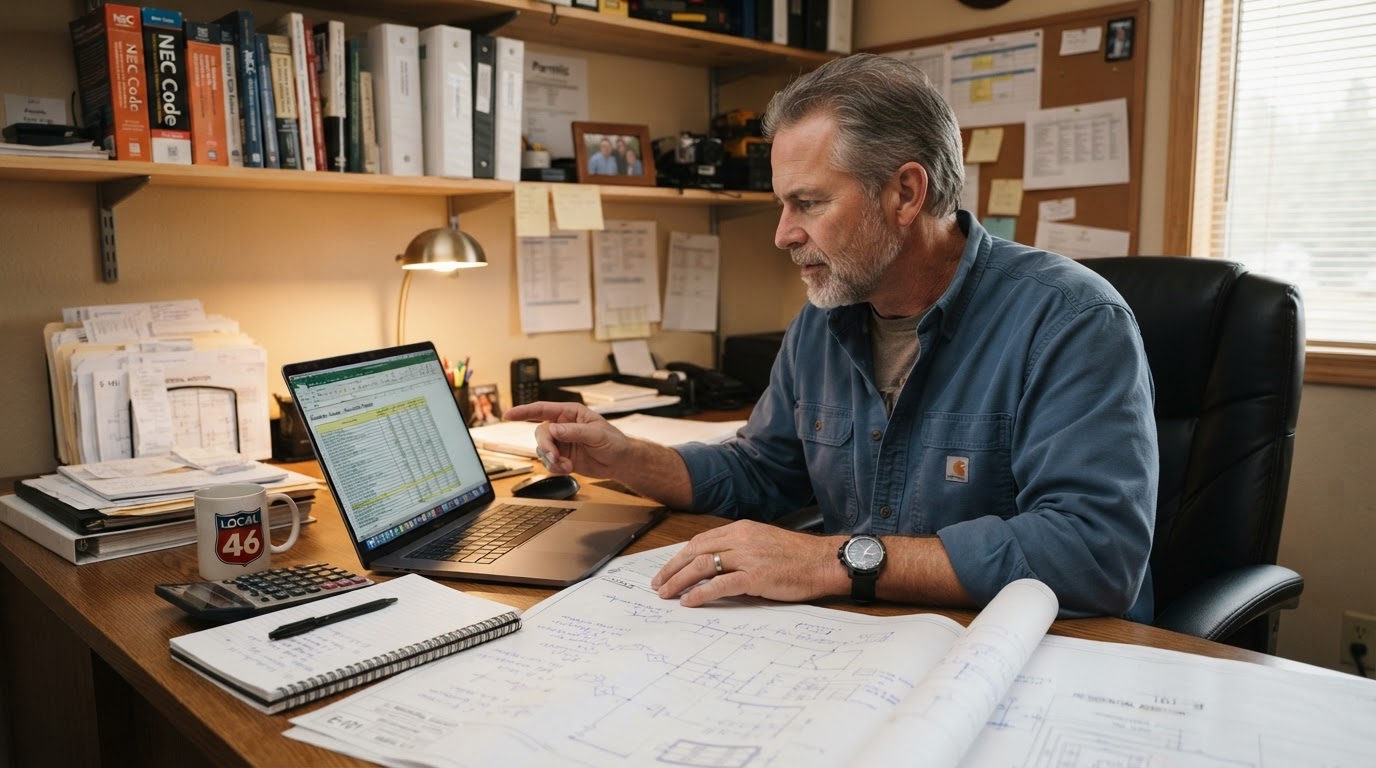
There is a point in almost every growing electrical company when estimating stops being something you simply fit into the day.
The calls are coming in. Site visits are getting done. Crews need direction. Customers are waiting on answers. And somewhere between running today's jobs and preparing for tomorrow's, you still have estimates that need to be written, priced, reviewed, sent, and followed up.
At first, doing the estimates yourself makes sense. You know the work, your labor, your material preferences, your margins, and exactly how you want a job priced.
But as the company grows, the question changes.
It is no longer:
“Can I still do my own estimating?”
It becomes:
“Is doing all of my own estimating still the best use of my time—and is it keeping up with the opportunities coming into the business?”
Here are seven signs your electrical business may have reached that point.
1. You're Writing Estimates at Night or on Weekends
This is probably the easiest sign to recognize.
You spend the day:
- visiting jobs,
- answering customer questions,
- managing electricians,
- ordering material,
- coordinating schedules,
- handling service issues,
- and solving whatever unexpected problem landed on your plate.
Then you get home and start estimating.
An occasional evening estimate is normal in a small contracting business.
But when nights and weekends have become your regular estimating department, you no longer have an occasional workload problem. You have a capacity problem.
The bigger concern isn't simply that you're working late.
It's what estimating after hours competes with:
- planning the business,
- managing cash flow,
- recruiting,
- training your team,
- following up on opportunities,
- spending time with your family,
- and eventually getting enough rest to do it all again tomorrow.
The owner can technically keep doing everything.
That doesn't mean the owner should.
2. You Can Get to the Site Faster Than You Can Get the Estimate Out
You may be doing a great job at the front of the customer journey.
The lead comes in. You respond. You visit the property. You talk through the project. You take photos and measurements. The customer is interested.
Then the opportunity sits.
Maybe it waits until that evening. Maybe tomorrow. Maybe the next job runs long. Maybe an emergency call comes in.
Suddenly, three days have passed and you're trying to remember exactly what you discussed while reconstructing the job from photos, notes, texts, and memory.
At that point, the problem isn't necessarily lead generation.
It is the gap between:
Opportunity → Scope → Estimate
A business can have plenty of demand and still struggle to turn that demand into quoted work if the estimating process cannot keep pace.
3. You Are the Only Person Who Can Turn Field Information Into a Price
This is common in owner-led electrical businesses.
Your team may be perfectly capable of performing the installation, collecting information in the field, taking photos, measuring runs, identifying equipment, and documenting the customer's requested scope.
But when that information gets back to the office, everything stops until you touch it.
You are the person who knows:
- how you price labor,
- what material markup you use,
- which manufacturers you prefer,
- how you account for overhead,
- what exclusions belong in the proposal,
- what warranty language you use,
- how much risk you see in the scope,
- and what final selling price you are willing to approve.
That knowledge is valuable.
The problem is when knowledge and data entry become the same job.
Keeping control over your numbers does not necessarily require personally performing every administrative step required to build the estimate.
A more scalable process separates:
the contractor's judgment
from
the work required to organize, calculate, document, and prepare the estimate for approval.
You should still control your pricing. You just may not need to personally build every document that carries it.
4. Estimates Are Sitting Unfinished While Today's Jobs Take Priority
Field work usually wins.
And it should.
If a technician needs help, a customer has no power, material didn't arrive, an inspection failed, or a job suddenly requires your attention, you deal with the immediate problem.
The estimate can wait.
Unfortunately, the estimate always can wait.
That's exactly why estimating backlogs build quietly.
One unfinished estimate becomes three. Three become seven. Eventually, you have a list of good opportunities that require enough mental energy to feel like an entirely separate workday.
The issue is not that you don't care about those prospects. The issue is that urgent operational work repeatedly outranks important future-revenue work.
Additional estimating capacity can create a lane where qualified opportunities continue moving even when the owner has to stay focused on today's production.
5. Estimate Follow-Up Lives in Your Head
Sending the estimate is only one part of the process.
What happens next?
For many small contractors, the answer is something like: “I usually follow up.”
But there is a big difference between usually and systematically.
Estimate follow-up often gets scattered across:
- text messages,
- email,
- CRM notes,
- phone reminders,
- sticky notes,
- inbox flags,
- personal calendars,
- and the owner's memory.
That may work when you have three estimates in play. It becomes much harder when you have fifteen.
An estimate pipeline needs visibility. At minimum, you should be able to quickly answer:
- Has the estimate been completed?
- Has it been approved?
- Has it been sent?
- Has the customer responded?
- Is a revision needed?
- Are we waiting on information?
- Did the customer choose someone else?
- Is the opportunity still active?
- Is there a next follow-up date?
This is where estimating eventually becomes more than estimate creation. For some electrical contractors, the real need is Estimate Management or broader Estimate Pipeline Management—keeping the workflow organized after the initial scope enters the system.
6. You Need More Estimating Capacity—but You're Not Ready for Another Full-Time Position
There is nothing wrong with hiring an estimator.
For the right electrical contractor, a dedicated in-house estimator can be an excellent investment.
The question is whether your company has reached the point where it needs—and can consistently use—that amount of fixed capacity.
According to the U.S. Bureau of Labor Statistics, the median annual wage for cost estimators was $78,740 in May 2025. For cost estimators working within specialty trade contractors, the median annual wage was $80,330.
Those are wage figures, not the complete cost of employing someone.
An in-house employee can also bring advantages that an outsourced service cannot perfectly duplicate, including daily immersion in your company, direct team access, and potentially greater availability as estimating volume increases.
But smaller electrical contractors can find themselves in an awkward middle stage:
Too much estimating work for the owner.
Not enough predictable estimating volume to justify another full-time role.
That is one of the clearest situations in which outsourced estimating support can be worth evaluating.
The goal is not necessarily to replace an employee. It is to add capacity without immediately adding another permanent position.
7. Growth Is Creating More Opportunities—and More Office Work
This one can sneak up on you.
You start marketing more consistently. Your reputation grows. Past customers refer you. More contractors, realtors, property owners, or homeowners start calling.
That's good.
But every additional qualified opportunity creates work before it ever becomes revenue.
Someone still has to:
- gather the scope,
- organize the job information,
- review photos and plans,
- determine what information is missing,
- prepare quantities where appropriate,
- apply labor and pricing rules,
- write the proposal,
- document assumptions and exclusions,
- send or approve the estimate,
- track its status,
- follow up,
- manage revisions,
- and eventually move the opportunity to a decision.
Growth doesn't just create more field work. It creates more pre-field work.
If your estimating system cannot absorb that workload, increasing lead volume can simply create a larger backlog.
That's why estimating capacity should be treated as part of your growth infrastructure—not an after-hours chore that gets handled whenever the owner finally has time.
Does This Mean You Should Outsource Your Electrical Estimating?
Not automatically.
There are several ways to solve an estimating-capacity problem.
You could:
- improve your existing estimating process,
- standardize your intake,
- build a better pricebook,
- train an internal team member,
- hire an estimator,
- use estimating software,
- outsource part of the estimating workflow,
- or combine several approaches.
The right answer depends on:
- your estimate volume,
- project complexity,
- existing staff,
- pricing system,
- technical workflow,
- business size,
- desired turnaround,
- and how much control you want to keep internally.
For some contractors, hiring is the right next move. For others, adding outsourced estimating capacity gives them room to grow before taking on another full-time role.
The important thing is recognizing when the existing process has become the constraint.
Outsourcing Does Not Mean Giving Up Control of Your Pricing
For many electrical contractors, this is the biggest concern.
And it should be.
Your labor rates, markup, margins, scope decisions, customer commitments, and final selling price belong to your company.
Good estimating support should work inside approved rules, not replace the contractor's judgment.
OTBSE Electrical Estimating Services is designed around that principle.
The contractor remains responsible for the decisions that belong to the contractor.
Depending on the level of support selected, OTBSE helps provide the structure and execution needed to keep estimates moving.
Estimating Support
For contractors primarily needing additional help getting estimates prepared.
Estimate Management
For contractors who need estimating plus more structured management around the estimate workflow.
Estimate Pipeline Management
For companies needing broader support keeping approved estimating activities, tracking, follow-up, and pipeline workflow organized.
Compare the Three Estimating Service Levels →
The purpose is not to take your company away from you.
It is to help prevent every estimate from depending on you doing every step personally.
What Should You Have in Place Before Outsourcing?
Outsourcing works best when your company already has—or is willing to establish—clear estimating rules.
That includes information such as:
- labor rates or labor methodology,
- material pricing and markup rules,
- overhead and profit approach,
- preferred materials and manufacturers,
- standard exclusions,
- warranty language,
- proposal terms,
- project intake requirements,
- and final approval authority.
If the pricing strategy exists only in the owner's head, the first step isn't necessarily handing estimates to someone else.
The first step may be documenting how your company estimates.
That work has value whether you eventually outsource or hire internally.
The Goal Is More Capacity—Not Less Control
Growing an electrical company creates a constant tension.
You need to stay close enough to the work to protect quality and profitability.
But if every process requires your direct involvement from beginning to end, eventually the company can only move as fast as you do.
Estimating is often one of the first places that becomes obvious.
If good opportunities are sitting because you're in the field, managing crews, answering customers, or writing quotes late at night, it may be time to stop asking whether you can keep doing all of the estimating yourself.
Ask a better question:
“What would the business look like if estimating no longer had to wait for me?”
Your Estimate Pipeline Shouldn't Stop Because You're in the Field
You shouldn't have to choose between running today's jobs and quoting tomorrow's. OTBSE Electrical Estimating Services gives electrical contractors additional estimating and estimate-management capacity while keeping company pricing, approvals, and business decisions where they belong—with the contractor.
Explore OTBSE Electrical Estimating Services
See how Estimating Support, Estimate Management, and Estimate Pipeline Management can add capacity without taking control of your pricing or business decisions away from you.
Explore Electrical Estimating Services →