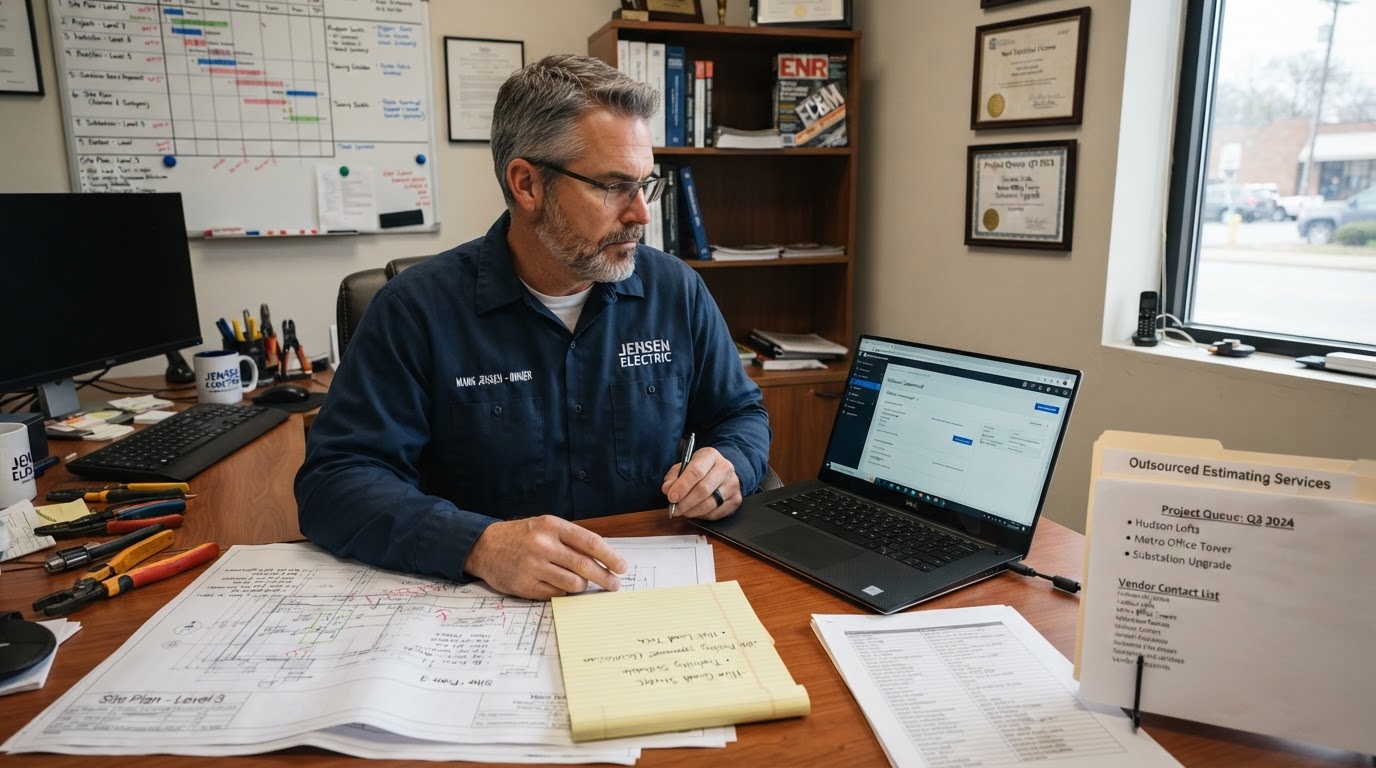
There is a point in a growing electrical company when estimating becomes too important—and too time-consuming—to keep squeezing into whatever time the owner has left.
Maybe you are pricing jobs at night. Maybe your office is overwhelmed. Maybe estimates are taking longer to get out than site visits are taking to complete.
Maybe you know you need more estimating capacity, but you are not sure whether that means:
hire someone
or
outsource the work.
Neither answer is automatically better.
A full-time estimator can become a deeply integrated part of your company. Outsourced estimating can give you additional capacity without immediately adding another permanent position.
The right choice depends on your workload, estimate volume, project complexity, internal systems, and how much dedicated estimating capacity your company actually needs.
Here is how to compare the two.
If this sounds familiar, you may have already noticed some of the signs your electrical business has outgrown DIY estimating. The next question is how to add the capacity you need.
First, Identify the Actual Problem
Before deciding how to solve the estimating problem, define it.
Are you dealing with:
- too many estimates for the owner to complete;
- inconsistent turnaround;
- incomplete job information;
- weak proposal preparation;
- poor follow-up;
- lack of pricing standards;
- a growing backlog;
- large plan takeoffs;
- or all of the above?
Those are not the same problem.
For example, hiring a full-time estimator will not automatically fix a company with no standardized pricing, poor field documentation, incomplete scopes, or no approval process.
And outsourcing estimating will not fix those problems either.
The first question is not:
“Employee or outsourced service?”
It is:
“What part of our estimating process is actually constrained?”
If the core issue is simply capacity, then the hiring-versus-outsourcing comparison becomes much clearer.
Hiring a Full-Time Estimator
A dedicated estimator can become a major asset for an electrical contractor with enough consistent volume.
An in-house estimator may spend most or all of the workweek focused on:
- reviewing scopes;
- performing takeoffs;
- pricing labor and materials;
- preparing proposals;
- communicating with project managers or field staff;
- managing bid deadlines;
- maintaining estimating systems;
- tracking opportunities.
The biggest advantage is immersion.
An internal estimator learns your people, your customers, your preferred materials, how your crews actually produce work, your pricing philosophy, your typical jobs, your internal language, and your risk tolerance.
Over time, that familiarity can be extremely valuable.
What Does a Full-Time Estimator Cost?
There is no single national number that tells an electrical contractor exactly what an estimator will cost their company.
But wage data provides useful context.
The U.S. Bureau of Labor Statistics reports that the median annual wage for cost estimators was $78,740 in May 2025.
For cost estimators employed by specialty trade contractors, the median annual wage was $80,330.
Those numbers represent wages.
They do not include every potential employer cost such as:
- payroll taxes;
- benefits;
- insurance;
- recruiting;
- training;
- equipment;
- software;
- management time.
Those additional costs vary dramatically from company to company, so they should not be turned into a generic “true cost of an estimator” statistic.
The point is simply that adding a full-time estimator represents a meaningful fixed staffing commitment.
For the right company, that commitment can be absolutely worthwhile.
When Hiring an Estimator Usually Makes More Sense
An internal estimator becomes increasingly attractive when estimating demand is:
consistent, substantial, and predictable.
For example, hiring may make more sense when:
- you have enough estimating work to keep someone meaningfully occupied throughout the week;
- estimates are highly complex;
- the estimator needs constant access to field/project teams;
- you bid a high volume of plan-based work;
- company-specific knowledge is difficult to standardize;
- estimating is becoming a full-time internal function;
- you want the estimator involved in project handoff or other internal operations.
The more central estimating becomes to daily company operations, the stronger the argument for dedicated internal capacity can become.
Outsourcing Electrical Estimating
Outsourced estimating works differently.
Instead of adding another employee, the contractor purchases estimating capacity from an external provider.
That service might include:
- estimate preparation;
- takeoff support;
- scope organization;
- proposal preparation;
- assumptions and exclusions;
- estimate tracking;
- follow-up;
- broader estimate-pipeline support.
Exactly what is included depends on the provider.
The key advantage is flexibility.
The contractor can potentially add capacity without immediately taking on another permanent full-time position.
Why Small Electrical Contractors Consider Outsourcing
Many owner-operated electrical companies reach an awkward stage.
They have:
too much estimating work for the owner
but
not enough predictable estimating work for a dedicated estimator every day.
That is the gap outsourced estimating can fill.
Instead of asking:
“Do I have enough work for another full-time employee?”
the contractor can ask:
“How much estimating capacity do I actually need right now?”
That can be especially relevant to:
- owner-led service contractors;
- residential remodel contractors;
- smaller electrical businesses;
- contractors with periodic estimating surges;
- companies trying to reduce owner bottlenecks.
Outsourcing Is Not the Same as Hiring Cheap Takeoff Labor
This distinction matters.
The outsourced estimating market includes everything from:
- freelance takeoff specialists;
- offshore quantity services;
- project-based estimators;
- electrical estimating firms;
- proposal-preparation services;
- recurring estimating subscriptions;
- broader contractor-office support.
Those are not interchangeable.
A contractor looking only for quantities from construction drawings may choose a very different provider from a contractor who wants help turning field information into a client-ready estimate using the company's own pricing system.
OTBSE Electrical Estimating Services is designed around the second problem.
The goal is not:
“Send us plans and get the cheapest takeoff.”
The goal is:
“Give us the information and rules your company already uses, and add structured estimating capacity around them.”
The Most Important Question: Who Controls the Pricing?
This is often the contractor's biggest concern with outsourcing.
It is also one of the most important questions to ask any estimating provider.
Who determines:
- labor rates;
- markup;
- material preferences;
- overhead;
- profit;
- exclusions;
- warranty language;
- scope assumptions;
- final selling price?
An outsourced estimating provider should not casually invent those things on behalf of the contractor.
Under OTBSE's model, the contractor remains in control of:
- company pricing;
- margins;
- final approvals;
- customer commitments;
- technical decisions;
- business decisions.
The service provides estimating and workflow capacity around approved company rules.
That distinction is crucial.
Outsourcing execution does not have to mean outsourcing authority.
Comparing Fixed Capacity With Flexible Capacity
This may be the simplest way to understand the difference.
Full-Time Estimator
You are adding fixed internal capacity.
The employee is part of the team whether that week produces:
- 5 estimates;
- 15 estimates;
- 30 estimates.
That can be an enormous advantage when the workload consistently justifies it.
Outsourced Estimating
You are buying external capacity according to the provider's service model.
That may be:
- per estimate;
- monthly allowance;
- project based;
- managed service.
That can give smaller contractors more flexibility when estimate volume fluctuates.
Neither model is inherently better. They solve capacity in different ways.
Comparing Control
Internal Estimator
You have direct managerial control over:
- work priorities;
- daily schedule;
- training;
- process;
- availability.
The estimator can participate in meetings, collaborate continuously with field staff, and become deeply embedded in the company.
Outsourced Estimating
Control comes through:
- documented rules;
- service scope;
- intake requirements;
- approval processes;
- turnaround expectations;
- quality control.
A strong outsourced process requires more structure.
The provider needs to know exactly what it is allowed to do—and what remains the contractor's responsibility.
For some companies, creating that structure is actually one of outsourcing's side benefits. It forces the estimating process out of the owner's head and into documented systems.
Comparing Onboarding
Hiring does not eliminate onboarding. It simply changes who is being onboarded.
A new estimator still needs to learn your pricing, jobs, materials, systems, estimating software, proposal standards, exclusions, and customer expectations.
An outsourced estimating provider needs similar information.
The difference is that outsourced onboarding should be designed around documented company rules rather than informal daily exposure.
Before either option works well, the contractor should know how the company wants estimating done.
Comparing Scalability
Suppose your estimate volume suddenly increases.
With an internal estimator, additional capacity may mean:
- overtime;
- reprioritizing;
- another hire;
- temporary backlog.
With outsourcing, the provider may be able to absorb additional work—but only within its own capacity and service limits.
Do not assume outsourcing provides unlimited scale.
A professional provider should define:
- estimate allowances;
- complexity limits;
- turnaround expectations;
- rush availability;
- scope boundaries.
“Unlimited estimating” sounds attractive until one complicated project consumes several days of work.
Capacity should be defined realistically.
Comparing Company Knowledge
This is an area where internal hires can have a real advantage.
Someone working inside your company every day develops context that is difficult to reproduce externally.
They hear conversations. They know which technician works faster. They know which customers require more explanation. They see where jobs commonly go wrong.
That knowledge matters.
An outsourced provider compensates by using:
- standardized contractor profiles;
- written pricing rules;
- project intake;
- documented preferences;
- approval checkpoints;
- history.
If a company relies heavily on undocumented tribal knowledge, outsourcing will expose that weakness quickly.
Comparing Management Responsibility
An employee requires management. An outsourced provider requires vendor/process management.
Neither option is “no management.”
With an employee, you manage performance, schedule, training, workload, and development.
With an outsourced provider, you manage scope, standards, approvals, service performance, and communication.
The management burden is different—not nonexistent.
What About Estimating Software?
Software is another option, but it solves a different problem.
Estimating software can improve takeoffs, pricing organization, templates, calculations, and proposal production.
But software still needs someone to operate it.
If the owner is already the bottleneck, buying better estimating software does not automatically create more hours in the day.
Software can make an estimator more efficient. It does not necessarily replace estimating labor.
A Simple Decision Framework
Consider an in-house estimator when:
Your company consistently has enough estimating work to justify dedicated internal capacity.
Consider outsourcing when:
You need meaningful additional capacity, but estimating volume or company size does not yet justify another full-time position—or you need help absorbing periodic backlog.
Consider improving systems first when:
The estimating process is inconsistent because pricing, intake, scope, or approval rules are not documented.
And consider a hybrid model when:
Your internal team handles certain estimating work while an outsourced provider absorbs defined categories, overflow, or workflow support.
Hybrid models can be especially useful for growing contractors.
Could Outsourcing Replace Every Estimating Employee?
No.
That is not a credible promise.
Large electrical contractors, complex commercial bidders, industrial contractors, and companies with high continuous bid volume may benefit significantly from experienced internal estimating teams.
An outsourced service can be:
- overflow capacity;
- a growth bridge;
- specialized support;
- a solution for smaller contractors;
- part of a hybrid department.
The goal should be to design the estimating function around the business—not force every business into the same model.
What Does OTBSE Electrical Estimating Support Look Like?
OTBSE's current estimating-service structure provides three levels of support.
Estimating Support
Designed primarily for contractors who need additional estimating capacity.
Estimate Management
Adds broader workflow support around estimates.
Estimate Pipeline Management
Provides the highest level of approved estimating, tracking, follow-up, and pipeline-management support within the defined service scope.
The common principle across all three:
The contractor stays in control of pricing and business decisions.
That is the point. You get more estimating capacity without handing someone else ownership of your company.
Which Option Is Right for Your Electrical Business?
If estimating is already a full-time function inside your business, hiring may be the obvious next step.
If your estimating workload is growing but inconsistent, outsourcing may offer a more flexible bridge.
If the problem is not capacity but lack of process, fix the process first.
And if you are somewhere in between? That is usually where the conversation becomes worthwhile.
Look at:
- how many estimates you produce;
- how long they take;
- who performs them;
- how often they are late;
- how many sit unfinished;
- how much owner time they consume;
- whether workload is consistent;
- whether another full-time position makes sense.
Then solve the actual constraint.
The right question is not:
“Is outsourcing better than hiring?”
It is:
“What estimating structure gives this company the capacity it needs at this stage of growth?”
Need More Estimating Capacity—But Not Sure Another Full-Time Hire Is the Right Move?
You do not have to choose between doing every estimate yourself and immediately building a full estimating department. OTBSE Electrical Estimating Services gives electrical contractors another option: additional estimating and estimate-management capacity built around your company's approved pricing and workflow.
Compare OTBSE Estimating Packages
Explore Estimating Support, Estimate Management, and Estimate Pipeline Management.
Compare OTBSE Estimating Packages →Your pricing stays yours. Your approvals stay yours. Your business decisions stay yours.
