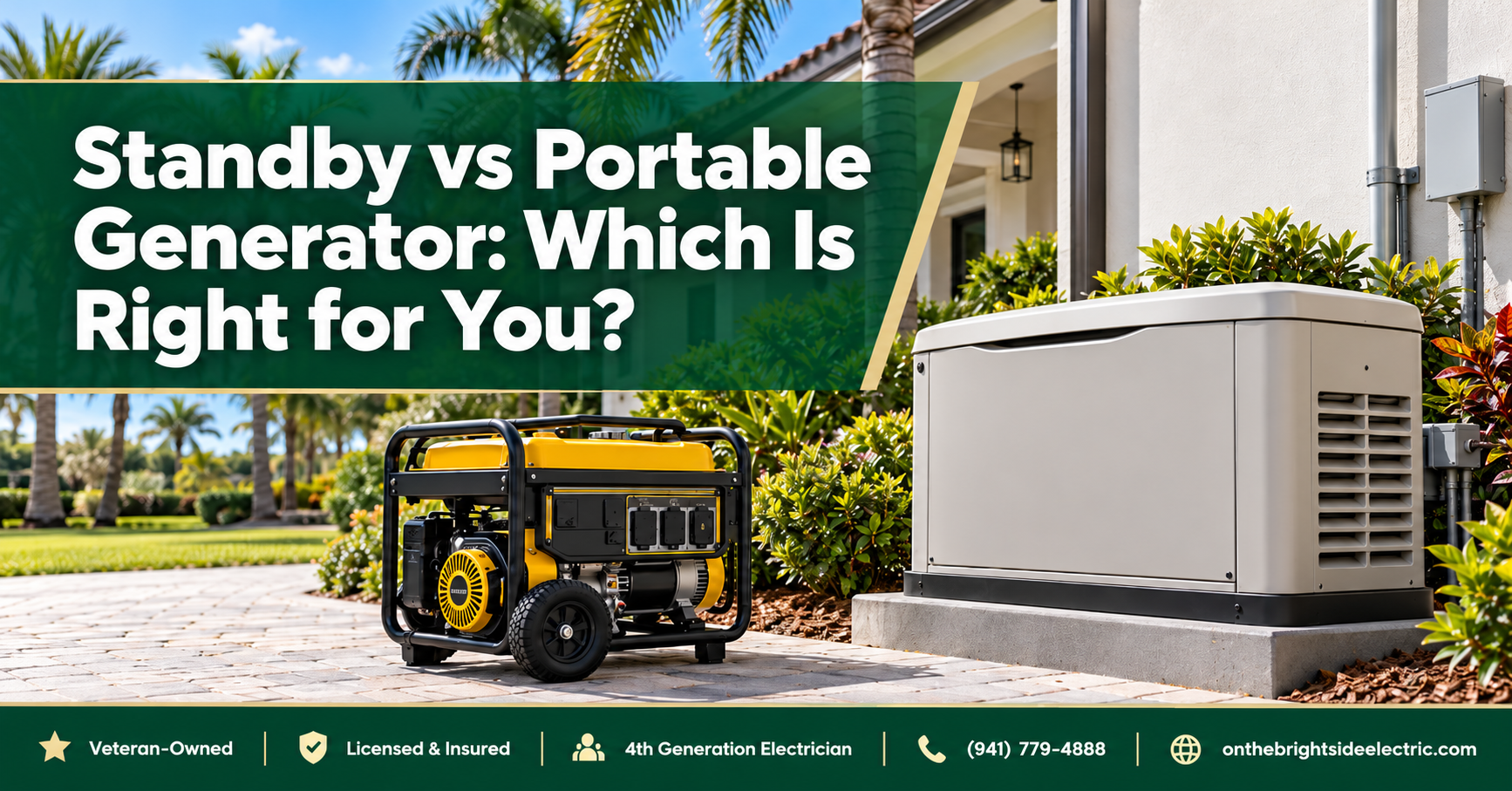
Portable generators are popular in Florida because they can keep essential loads running when utility power is out.
But owning the generator is only half of the plan.
If you want the generator to safely supply circuits through your home's electrical panel, the panel and transfer equipment have to be compatible with the installation.
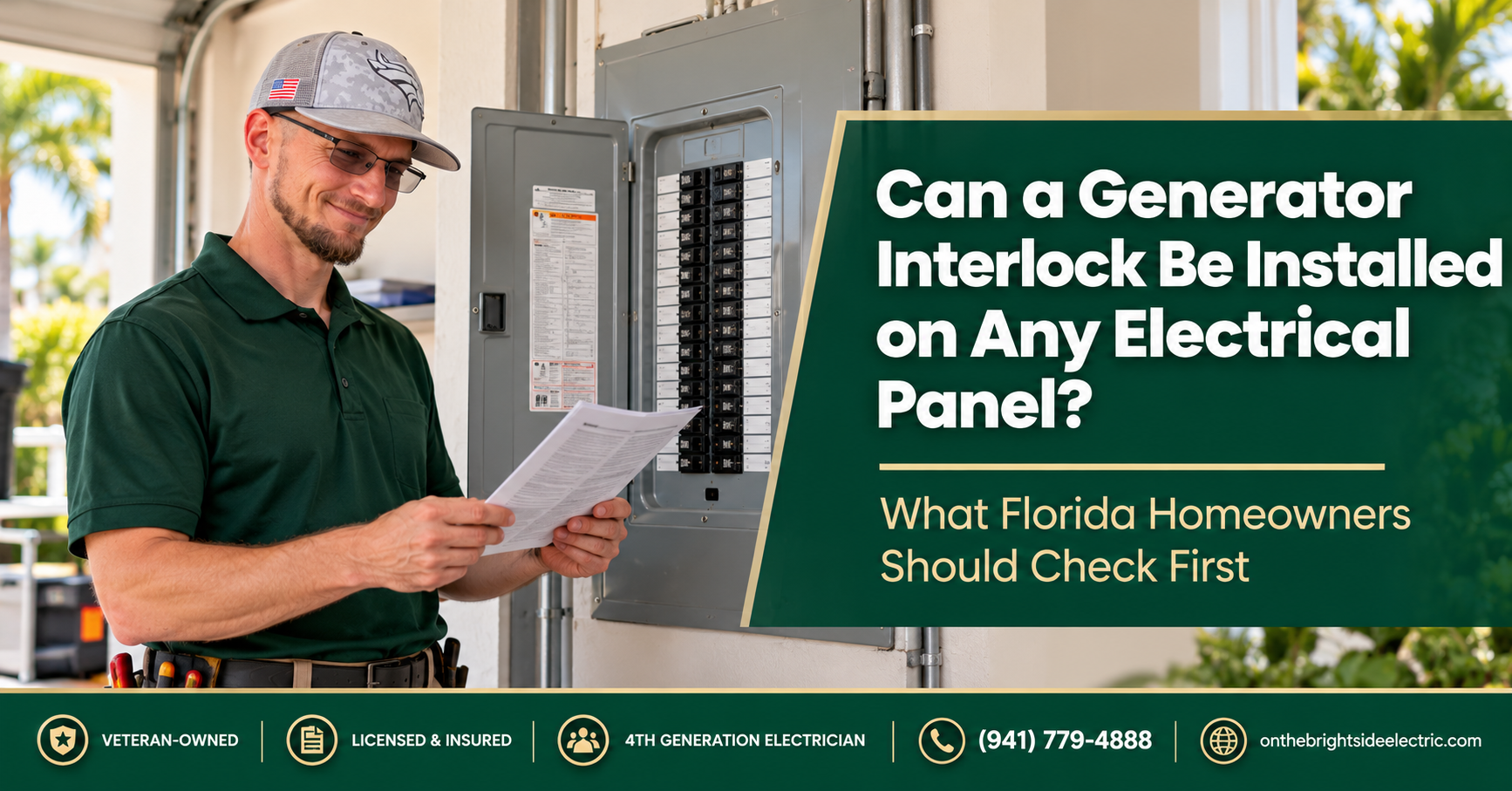
One of the most common homeowner questions is whether a generator interlock can simply be added to any breaker panel.
The short answer is no.
Generator interlocks are panel-specific.
The electrician needs to identify the exact electrical equipment, confirm that an appropriate interlock or transfer solution exists, evaluate the panel condition and breaker arrangement, and determine how the generator inlet will be connected before the work is approved.
Quick Answer
A generator interlock cannot automatically be installed on every electrical panel.
The correct interlock has to match the exact panel configuration, including the manufacturer, panel series or catalog number, main-breaker arrangement, compatible breaker family, and required generator-breaker location.
Some panels have appropriate interlock options. Others may require a different transfer solution or additional panel work.
The interlock should be selected based on the electrical panel, not simply the generator brand or amperage.
What Does a Generator Interlock Actually Do?
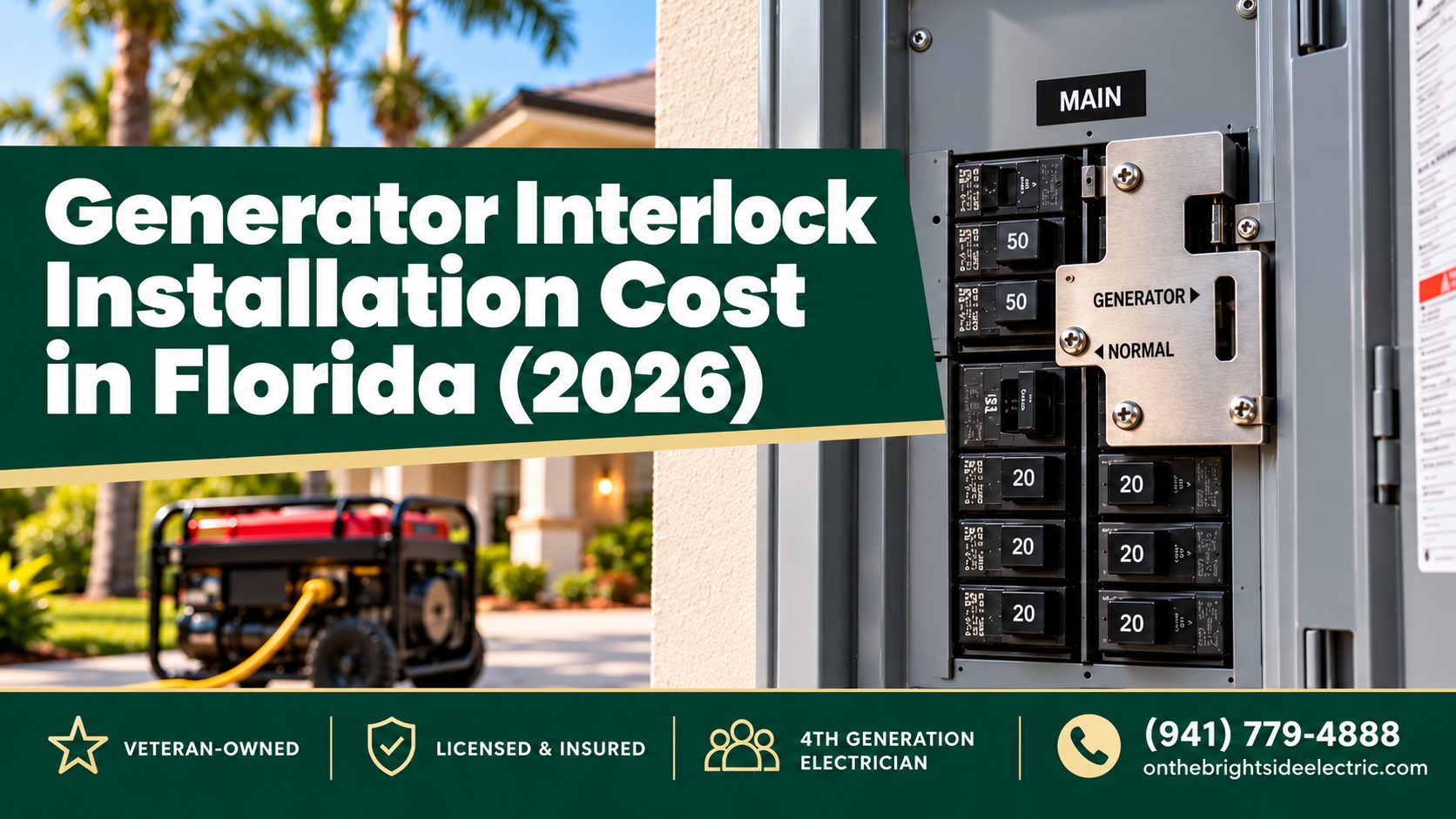
A generator interlock is part of a manual transfer arrangement for a portable generator.
It is designed so the utility main breaker and the generator-supply breaker cannot be in an unsafe operating position at the same time.
That separation matters because generator power must not be allowed to backfeed the utility system.
Florida Power & Light warns that improper generator connections can send electricity back onto utility lines and create hazards for utility workers and equipment.
The Electrical Safety Foundation International also advises that generators connected to household wiring require appropriate transfer equipment installed by a qualified electrician.
An interlock is only one part of the complete generator hookup.
The system commonly also includes:
- a dedicated generator breaker
- an exterior power inlet
- properly sized wiring
- required labeling
- an appropriate generator cord
- transfer equipment that safely separates generator power from utility power
Generator Inlet, Interlock, and Transfer Switch: What Is the Difference?
| Component | What It Does | What It Does Not Do |
|---|---|---|
| Generator Inlet | Provides a dedicated exterior connection point for the portable generator cord | Does not separate generator power from utility power by itself |
| Generator Interlock | Mechanically prevents the main breaker and generator breaker from being on in an unsafe combination | Does not create generator capacity or make every panel compatible |
| Transfer Switch | Transfers selected circuits or electrical loads between utility and generator power | Does not increase the output capacity of the generator |
A generator inlet and transfer equipment work together as part of the overall generator connection. An inlet by itself is not a complete transfer system.
Why Is Generator Interlock Compatibility Panel-Specific?
The interlock has to coordinate with the physical and electrical design of the load center.
Manufacturers publish different interlock products for different panel families and configurations.
For example:
Schneider Electric publishes different generator interlock kits for specific QO and Homeline load-center series and states that certain Homeline series do not have a generator interlock kit available.
Eaton identifies mechanical interlock kits for specific BR load-center catalog numbers and main-breaker families.
ABB publishes ReliaHome interlock kits based on particular load-center and meter-combination configurations.
That is why a kit that fits one panel from a manufacturer should not be assumed to fit every panel carrying the same brand name.
Direct Answer
The interlock follows the panel, not the generator.
The generator may determine the inlet size, connection method, and available power, but the interlock itself must be appropriate for the exact electrical panel configuration.
What Does an Electrician Check Before Recommending an Interlock?
An electrician may need to verify:
- panel manufacturer
- exact series or catalog number
- main-breaker location
- main-breaker operating direction
- electrical service configuration
- panel amperage
- compatible breaker family
- available breaker positions
- generator-supply breaker location
- required breaker-retention method
- condition of the panel
- condition of the bus and cover
- whether the equipment has been modified
- whether incompatible components are already present
- generator output
- generator receptacle configuration
- proposed inlet location
- loads the homeowner expects to operate
- manufacturer instructions
- applicable permit and inspection requirements
A homeowner does not need to determine all of this alone.
Clear photos of the panel and generator information can often allow an electrician to perform an initial remote review and identify what still needs to be confirmed on site.
Can I Use a Universal Generator Interlock Kit?
Homeowners should not assume that a generic or universal-looking interlock plate is appropriate simply because it appears to line up with the breakers.
The important question is whether the complete interlock arrangement is appropriate for the exact panel and installation.
Manufacturer documentation, product instructions, listing information, breaker compatibility, physical configuration, and local inspection requirements all matter.
If an electrician cannot verify an acceptable configuration for the existing panel, the answer should not be to improvise a bracket until it appears to fit.
What if My Electrical Panel Is Older?
An older panel is not automatically disqualified from every generator connection, but age can complicate the project.
The electrician may need to determine whether:
- an appropriate interlock exists for that exact equipment
- compatible breakers remain available
- the panel is in suitable condition
- existing modifications affect compatibility
- documented equipment concerns make continued modification inappropriate
If the panel itself needs replacement, it may make more sense to coordinate the panel project and generator-readiness work instead of modifying equipment that is already due for replacement.
For a deeper look at that decision, read our guide on electrical panel repair, replacement, or 200-amp service upgrade.
What if My Panel Is Full?
A generator interlock setup typically requires dedicated breaker space in the appropriate location for the generator-supply breaker.
If the panel is full, that does not automatically mean a 200-amp service upgrade is required, but it can affect the design.
The electrician may evaluate whether:
- the existing panel can be reconfigured within the equipment's permitted use
- another approved transfer solution is available
- a subpanel is appropriate for other circuit-distribution needs
- replacing the panel makes more sense
- additional electrical capacity is actually required
Breaker space and electrical service capacity are related planning issues, but they are not the same thing.
Can a Generator Interlock Work on a 100-Amp or 200-Amp Panel?
Potentially, yes.
The service rating alone does not determine whether an interlock can be installed.
Manufacturers offer interlock products for multiple load-center ratings and configurations.
The exact series, main-breaker arrangement, breaker type, and installation instructions still have to match.
A homeowner should not choose a kit based only on seeing "100A" or "200A" printed on the main breaker.
What Happens if There Is No Appropriate Interlock for My Panel?
If the existing panel cannot accept an appropriate interlock arrangement, that does not mean a portable generator can never be connected to the home.
Depending on the electrical system and homeowner goals, an electrician may evaluate:
- a manual transfer switch
- a generator panel
- another approved transfer-equipment configuration
- panel replacement
- a broader electrical-service project when appropriate
The important requirement is that generator power be safely separated from the utility source.
The solution should be designed around the actual equipment rather than forcing one preferred product onto every house.
Interlock or Transfer Switch: Which Is Better?
Neither is automatically better for every homeowner.
An interlock can be a practical solution for a compatible panel when the homeowner wants access to circuits in the existing panel and understands that the generator can support only a limited amount of load at one time.
A manual transfer switch may be preferable when the homeowner wants a fixed group of clearly identified backup circuits or when the existing panel cannot use an appropriate interlock arrangement.
Permanent standby-generator systems generally use transfer equipment specifically designed for that system.
The right answer depends on:
- the electrical panel
- generator size
- generator connection
- desired backup loads
- homeowner operating preferences
- approved equipment configuration
What Generator Loads Can I Run Through an Interlock?
The presence of an interlock does not increase generator output.
Even if the electrical panel gives you access to many household circuits, the portable generator still has a finite running and starting capacity.
Large loads such as:
- central air-conditioning equipment
- electric water heaters
- electric ranges
- pool equipment
- large pumps
- other high-demand appliances
may exceed what a portable generator can supply.
Load planning is part of a safe generator setup.
Homeowners should understand which circuits matter most during an outage and the generator's operating limitations before turning on large loads.
Why a Generator Inlet Is Better Than Improvised Backfeeding
A proper power inlet provides a dedicated connection point outside the home and connects to permanently installed wiring designed for the generator setup.
Do not attempt to energize home wiring through:
- a dryer receptacle
- a range receptacle
- another branch-circuit receptacle
- a cord with two male ends
- any improvised backfeeding method
Improvised backfeeding can energize utility lines and create severe shock and electrocution hazards.
FPL advises homeowners to use a licensed electrician for generator connections to house wiring.
ESFI also warns against direct generator connections to household wiring without proper transfer equipment.
What Photos Should I Send for a Generator Interlock Estimate?
Helpful items include:
- a straight-on photo of the closed electrical panel
- a photo with only the normal hinged panel door open so the breaker layout and directory are visible
- a clear photo of the manufacturer label
- the panel catalog number or series information if visible
- a clear photo showing the main-breaker rating without removing the deadfront
- a wider photo showing the panel location
- a photo of the proposed exterior generator-inlet location
- a photo of the generator data plate
- a photo of the generator's available receptacles
- generator make and model
- the circuits or appliances the homeowner most wants available during an outage
Do not remove the inner metal deadfront or expose energized electrical components to take photos.
Generator Interlock and Inlet Installation in Sarasota and Manatee County
On The Bright Side Electric installs generator interlock and inlet installation, transfer equipment, and related electrical work for homeowners throughout Sarasota and Manatee Counties.
Service areas include:
- Sarasota
- Bradenton
- Parrish
- Palmetto
- Ellenton
- Lakewood Ranch
- Siesta Key
- Longboat Key
- surrounding communities within OTBSE's service area
For many generator-interlock projects, we can begin with a free remote consultation.
Send us photos of the electrical panel, generator information, and the proposed inlet location.
We can review what you have, identify what still needs to be confirmed, and explain whether the appropriate next step is an estimate or an on-site diagnostic.
For broader context on safe portable generator connections, see our guide on how to safely connect a portable generator to your Florida home, or learn about electrical service upgrades for Florida homeowners.
Key Takeaway
Panel brand alone is not enough. The exact panel series, breaker arrangement, compatibility information, and equipment condition determine whether a generator interlock is appropriate.
Request a Free Remote Generator Interlock Estimate
Send your panel photos, generator model, and proposed inlet location. We will review the information and help determine the appropriate next step.
Request a Free Remote Estimate