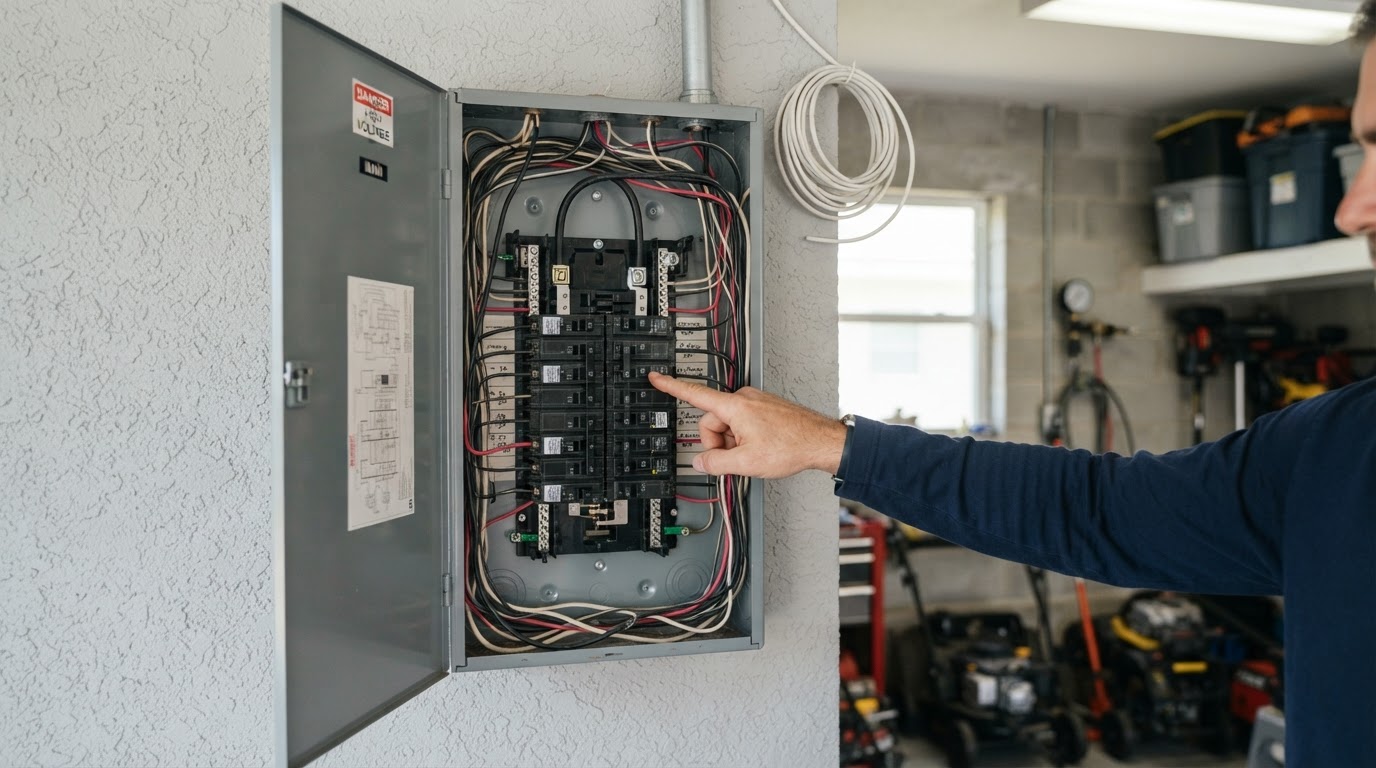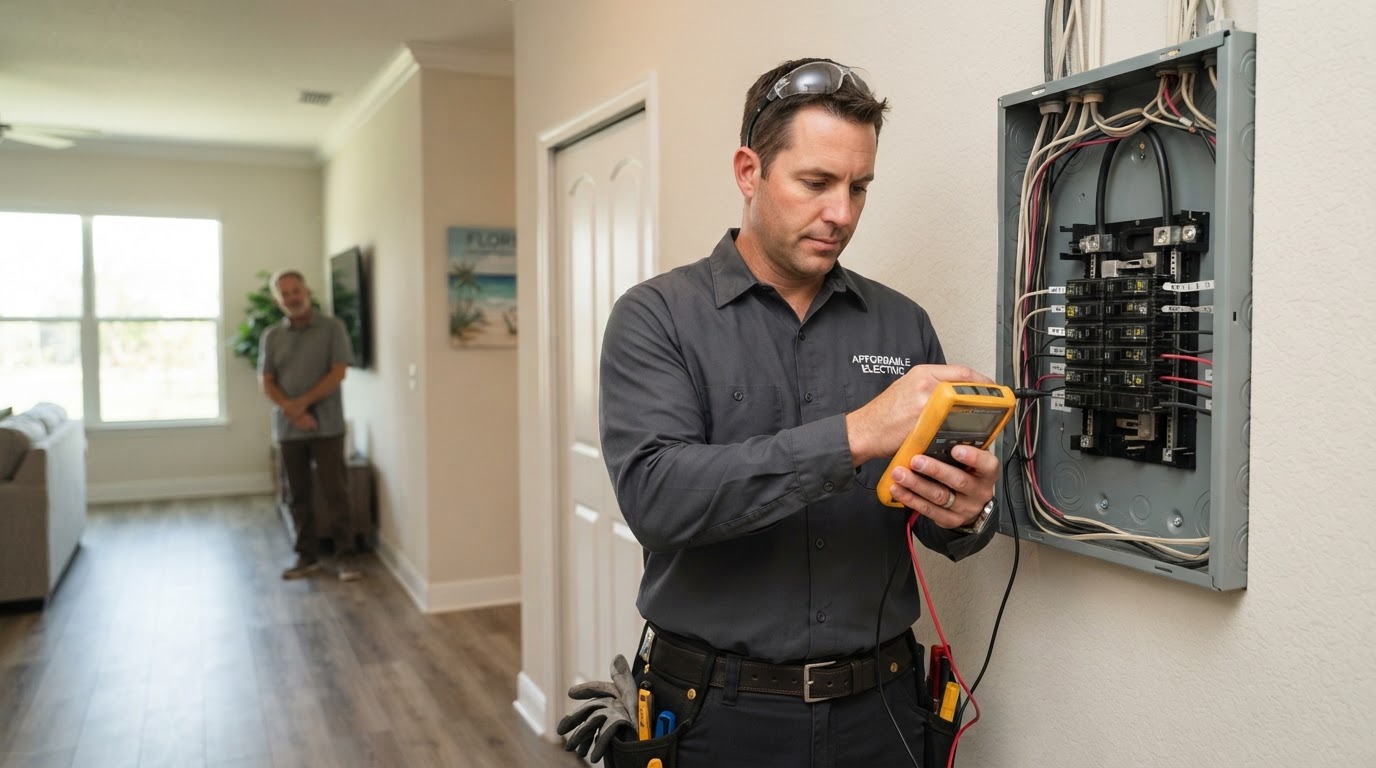
A homeowner calls an electrician because a breaker keeps tripping.
Another calls because an insurance inspection flagged the panel.
Someone else wants a Level 2 EV charger and has been told the house might need a panel upgrade.
All three homeowners may use the same phrase, but they may need completely different electrical work.
That is where panel terminology gets confusing.
A panel repair, panel replacement, and electrical service upgrade solve different problems. Sometimes one project includes more than one of them, but they should not automatically be treated as the same thing.
For homeowners in Sarasota and Manatee Counties, understanding the difference can make conversations with an electrician much easier and help you understand exactly what is included in an estimate.
Quick Answer
An electrical panel repair fixes a specific serviceable problem. A panel replacement replaces the existing breaker panel, which may or may not change the home's total electrical capacity. A service upgrade increases or changes the electrical capacity supplied to the home and can involve additional service equipment, utility coordination, permitting, and inspection.
The correct solution depends on what is wrong with the existing equipment and how much electrical capacity the home actually needs.
What Is the Difference Between a Panel Repair, Panel Replacement, and Service Upgrade?
The easiest way to understand the difference is to separate condition from capacity.
A panel may have a repairable problem while the rest of the equipment is appropriate for the home.
A panel may need replacement because of condition, damage, age, availability of compatible components, or another documented concern even though the home's existing service capacity is adequate.
A home may also have equipment that is functioning normally but no longer provide enough capacity for what the homeowner wants to add.
Those are different situations.
Electrical Panel Repair
A panel repair addresses a specific problem without automatically replacing the entire panel.
Depending on the equipment and what an electrician finds, a repair might involve a serviceable breaker, connection, component, labeling issue, or another localized concern.
Not every panel problem can or should be repaired.
The electrician first has to determine whether the existing equipment can be safely serviced and whether compatible, approved components are available for that specific panel.
Electrical Panel Replacement
A panel replacement removes the existing panel and installs a new one.
That does not automatically mean the home's electrical service capacity increases.
For example, a homeowner may need an outdated or damaged panel replaced while retaining an electrical service size that is still appropriate for the home's calculated demand.
The scope depends on the existing service equipment, installation, local requirements, and condition of the electrical system.
200-Amp Electrical Service Upgrade
A 200-amp service upgrade is a capacity project.
Instead of simply replacing the breaker box, the goal is to increase or appropriately configure the amount of electrical service available to the home.
Depending on the property and existing installation, that project may involve:
- a new main panel
- service entrance equipment
- meter equipment
- grounding and bonding work
- a load calculation
- utility coordination
- permits
- inspection
- other corrections required as part of the approved scope
A new panel marked for 200 amps by itself does not necessarily mean the house has been converted to a complete 200-amp electrical service.
At a Glance: Which Type of Panel Work Solves Which Problem?
This table is a planning guide, not a diagnosis. Electrical equipment and service capacity have to be evaluated for the specific home.
| Situation | Panel Repair | Panel Replacement | Service Upgrade |
|---|---|---|---|
| One specific serviceable component has failed | Possibly | Usually not first choice | Usually no |
| Existing panel is damaged or no longer appropriately serviceable | Sometimes not practical | Often considered | Only if more capacity is also needed |
| Panel needs replacement but current service capacity is sufficient | No | Often | Not automatically |
| Home needs significantly more electrical capacity | Does not add capacity | Replacement alone may not add capacity | Often considered |
| Home has no breaker spaces but adequate calculated capacity | Maybe another solution | Possibly | Not automatically |
| New EV charger or major electric load is planned | Depends on evaluation | Possibly | Only if capacity requires it |
| Insurance or inspection has raised a panel concern | Depends on actual concern | May be required or appropriate | Only if the scope also requires added capacity |
How Does an Electrician Decide Whether a Panel Can Be Repaired?
The decision should start with the actual problem rather than assuming every electrical-panel complaint requires replacement.
An electrician may consider:
- the panel manufacturer and specific equipment
- whether compatible listed replacement components are available
- condition of breakers and internal components
- evidence of corrosion, moisture, overheating, arcing, or physical damage
- condition of conductor terminations
- grounding and bonding
- whether modifications have been made to the panel
- repeated electrical symptoms
- the reason an inspector or insurance carrier raised a concern
- whether the equipment is appropriate for continued service
A repair makes sense only when it properly addresses the underlying problem.
Replacing one part of an electrical system without identifying why it failed can leave the real problem unresolved.
When Does Replacing the Whole Electrical Panel Make More Sense?
A complete replacement may be considered when the panel itself is the problem rather than a single serviceable component.
Examples can include significant deterioration, damaged equipment, obsolete or difficult-to-service equipment, documented insurance or inspection concerns, or a panel configuration that is no longer suitable for the home.
Replacement may also make sense when several related corrections would otherwise be required and installing new equipment creates a clearer, more serviceable electrical system.
But replacement should not automatically be confused with increasing the home's service amperage.
A homeowner could receive a new electrical panel and still retain the same service capacity if that capacity remains appropriate.
Do I Need 200-Amp Service Just Because My Panel Is Old?
No.
The age of a panel alone does not determine the required electrical service size.
Electrical capacity is based on the home's electrical demand and the system serving it.
A home with an older panel may need new equipment because of its condition while still having adequate capacity for the homeowner's current needs.
Another home may have relatively modern equipment but need additional capacity because the homeowner is adding substantial new electrical loads.
A proper evaluation separates those two questions:
Is the existing equipment suitable?
and
Does the home have enough electrical capacity?
Those questions are related, but they are not identical.
What Kinds of Projects Can Trigger a Capacity Evaluation?
Large new electrical loads can change the conversation.
Examples include:
- Level 2 EV charging
- multiple EV chargers
- major kitchen remodeling
- induction cooking
- electric water heating
- new HVAC equipment
- pool or spa equipment
- home additions
- workshops
- accessory structures
- additional electric appliances
- other major electrification projects
Adding one of these items does not automatically mean you need 200-amp service.
The electrician should evaluate the proposed equipment along with the electrical demand already present in the home.
Does an EV charger automatically mean I need a 200-amp upgrade?
No. A Level 2 EV charger adds a significant electrical load, but whether a service upgrade is necessary depends on the home's existing service capacity, current loads, proposed charger, and the results of the electrical evaluation. Some homes have sufficient capacity. Others may require a different charging configuration, load-management strategy, panel work, or service upgrade.
For a deeper look at how panel capacity factors into EV charging, see our guide: Can My Electrical Panel Handle a Level 2 EV Charger?
My Electrical Panel Is Full. Does That Mean I Need 200 Amps?
Not necessarily.
A panel can be full in more than one sense.
It may have no physical breaker spaces available.
That is different from the home having no electrical capacity available.
Breaker space is a physical layout issue.
Service capacity is an electrical-load issue.
An electrician may need to determine whether:
- the home has adequate capacity but needs a different panel configuration
- a properly designed subpanel may be appropriate
- existing equipment should be replaced
- additional electrical capacity is actually required
This is why counting empty breaker spaces is not enough to determine whether a service upgrade is necessary.
Can I Add a Subpanel Instead of Upgrading My Electrical Service?
Sometimes.
A subpanel can provide additional breaker spaces and distribute circuits to another location, but it does not create additional utility-service capacity by itself.
If the home's existing service has enough available capacity and the main issue is circuit distribution or breaker space, a subpanel may be one option.
If the home already lacks sufficient service capacity for the planned electrical load, adding a subpanel does not solve that underlying capacity problem.
The electrical load still has to be evaluated.
Can You Replace an Electrical Panel Without Rewiring the Whole House?
Often, yes.
Replacing an electrical panel does not automatically mean every branch circuit in the house must be replaced.
The existing wiring still needs to be evaluated for the project, and deficiencies discovered during the work may require correction.
But a panel replacement and whole-home rewiring are separate scopes of work.
Homeowners should be cautious about assuming that one automatically requires the other.
Does a new panel mean my whole house gets new wiring?
No. A panel replacement changes the panel equipment. It does not automatically replace the wiring running through the walls to every light, receptacle, appliance, and circuit.
What if My Breaker Keeps Tripping, the Panel Buzzes, or the Lights Flicker?
Those symptoms should be diagnosed rather than used as proof that you need a new panel.
Repeated breaker trips can be caused by several conditions, including circuit overloads or electrical faults.
Buzzing, overheating, burning odors, visible damage, arcing, or abnormal heat deserve prompt professional attention.
The Electrical Safety Foundation International identifies frequent breaker trips, flickering lights, unusual buzzing or sizzling, overheating, odors, sparks, and other abnormal symptoms as warning signs that should be evaluated by a qualified electrician.
Do not remove the interior panel cover to investigate the problem yourself.
If there is smoke, active arcing, a burning smell, significant heat, or another condition that appears immediately dangerous, avoid interacting with the equipment and seek professional help promptly.
Learn more in our guides on 10 signs your electrical panel may need an upgrade and what a buzzing or humming electrical panel can mean.
What if My Insurance Company or Four-Point Inspection Flagged the Panel?
Start with the exact issue that was documented.
An insurance concern may be based on equipment type, observed condition, installation details, documentation, or the carrier's own underwriting requirements.
Do not assume every insurance flag means the entire electrical service must be upgraded.
Homeowners should provide the electrician with:
- the complete four-point inspection report
- any letter or notice from the insurance carrier
- clear photos of the panel
- the panel label and manufacturer information
- any previous electrical documentation they have
The electrician can then determine what can be evaluated remotely and whether an on-site inspection is needed.
See our insurance and four-point panel assistance page, and our guide on what documents and photos to send after a four-point inspection.
Does Electrical Panel Work Require a Permit in Sarasota or Manatee County?
Electrical permitting requirements depend on the project and jurisdiction, but panel replacements and service changes should be approached as permitted electrical work rather than informal homeowner repairs.
Manatee County's published permitting guidance identifies electrical alterations and residential or commercial service changes as work requiring permits.
Sarasota County also states that permits are required for work involving electrical systems.
On The Bright Side Electric coordinates permitting and inspection requirements for applicable projects and handles utility coordination when the approved scope requires it.
Do not assume every jurisdiction follows an identical process.
Panel Replacement vs. Service Upgrade: Why Two Estimates Can Look Very Different
Two electricians can look at the same homeowner request for a panel upgrade and provide different scopes because the phrase itself is ambiguous.
One contractor may quote only the breaker panel.
Another may be pricing a full service-capacity change that includes additional equipment, utility coordination, grounding work, permits, and inspection.
Before comparing estimates, ask:
- Is the electrical service amperage changing?
- Is only the panel being replaced?
- Is the meter equipment included?
- Is service-entrance work included?
- Is utility coordination included?
- Are permits and inspections included?
- Is grounding or bonding work included?
- Are existing circuit corrections included or excluded?
- Is surge protection included if required or selected for the project?
- What conditions could change the scope after work begins?
This makes it much easier to compare actual project scope rather than comparing only the bottom-line price.
What Does a 200-Amp Service Upgrade Actually Change?
A properly scoped service upgrade increases the electrical capacity available to the home.
That can be useful when the home's calculated demand and planned loads exceed what the existing service is designed to support.
At On The Bright Side Electric, our 200-amp service-upgrade process may include the panel, service entrance components, meter coordination, grounding and bonding, load calculation, permitting, inspection, utility coordination, and planning for future electrical loads based on the actual project.
Learn more about 200-amp electrical service upgrades in Sarasota and Manatee County, or read our broader guide on electrical service upgrades for Florida homeowners.
How Do You Know Which Option Your Home Needs?
Think about the decision in this order.
1. What problem are we solving?
Is there a failed component, recurring electrical symptom, damaged equipment, insurance concern, or planned addition of new electrical load?
2. What condition is the existing panel in?
The electrician evaluates whether the existing equipment can continue to be appropriately serviced.
3. How much electrical capacity does the home have?
The service size and electrical demand need to be understood.
4. What are you planning to add?
Tell the electrician about future projects, not only today's problem.
If you expect to add an EV charger next year, remodel the kitchen, add a pool, install new HVAC equipment, or substantially electrify the home, that information matters during planning.
5. Does the project require more capacity or just different equipment?
This is the key distinction between many panel replacements and full service upgrades.
What Photos Should I Send for a Remote Panel Review?
For projects that can initially be evaluated remotely, send clear photos and basic project information.
Useful items include:
- a straight-on photo of the closed panel
- a photo with the outer panel door open so the breakers and circuit directory are visible
- a close photo of the manufacturer's label
- a clear photo showing the main breaker rating if visible without removing covers
- photos of visible exterior damage or corrosion
- the reason you are requesting the evaluation
- any inspection or insurance paperwork
- planned electrical additions such as an EV charger or remodel
Never remove the inner metal deadfront or expose internal energized components to take photos.
A remote review can help determine the appropriate next step, but some conditions require an on-site diagnostic.
Electrical Panel Help in Sarasota and Manatee County
On The Bright Side Electric provides electrical panel replacement, panel upgrades, 200-amp service upgrades, troubleshooting, insurance and four-point assistance, EV charger installation, and related residential electrical work throughout Sarasota and Bradenton and surrounding communities within our service area.
Our goal is not to automatically sell the biggest project.
The goal is to determine what the electrical system actually needs and clearly explain the difference between repairing a problem, replacing equipment, and increasing capacity.
Key Takeaway
The panel and the electrical service are related, but they are not the same thing. The right project depends on both the condition of the existing equipment and the amount of electrical capacity the home needs.
Not Sure Whether You Need a Repair, Replacement, or Service Upgrade?
You do not have to diagnose the panel yourself.
Start by sending us clear panel photos, information about the problem, and details about any new electrical equipment you plan to add.
For many projects, we can begin with a free remote consultation and help determine whether the next step should be an estimate or an on-site diagnostic.
Request a Free Remote Electrical Panel Estimate.
Send your panel photos and project details. We will review what you have and help you understand the appropriate next step.
If the issue requires troubleshooting or an on-site diagnostic rather than an estimate, we will explain that distinction clearly.