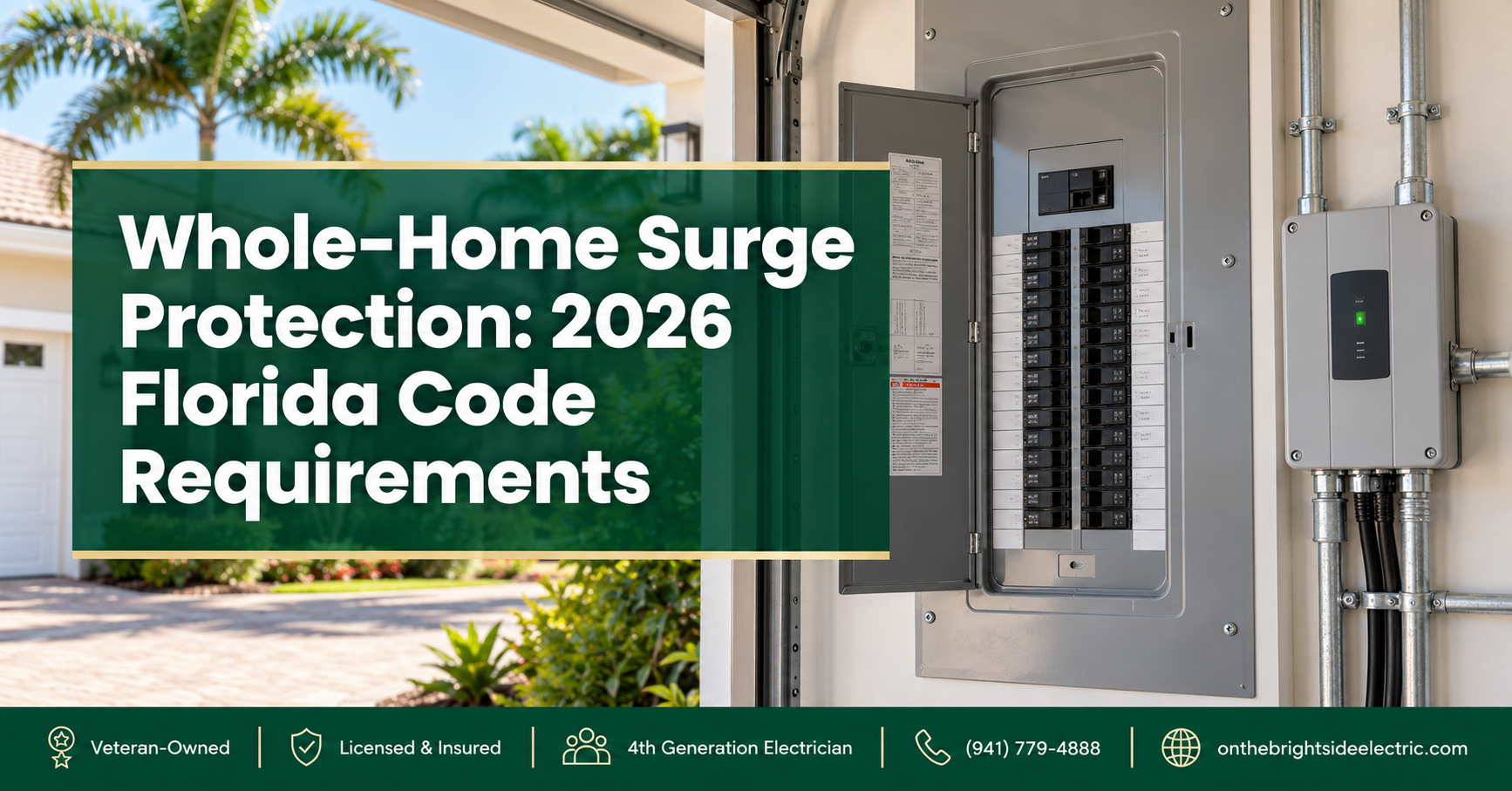
Yes. Under the 2020 NEC requirements applicable to Florida dwelling services, NEC 230.67 calls for surge protection at new dwelling services and when service equipment is replaced. Not every downstream panel repair or change is automatically a service-equipment replacement. If your electrician is replacing your panel and does not mention surge protection, ask about it. For covered work, it is a code requirement, not an optional upgrade.
Table of Contents
- What the code actually requires
- Type 1 vs. Type 2: what is the difference?
- Why Florida made this mandatory
- What it costs to add
- What surge protection does and does not do
- Do I need it if I am not replacing my panel?
- FAQ
What the Code Actually Requires
The 2020 edition of the National Electrical Code (NEC), adopted into the Florida Building Code, requires a listed surge protective device on all new dwelling-unit services and on service replacements. In plain terms: when covered dwelling service equipment is installed or replaced, a qualifying SPD is required.
This applies to panel upgrades, service relocations, and new construction. It does not retroactively require all untouched existing services to be upgraded. Applicability to a particular project depends on whether service equipment is being replaced and the locally adopted code. If you are planning a panel upgrade, surge protection is part of that conversation.
Type 1 vs. Type 2: What Is the Difference?
- Type 1 SPD: Installed on the line side of the main breaker, typically at the meter. Handles large external surges. Often installed by or coordinated with the utility.
- Type 2 SPD: Installed on the load side, usually as a breaker-style device inside your panel. This is what most residential panel replacements get.
A listed Type 1 or Type 2 SPD can satisfy the relevant requirement when installed in a permitted location and per the adopted code and product instructions. Your electrician selects the correctly rated device for your service size.
Why Florida Made This Mandatory
Florida experiences frequent lightning and weather-related electrical disturbances. Beyond direct strikes, the far more common threat is the thousands of smaller surges that hit the grid every year: utility switching, transformer events, and the massive inrush when power is restored after an outage.
Modern homes are full of surge-sensitive electronics: HVAC control boards, smart appliances, computers, EV chargers, pool equipment controllers. A single surge event can destroy thousands of dollars of equipment in seconds. The code requirement reflects a simple reality: the cost of protection is small compared to the cost of replacement. For the full picture, see our whole-home surge protection guide and our article on protecting electronics from lightning.
What It Costs to Add
On a panel replacement, the incremental cost of the SPD device and its installation is modest relative to the total job, typically a few hundred dollars for the device plus labor. As a standalone addition to an existing panel, expect a short service visit, usually one to two hours.
The most cost-effective time to add whole-home surge protection is during a panel upgrade, when the panel is already open and the electrician is already there. For context on that larger project, see our breakdown of panel upgrade cost in Manatee County.
What Surge Protection Does and Does Not Do
It does:
- Clamp everyday grid surges before they reach your electronics
- Help limit certain transients, subject to the surge magnitude and device rating
- Work alongside point-of-use protectors (quality power strips) for layered defense
It does not:
- Stop a direct lightning strike to your home. Nothing does. (Lightning protection systems are a separate specialty.)
- Last forever. SPDs can degrade or fail from surge exposure. Check manufacturer-provided status indicators and follow product instructions; there is no universal replacement interval.
Do I Need It If I Am Not Replacing My Panel?
Code does not require it for an untouched existing service, but it is one of the highest-value electrical investments a Florida homeowner can make. If your existing service lacks a whole-home SPD, ask an electrician whether adding one would improve protection for sensitive equipment. See our whole-home surge protection services page to get started.
Frequently Asked Questions
Here are the questions Florida homeowners ask most often about the surge protection code requirement.
How do I know if my surge protector is still working?
Most SPDs have an indicator light. Green means protected. Status meanings vary by product; follow the manufacturer's instructions and arrange evaluation when the status indicates loss of protection.
Do I still need power strips with whole-home surge protection?
Yes. Layered protection is the standard recommendation: a panel-mounted SPD handles large surges, and quality point-of-use protectors handle what remains.
Will surge protection stop a direct lightning strike?
No device stops a direct strike. SPDs handle the far more common secondary surges from the grid, which cause the majority of surge damage.
Is the surge protector included in a panel replacement quote?
It should be, since code requires it. If a quote does not list it, ask. An itemized quote is always better.
How often should surge protectors be replaced in Florida?
There is no fixed schedule, but Florida's surge activity wears devices faster than in calmer regions. Inspect the indicator according to manufacturer guidance; replace the SPD when the device or an electrician indicates it has failed.
Getting a Panel Replaced? Add Surge Protection and Meet Code
Call or text (941) 779-4888 for a free estimate. We will make sure your home meets code and your electronics stay protected.
On The Bright Side Electric LLC
Veteran-Owned | 4th Generation Electrician | Licensed & Insured | EC#13014677