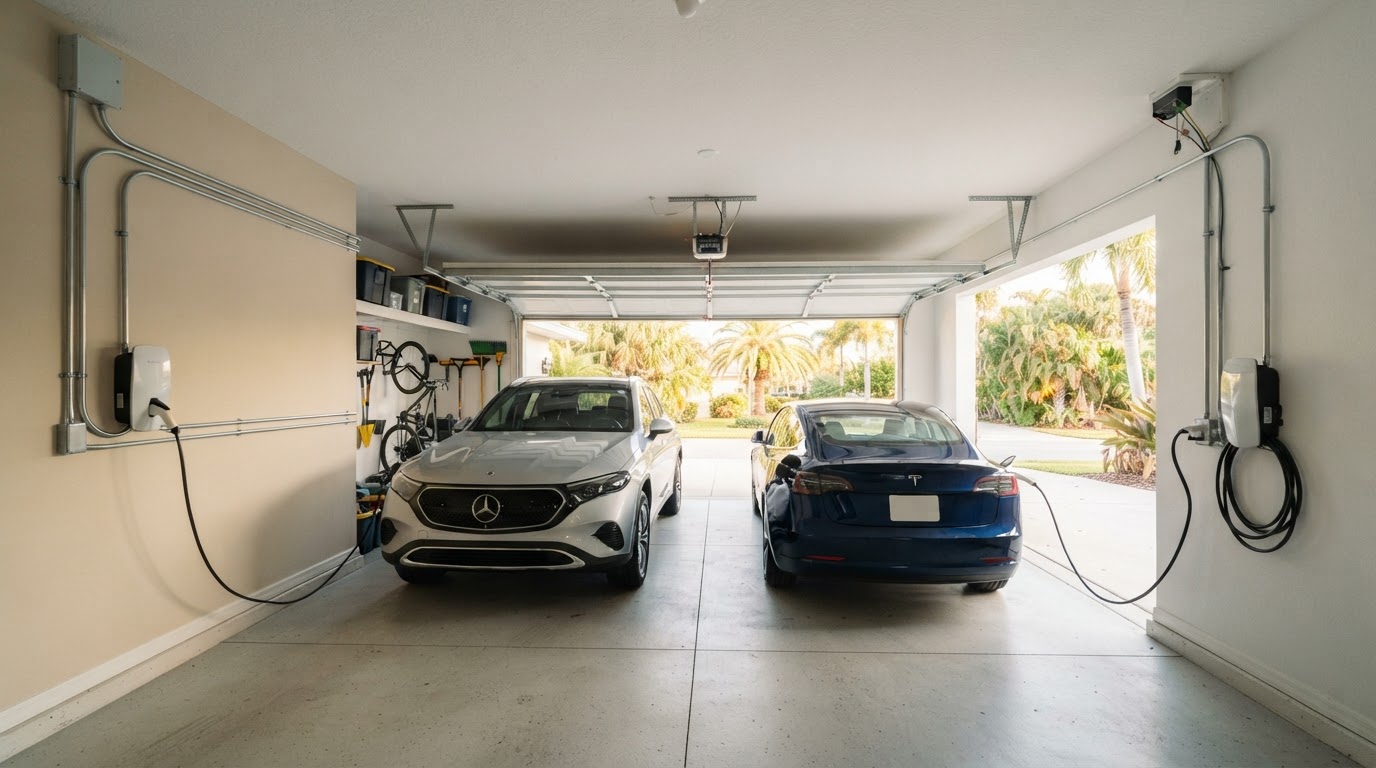
One electric vehicle can change how you use your garage. A second EV changes the planning conversation.
If your household is adding another electric vehicle, you may be wondering whether you need a second Level 2 charger, whether both cars can charge at the same time, and whether your electrical panel can handle the additional demand.
The good news is that a two-EV household does not automatically need a panel or service upgrade. The right solution depends on your home's available electrical capacity, the charging equipment, how far each vehicle is driven, and whether both vehicles truly need maximum charging power at the same time.
For homeowners in Sarasota and Manatee Counties, the best time to answer those questions is before buying the second charger or committing to a wiring layout.
In short: Yes, many homes can charge two electric vehicles, but the right setup depends on the home's available electrical capacity, the charging rate each vehicle actually needs, the charger equipment, and whether both vehicles need to charge at full power at the same time. A second EV does not automatically require a panel or service upgrade. A licensed electrician can evaluate the existing service and determine whether separate circuits, lower charging rates, compatible power-sharing equipment, or load management can safely support the household's charging routine.
Can a House Support Two Level 2 EV Chargers?
Often, yes. But there is no universal two-charger configuration that fits every home.
A licensed electrician may need to evaluate:
- the home's electrical service and panel capacity
- existing household loads such as air conditioning, electric water heating, pool equipment and other large appliances
- the maximum input and output ratings of the proposed charging equipment
- the charging capability of each vehicle
- whether the chargers will operate simultaneously
- the distance from the electrical panel to each parking location
- whether the chargers support compatible power-sharing or load-management features
An empty breaker space is not the same thing as available electrical capacity. The electrical system needs to be evaluated as a whole. For a broader overview of the process, see our guide to EV charger installation for Florida homeowners.
The First Question Is Not "How Big Are the Chargers?"
A better first question is: How much charging does each vehicle actually need overnight?
Imagine one vehicle travels 20 miles most weekdays while the second travels 60 miles. Those cars may not need identical charging rates.
If both vehicles are parked for eight to twelve hours overnight, the household may have more flexibility than someone who needs both vehicles replenished quickly during a short charging window.
That matters because home charging should be designed around the vehicles, the home and the routine, not simply around the highest amperage a charger can advertise.
Four Common Ways a Two-EV Home Can Be Set Up
The correct design depends on the specific listed equipment, manufacturer instructions, applicable electrical requirements and the home's electrical system.
| Approach | How It Works | When It May Fit |
|---|---|---|
| Two dedicated charging circuits | Each charger is supplied according to its approved circuit and equipment requirements. | Homes with adequate capacity and a layout that supports two circuit runs. |
| Two chargers using compatible power sharing | Compatible charging equipment coordinates the available charging power instead of both units drawing their maximum simultaneously. | Households that want two convenient charging locations while controlling total EV load. |
| Dynamic load management | Compatible equipment monitors available household capacity and adjusts EV charging based on other electrical demand. | Homes where available capacity changes as large household loads turn on and off. |
| One Level 2 charger plus another charging strategy | Vehicles alternate the Level 2 charger, or one vehicle uses slower charging when practical. | Households whose mileage and parking routine do not justify two full-power charging points. |
What Is EV Charger Power Sharing?
Power sharing allows compatible charging equipment to coordinate how much electrical capacity multiple chargers use.
Instead of assuming every charger must draw its maximum output at the same moment, the system manages the available charging power across the connected vehicles.
For example, Tesla documents Group Power Management for up to six Gen 3 Wall Connectors. Tesla states that the feature distributes power across multiple Wall Connectors while keeping the total draw within configured limits. You can review the details on Tesla's Wall Connector power management page.
Its Dynamic Power Management can also monitor available panel power and adjust a Wall Connector's charging rate as household electrical use changes.
That does not mean every charger brand can share power with every other charger. Equipment compatibility and installation requirements matter, so the exact products should be reviewed before the electrical design is finalized.
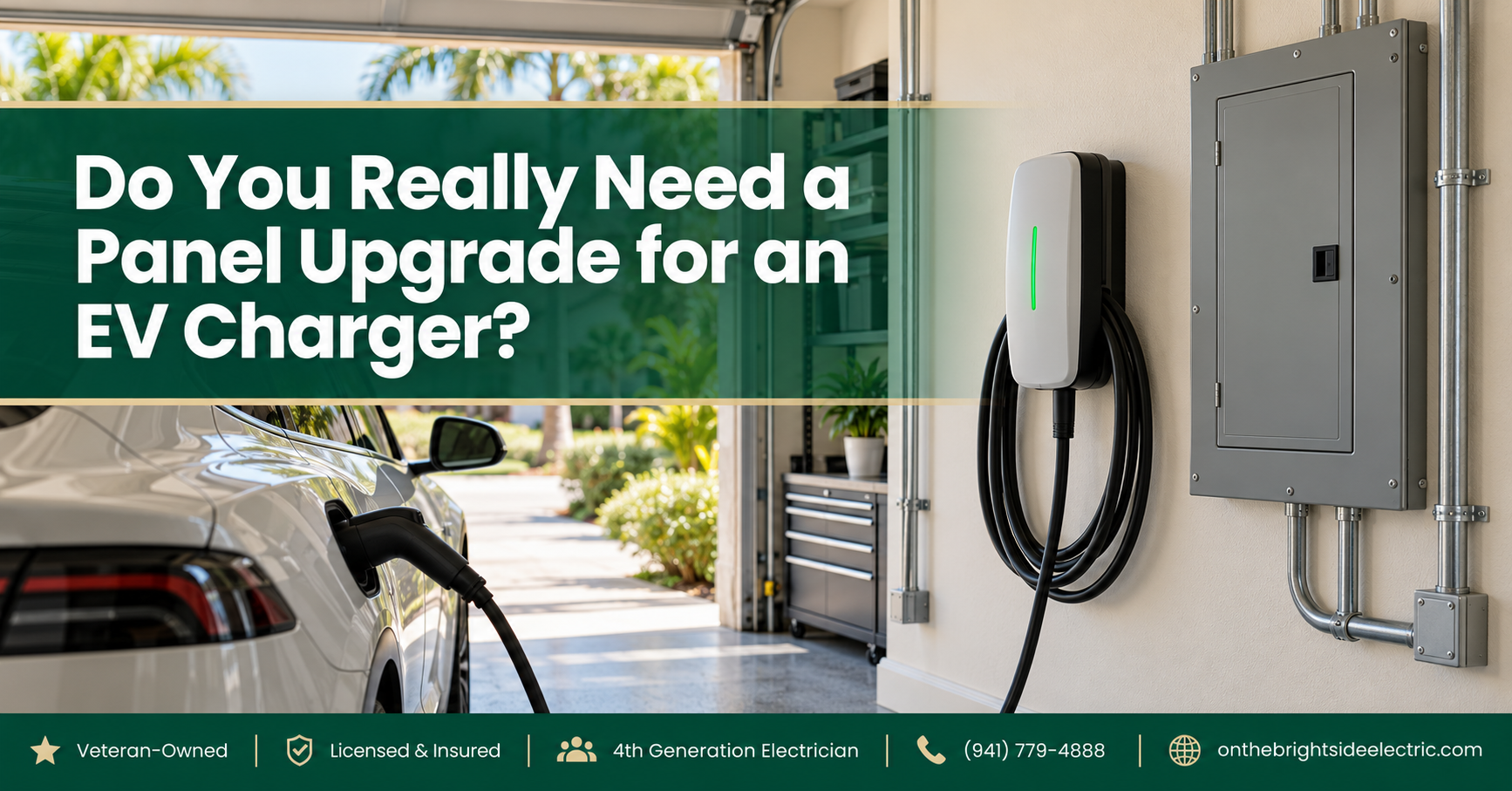
Does Adding a Second EV Charger Mean You Need a Panel Upgrade?
Not necessarily.
A second charger may lead to a panel or service upgrade when the existing electrical system does not have enough capacity for the proposed loads, but upgrading the service is not the only possible outcome.
Depending on the home and equipment, the electrician may determine that the project can use:
- available existing capacity
- a charging configuration with a lower maximum output
- compatible power sharing between chargers
- approved load-management equipment
- a different charging schedule or equipment strategy
- a panel or service upgrade when additional capacity is actually needed
The key is to evaluate the load before deciding on the solution.
If you want a deeper explanation of that step, read our guide: Can My Electrical Panel Handle a Level 2 EV Charger? A Florida Homeowner's Guide.
Should Both EV Chargers Be 48 Amps?
Not automatically. Bigger is not always more useful.
The vehicle itself limits how much AC charging power it can accept, and the household's daily driving determines how much energy needs to be replaced.
Installing two high-output chargers may be appropriate in some homes, but it should not be the default assumption for every two-EV household.
A well-planned installation gives each vehicle enough charging capacity for the way the household actually drives while staying within the electrical system's safe operating limits.
Can You Put Two EV Chargers on One Circuit?
Do not assume that two independent chargers can simply be connected to one ordinary branch circuit.
Multi-charger arrangements must be specifically designed around equipment that is listed and configured for the intended power-management method and installed according to the manufacturer's instructions and applicable electrical requirements. For general context on Florida building codes, you can review the Florida Building Commission resource page.
If your goal is to reduce the amount of new electrical work, tell the electrician that before purchasing the chargers.
Some compatible systems are designed specifically to coordinate multiple charging points.
Hardwired or Plug-In for a Two-EV Household?
Either approach may be appropriate depending on the chargers and installation, but the decision becomes more important when you are planning two charging locations.
You will want to consider:
- equipment requirements
- indoor versus outdoor placement
- circuit design
- receptacle requirements where applicable
- future charger replacement
- whether the selected chargers support the power-management strategy you want
For a detailed comparison, see our guide: Hardwired vs. Plug-In Level 2 EV Chargers: Which Installation Is Right for Your Home?
Plan the Parking Layout Before the Wiring
A two-EV charging project is partly an electrical project and partly a parking-layout project.
Before installation, think about:
- where each vehicle normally parks
- which side of each vehicle contains the charge port
- whether vehicles may swap parking spaces
- charger cable reach without stretching across walking paths
- garage-door and storage clearance
- indoor versus outdoor exposure
- the route from the panel to each charging location
- whether a future third EV or different vehicle could change the layout
A little planning now can prevent an inconvenient charger location from becoming permanent.
What About a Detached Garage or Long Circuit Run?
Distance matters.
A charger on the opposite side of the garage is one project. A second charging point at a detached garage, carport or distant driveway can be very different.
Longer runs can affect:
- wiring methods
- conductor sizing
- routing
- trenching or conduit needs
- installation labor
- the practicality of different equipment layouts
If you are requesting a remote estimate, include photos and an approximate panel-to-charger distance for both proposed locations.
Do You Need Two Chargers at All?
Sometimes the smartest two-EV setup uses only one Level 2 charger.
If both vehicles spend most nights at home and neither routinely arrives nearly empty, alternating one charger may be completely practical.
Some households can also use Level 2 charging for the higher-mileage vehicle and a slower charging method for the lower-mileage vehicle.
The point is not to install the most equipment.
It is to build a charging routine that reliably supports both drivers.
What to Send Us for a Two-EV Charger Estimate
On The Bright Side Electric offers a free remote estimate process for projects that can be evaluated from clear photos and project information.
For a two-EV charging project, send:
- a clear photo of the electrical panel with the door open and breaker labels visible
- a photo showing the panel location in context
- photos of both proposed charging locations
- the make and model of each EV
- the make and model of each charger you already own or are considering
- approximate distance from the panel to each charger location
- whether both vehicles need to charge at the same time
- your typical daily mileage for each vehicle
- any future electrical upgrades you are already considering
That information helps us identify whether the project appears suitable for a standard charger installation, needs additional electrical evaluation, or may benefit from a different charging strategy. Learn more about our EV charger installation services.
Two-EV Charger Installation in Sarasota and Manatee County
On The Bright Side Electric installs EV charging equipment for homeowners throughout Sarasota and Manatee Counties, including Sarasota, Bradenton, Parrish, Palmetto, Ellenton, Lakewood Ranch, Siesta Key and Longboat Key.
We can help evaluate the electrical side of a two-EV household, including charger circuits, panel capacity, equipment placement, compatible charging strategies and related panel or service work when it is actually needed.
Planning for a Second EV? Start With the Electrical System
You do not need to guess whether your home can support two electric vehicles, and you do not need to assume the answer is an expensive service upgrade. Send us your panel photos, charger information, parking layout and driving needs.
On The Bright Side Electric LLC
Veteran-Owned | 4th Generation Electrician | Licensed & Insured | EC#13014677