If you are bringing home an EV, or thinking about it, the charger question comes fast: what will it cost to charge at home? Here is the honest breakdown for Florida homeowners in 2026, covering the hardware, the installation, and the factors that move the price. For the service overview, see our EV charger installation services page.
Table of Contents
- The two parts of the cost
- Hardware: what chargers cost
- Installation: what electricians charge
- What makes an install simple or complex
- Level 1 vs. Level 2: the real comparison
- Permits and inspection
- Ongoing charging costs on FPL
- FAQ
The Two Parts of the Cost
Every home EV charger project has two costs:
- The charger hardware you buy
- The electrical installation a licensed electrician performs
They are separate purchases, and understanding them separately keeps quotes honest.
Hardware: What Chargers Cost
A quality Level 2 home charger from a major brand typically costs a few hundred dollars. Smart chargers with Wi-Fi, scheduling, and energy monitoring sit at the higher end of that range. Your vehicle manufacturer may recommend a specific unit, but most EVs work with any standard Level 2 charger.
Do not overthink the hardware. The installation quality matters more than the brand badge.
Installation: What Electricians Charge
In Florida, cost depends on charger location, circuit length, existing capacity, labor, permits and equipment. Obtain an itemized local quote rather than relying on a generic price range. That is the typical case: panel in the garage, charger on the garage wall, short wire run.
Costs rise when the job gets complex (see below). And if a panel upgrade is genuinely required, that is a separate project with its own price — our panel upgrade services page covers that scope.
What Makes an Install Simple or Complex
Simple (lower cost):
- Panel has capacity and open breaker space
- Charger location is near the panel (short wire run)
- Surface-mounted conduit is acceptable
- No trenching, no attic gymnastics
Complex (higher cost):
- Long wire runs across the house or through finished spaces
- Trenching to a detached garage or driveway pedestal
- Panel is full or at capacity (subpanel or upgrade needed)
- Older wiring that needs remediation to pass inspection
An assessment of the panel location, capacity and routing will show whether your installation is straightforward.
Level 1 vs. Level 2: The Real Comparison
- Level 1 uses a standard 120V outlet. It adds roughly 3 to 5 miles of range per hour. For a plug-in hybrid or a very short commute, it can work. For a full EV driven daily, it is usually inadequate.
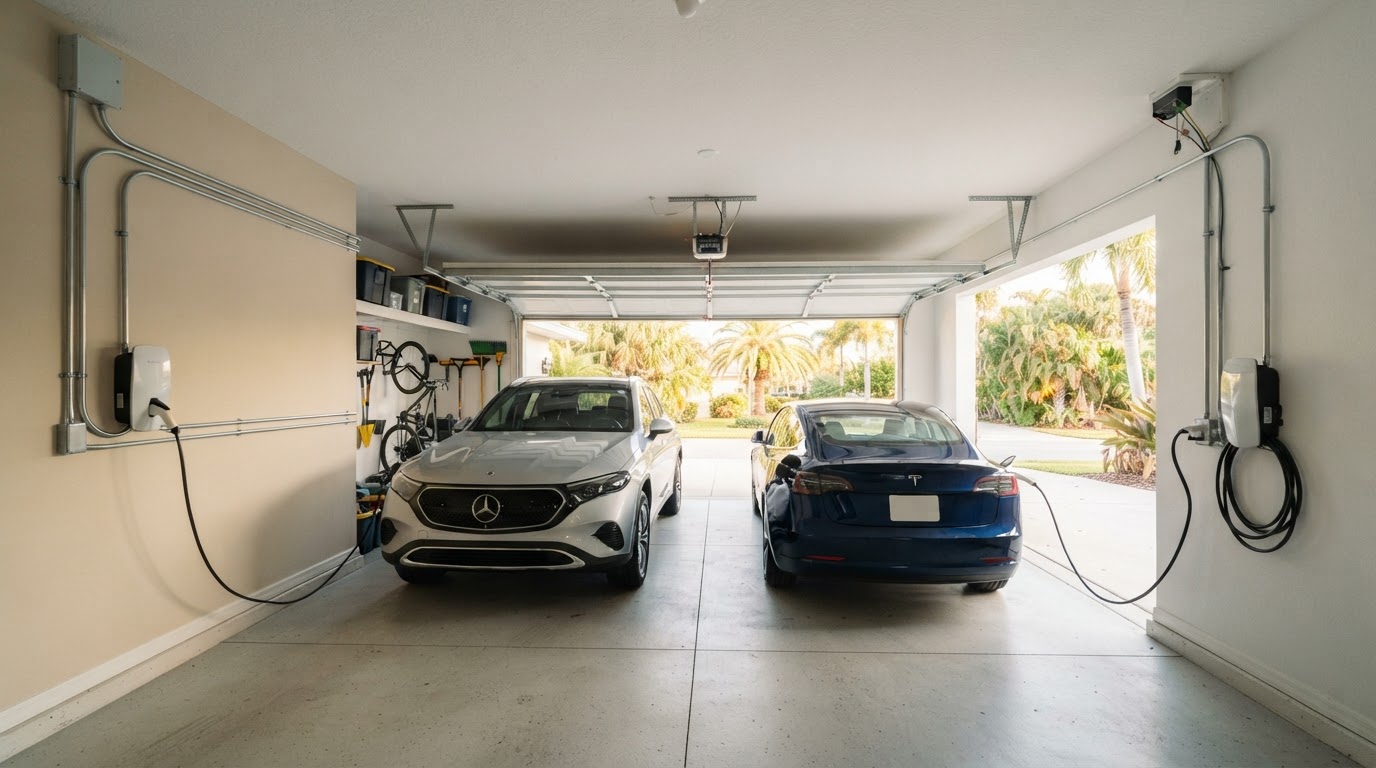
- Level 2 uses a 240V dedicated circuit. It adds roughly 25 to 40 miles of range per hour depending on amperage. Overnight, available range depends on the vehicle, battery, charger setting and charging conditions.
Level 1 costs almost nothing to start, but most EV owners upgrade to Level 2 within months. If you are installing once, install Level 2. Level 2 charging runs on a proper dedicated circuit installation sized to the charger.
Permits and Inspection
Most new permanently wired EV charging circuits require permits and inspection under applicable local rules. Verify with the relevant building department for the specific address. Your electrician pulls the permit. The inspection verifies correct breaker sizing, wire gauge, grounding, and GFCI protection where required. This is also what keeps your homeowner's insurance happy.
Ongoing Charging Costs on FPL
Home-charging economics depend on the vehicle, electricity tariff, charging schedule and the gasoline vehicle used for comparison. Exact numbers depend on your rate plan and driving, but home charging typically cuts "fuel" costs dramatically versus gas. Charging overnight, when demand is lowest, is the most economical pattern.
Confirm current FPL tariffs before estimating monthly operating cost; rate plans and energy prices can change. If you are weighing a utility program against owning your own hardware, see our comparison of FPL EVolution vs. owning your charger.
Frequently Asked Questions
Here are the questions Florida homeowners ask most often about home EV charger installation cost.
How long does installation take?
Most straightforward installations are completed in a half day. Complex runs can take a full day.
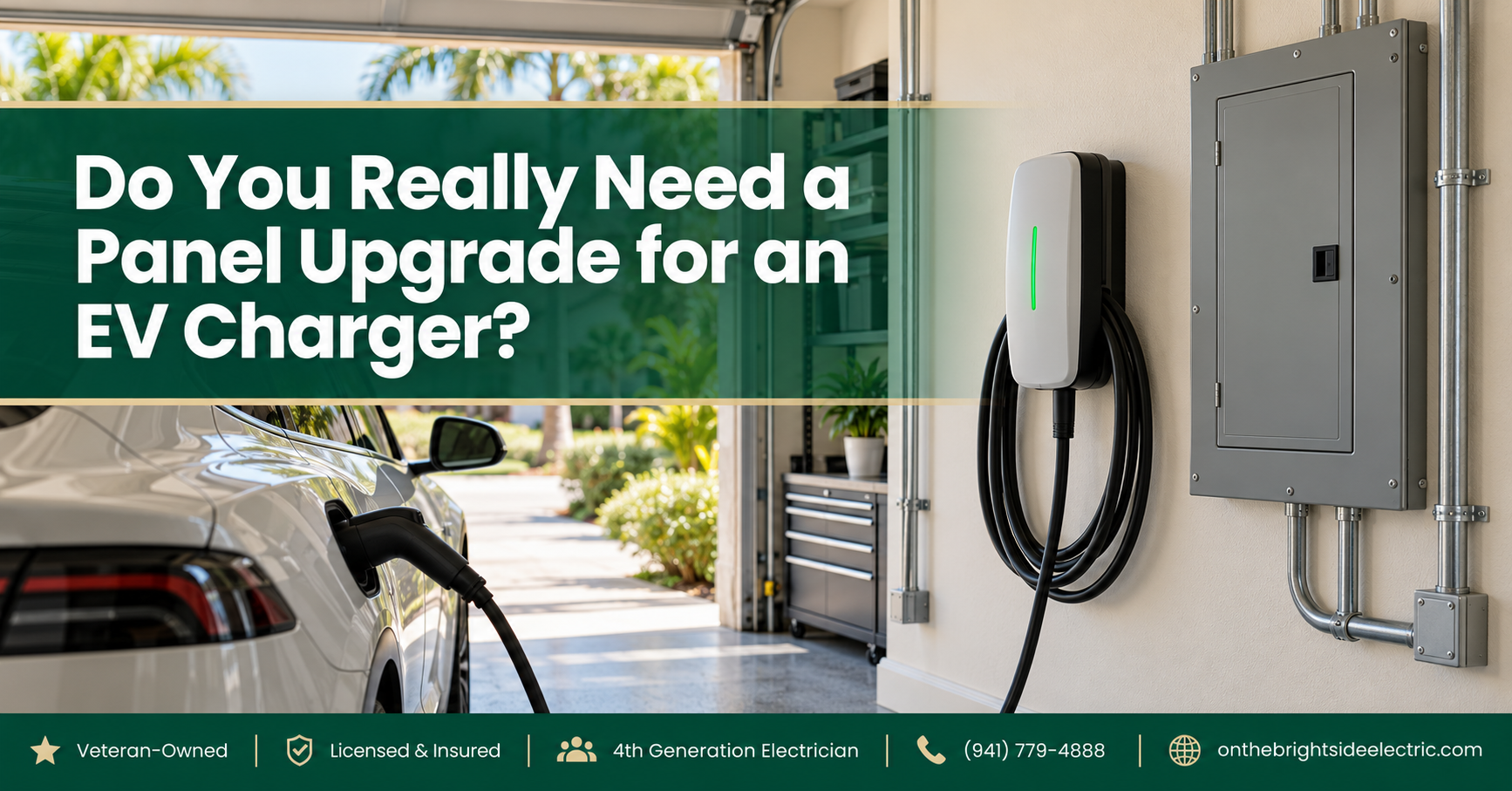
Do I need a panel upgrade for an EV charger?
Not always. A load calculation determines whether your panel has capacity. Many homes do not need an upgrade. (We wrote a whole guide on whether a panel upgrade is really needed.)
Can I install an EV charger myself?
A new hardwired Level 2 circuit requires proper installation and, where applicable, permits and inspections. A licensed electrician is the safest choice. Florida law also provides a limited owner-builder exemption for qualified homeowners who meet all requirements.
Hardwired or plug-in charger: which is better?
Hardwired units are generally preferred for Florida garages: cleaner install, no receptacle to wear out, and they satisfy code without GFCI-breaker complications. Plug-in units offer portability if you might move the charger.
Will an EV charger raise my electric bill a lot?
Charging increases electricity usage. Compare your EV's kWh-per-mile performance and your actual electricity rate with the gasoline vehicle you would otherwise drive.
Ready for an Exact Price on Your Home?
Call or text (941) 779-4888 for a free estimate. We will assess your panel, your garage, and give you a straight written number.
On The Bright Side Electric LLC
Veteran-Owned | 4th Generation Electrician | Licensed & Insured | EC#13014677