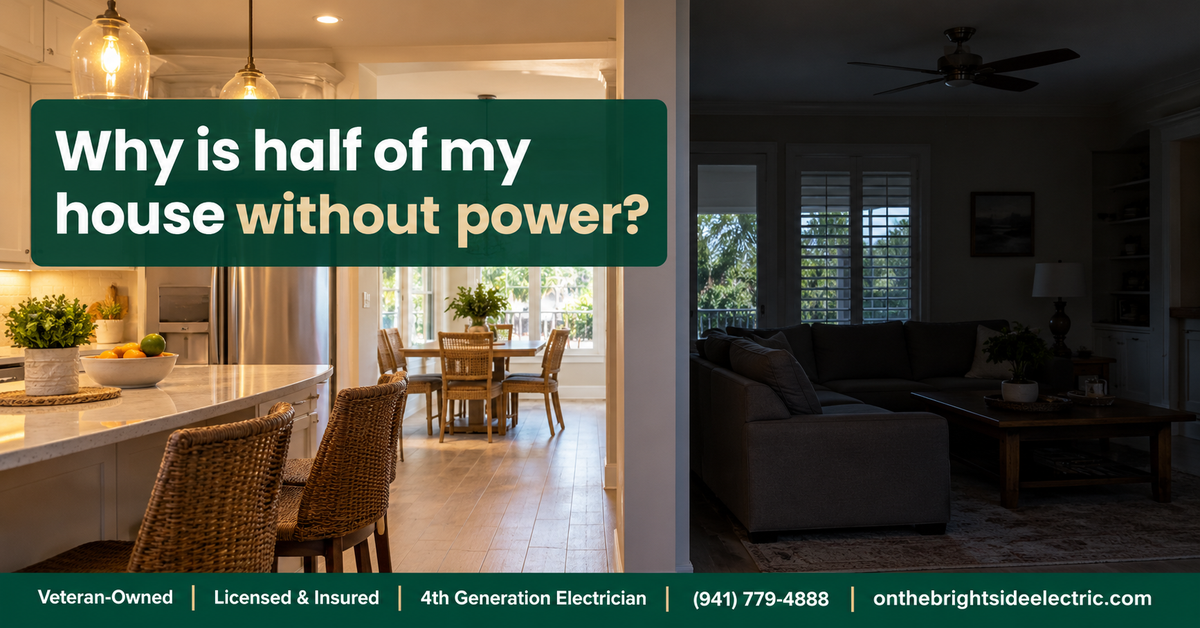
You walk into your kitchen, flip the light switch, and nothing happens. But when you step into the living room, the lights work perfectly.
Maybe your refrigerator is running, but your air conditioner has stopped. Or the outlets in one bedroom work while another bedroom has no electricity at all.
If you are thinking, "Half of my house has no power, but the other half is fine," you are dealing with what electricians call a partial power outage.
Unlike a complete blackout, partial power loss can be confusing because some electrical systems continue operating normally. The cause might be something relatively straightforward, such as a tripped circuit breaker, or it could involve a problem with the electrical service supplying your home.
For homeowners in Manatee County and Sarasota County, Florida, understanding these differences can help you determine what to check safely and when to contact a licensed electrician.
Here is what partial power loss can mean, why certain rooms or appliances stop working, and how to respond without putting yourself at risk.
What does it mean when only half your house has power?
Most modern Florida homes receive electrical service that supplies both 120-volt and 240-volt power.
Standard household outlets and many lighting circuits typically operate at 120 volts. Larger equipment, such as central air conditioners, electric dryers, ranges, and some water heaters, often requires 240 volts.
Your electrical system distributes this power through circuits connected to your main electrical panel.
When electricity stops reaching certain circuits, some rooms or appliances may lose power while others continue working.
The affected areas are not necessarily divided evenly between the left and right sides of your house.
For example, you might notice:
- Kitchen outlets work, but bedroom outlets do not.
- Bathroom lights operate, but the hallway is dark.
- Your refrigerator runs, but the electric dryer will not start.
- Some ceiling fans work while others have stopped.
- Certain outdoor outlets or garage circuits have lost power.
- Your air conditioner stops operating while some indoor lights remain on.
The pattern of affected circuits is an important clue.
A single room losing electricity often suggests a different problem than multiple unrelated areas losing power simultaneously.
That distinction helps an electrician determine whether to investigate a branch circuit, the main panel, or the electrical service entering the home.
What causes partial power loss in a house?
Several electrical problems can create the appearance that half your home has lost power.
The most common possibilities involve circuit protection devices, electrical connections, service equipment, or the utility supply.
1. A tripped circuit breaker
Circuit breakers are designed to interrupt electricity when certain electrical faults or excessive current conditions occur.
If a breaker trips, everything connected to that circuit may lose power.
Depending on how your home's wiring is arranged, a single breaker could supply outlets or lighting in more than one room.
A tripped breaker may be caused by an overloaded circuit, a short circuit, a ground fault, or another electrical problem.
Some breakers move to a middle position when they trip, making the condition less obvious than a switch that is fully off.
If power disappears from several outlets connected to one circuit, a breaker is one possible explanation.
However, repeated breaker trips should never be ignored or treated as a normal inconvenience. For additional guidance, read our article: Why does my breaker keep tripping, and when is it dangerous?
2. A tripped GFCI outlet
A ground-fault circuit interrupter, commonly called a GFCI, helps protect people from electrical shock by interrupting power when it detects certain electrical current imbalances.
These devices are commonly found in kitchens, bathrooms, garages, outdoor areas, and other locations where additional shock protection is required.
One GFCI device can sometimes protect multiple outlets located farther along the same circuit.
This means a tripped GFCI in one location may interrupt electricity to outlets elsewhere in your home.
For example, an outlet in the garage might stop working because a GFCI serving that circuit has tripped.
If several outlets are dead but your lighting remains normal, GFCI protection is worth considering.
However, a GFCI that repeatedly trips may indicate an electrical fault or an issue with connected equipment.
3. A loose or damaged electrical connection
Electrical connections can deteriorate over time because of heat, corrosion, vibration, previous installation problems, or other conditions.
A loose connection may interrupt electricity to downstream outlets, fixtures, or other electrical equipment.
Sometimes the power loss is intermittent.
You might notice a light flickering before it stops working, or an outlet that occasionally loses electricity.
A damaged connection can also generate heat.
Warning signs include unusual buzzing, discoloration around an outlet, or a burning smell.
These symptoms should be evaluated by a licensed electrician rather than investigated by opening electrical boxes or removing outlet covers.
4. A lost electrical service leg
One of the more important explanations for a widespread partial outage is a condition called a lost leg.
This happens when one of the two energized conductors supplying your home's normal 120/240-volt electrical service stops delivering power correctly.
The result can look like a strange combination of working and nonworking circuits.
We will explain this condition in more detail below.
5. A utility supply problem
Not every electrical outage originates inside the house.
A problem involving the utility's equipment, connections, transformer, or service conductors can interrupt part of the electricity reaching your home.
Storm-related damage and deteriorated connections are possible contributing factors.
If multiple unrelated circuits lose power at once, contacting your electric utility to report the partial outage is an appropriate step.
The utility and a licensed electrician may both need to be involved, depending on where the problem is located.
What is a lost leg of electrical service?
The term "lost leg" sounds technical, but the basic idea is relatively simple.
A typical residential 120/240-volt electrical service has two energized conductors, often called legs.
Each leg provides approximately 120 volts relative to the neutral conductor.
Together, the two legs provide approximately 240 volts for equipment designed to use that voltage.
Your electrical panel distributes circuits across these two legs.
If one leg stops supplying electricity properly, circuits connected to that side may lose power.
Meanwhile, circuits supplied by the other leg may continue operating.
Why does a lost leg affect different rooms?
Imagine that some of your kitchen circuits are connected to one service leg while certain bedroom and living room circuits are connected to the other.
If one leg becomes unavailable, some of those circuits may stop working.
The outage will not necessarily follow a recognizable pattern based on room locations.
That is why homeowners often describe the situation as half the house losing electricity, even when the affected rooms are scattered throughout the property.
What happens to large appliances?
Large 240-volt appliances generally depend on both electrical service legs.
If one leg is lost, equipment such as an electric dryer, range, water heater, or central air-conditioning system may stop working correctly.
Some equipment may appear completely dead.
Other equipment may have controls or indicators that still respond, even though the appliance cannot operate normally.
Do not repeatedly attempt to start equipment that is behaving abnormally.
A lost service leg can originate from a utility-side problem, a damaged electrical connection, service equipment, or a fault involving the main panel.
Identifying the actual location requires proper electrical testing by qualified personnel.
Is a lost leg the same as a lost neutral?
No. A lost electrical service leg and a lost neutral are different conditions, although both can cause unusual electrical behavior.
A service neutral helps maintain the proper voltage relationship for normal 120-volt circuits.
If a service neutral becomes loose or disconnected, voltage can become unbalanced across certain household circuits.
You may notice lights becoming unusually bright in one area while others become dim.
Electronic devices might reset or behave unpredictably when other appliances turn on.
A damaged neutral connection can expose connected equipment to abnormal voltage.
This is why significant brightness changes affecting multiple rooms deserve prompt professional attention.
Homeowners cannot reliably distinguish a lost leg from a neutral problem by observing lights and appliances alone.
Both conditions require diagnosis, and neither should be investigated through do-it-yourself testing inside an electrical panel.
What can you safely check when half your house loses power?
If part of your home suddenly loses electricity, focus on simple observations rather than electrical repairs.
Check which rooms and appliances are affected
Make a brief list of areas that have lost electricity.
Notice whether the problem involves one room, multiple unrelated rooms, or larger appliances.
You can also note whether the air conditioner, electric range, dryer, or water heater is behaving abnormally.
Do not operate questionable equipment just to test it.
Simply record what you have already observed.
Look at your breaker panel without opening it
If the area is dry, accessible, and free from signs of damage, you may visually inspect the breaker positions through the normal hinged access door.
Do not remove the panel cover or touch internal wiring.
A clearly tripped branch-circuit breaker may explain the loss of electricity to a limited area.
If you know how to reset that breaker safely, have disconnected the affected loads, and there are no other warning signs, a single reset may be appropriate.
If it trips again, leave it off.
Do not repeatedly reset breakers, force a breaker into position, or attempt to reset a questionable main breaker during widespread partial power loss.
Check accessible GFCI devices
If the outage appears limited to outlets on one circuit, inspect accessible GFCI receptacles for a tripped indicator.
If conditions are dry and safe, a normal reset may restore operation.
If the device immediately trips again or will not reset, stop and arrange professional evaluation.
Check for a reported utility outage
Review your electric utility's outage information or contact its customer service department.
Explain that your home has experienced partial power loss, not necessarily a complete outage.
You can also ask whether nearby neighbors have noticed similar problems.
Do not approach utility equipment or damaged electrical lines.
Protect equipment when safe
If lights become unusually bright or dim, or appliances behave unpredictably, stop using the affected equipment.
Unplug sensitive devices only if they are safely accessible and their outlets and cords show no signs of damage.
Avoid operating large appliances until the cause is identified.
When is partial power loss an urgent electrical problem?
Not every partial outage represents an immediate emergency.
A tripped GFCI protecting a bathroom outlet is different from a widespread service problem involving abnormal voltage.
However, certain symptoms require urgent attention.
These include:
- Lights becoming unusually bright or dim.
- Burning odors near outlets, switches, or electrical equipment.
- Buzzing, crackling, or visible sparking.
- A panel or electrical device that appears damaged or overheated.
- Multiple unrelated circuits suddenly losing electricity.
- Large appliances behaving abnormally during the outage.
- Electrical equipment affected by water or storm damage.
If you notice these conditions, stop using the affected electrical equipment and contact a licensed electrician promptly.
For suspected utility service problems, report the condition to your electricity provider as well.
If there is active fire, heavy smoke, a downed energized line, or another immediate danger, move to safety and call 911.
Do not approach damaged equipment or attempt to restore electricity yourself.
Why shouldn't homeowners troubleshoot inside the electrical panel?
An electrical panel contains energized components that can cause serious injury even when some circuits appear to be off.
Certain service conductors and connections may remain energized when the main breaker is switched off.
Removing the panel cover or attempting to test internal components can expose you to electrical shock or arc-related hazards.
Partial power loss can be especially misleading because the absence of electricity at an outlet does not mean all related wiring is safe.
Never remove the electrical panel cover, handle service conductors, open meter equipment, or attempt to tighten internal connections yourself.
Do not replace breakers or disconnect wires as a troubleshooting experiment.
A licensed electrician has the training and equipment to investigate electrical faults and verify whether circuits and equipment are safe to work on.
How does an electrician diagnose partial power loss?
A professional diagnosis begins by understanding the symptoms.
An electrician may ask which rooms lost electricity, whether large appliances stopped working, and whether the problem began after a storm or another event.
They can then evaluate the electrical system using appropriate testing procedures.
Depending on the situation, the investigation may involve checking:
- Incoming electrical supply conditions.
- Main breaker and service equipment operation.
- Voltage at appropriate testing locations.
- Electrical panel components and connections.
- Individual branch circuits.
- Evidence of heat damage or loose connections.
- Neutral conductor integrity.
The purpose is to identify where normal electricity flow has been interrupted.
If testing indicates a utility-side problem, the utility provider may need to repair its equipment before normal service can be restored.
If the problem involves homeowner-owned equipment, the electrician can explain the necessary correction.
A partial outage does not automatically mean you need a new electrical panel.
The appropriate repair depends on what the diagnosis reveals.
Why does partial power loss happen in Florida homes?
Homes throughout Manatee County and Sarasota County experience environmental conditions that can affect electrical equipment.
Florida's humidity, heavy rainfall, salt-air exposure in coastal areas, and seasonal thunderstorms can contribute to deterioration or damage over time.
Exterior electrical connections and service equipment may be particularly exposed to these conditions.
In communities such as Palmetto, Bradenton, Parrish, Lakewood Ranch, Sarasota, and Longboat Key, electrical service configurations and equipment ages can vary considerably.
Older homes may have aging electrical connections, while newer homes can still experience installation defects, equipment failures, or utility supply issues.
The home's age alone does not determine whether partial power loss is likely.
Proper diagnosis matters more than assumptions about the property.
If the problem began after severe weather, mention that information when reporting the outage or scheduling electrical service.
Can regular electrical inspections help prevent partial power problems?
Some partial power outages happen unexpectedly, including utility-related interruptions that an ordinary homeowner inspection cannot prevent.
Other problems develop gradually.
Deteriorating electrical connections, damaged equipment, and signs of overheating may sometimes be identified during a professional electrical inspection.
A licensed electrician can evaluate accessible electrical equipment, review visible concerns, and recommend further testing when appropriate.
Regular inspections are particularly valuable when you have noticed recurring electrical symptoms or have concerns about aging equipment.
For more information, read What does an annual electrical safety check include?.
An inspection cannot guarantee that future outages will never occur, but it can help identify certain electrical concerns before they become more disruptive.
Frequently asked questions about half-house power loss
1. Why does half of my house have no power but no breakers are tripped?
Multiple circuits losing electricity without a visibly tripped breaker may indicate a lost electrical service leg, damaged connection, main breaker problem, or utility supply issue. Contact your utility and a licensed electrician for appropriate diagnosis.
2. Can a bad breaker cause half my house to lose electricity?
A failed breaker can interrupt electricity to the circuits it supplies. However, widespread power loss involving unrelated rooms or large appliances may indicate a service or panel problem rather than an ordinary branch-circuit breaker.
3. Why do my lights work but my air conditioner and dryer do not?
Your lights may operate on 120-volt circuits while the air conditioner and dryer typically require 240 volts. A lost service leg can interrupt the power needed by those larger appliances, even when some lights still work.
4. Is it safe to use the outlets that still have power?
Do not assume the working outlets are safe until the cause of widespread partial power loss is known. Abnormal voltage or damaged service connections can affect equipment that still appears to operate. Avoid unnecessary electrical use and seek professional guidance.
5. Should I call the electric company or an electrician first?
Report widespread partial power loss to your electric utility, particularly when a service leg problem is suspected. Contact a licensed electrician promptly as well if the utility does not identify a supply issue, if homeowner-owned equipment may be involved, or if concerning electrical symptoms are present.
6. Will I need to replace my electrical panel if half my house loses power?
Not necessarily. Partial power loss can result from a tripped breaker, GFCI device, damaged connection, utility problem, or service equipment failure. A licensed electrician should identify the actual cause before recommending panel replacement or another repair.
Get professional help for partial power loss in Manatee and Sarasota County
When half your house loses electricity, the most useful first step is identifying the pattern and avoiding unnecessary electrical troubleshooting.
Some outages involve individual circuits or protective devices. Others involve electrical service connections that require qualified testing and coordination with the utility provider.
At On The Bright Side Electric, we are a fourth-generation veteran-owned family company in Palmetto, FL, serving homeowners throughout Manatee County and Sarasota County.
We help homeowners investigate electrical issues, understand their options, and determine appropriate corrections based on the actual condition of the electrical system.
If you are experiencing partial power loss, unusual electrical behavior, or an unexplained outage affecting multiple areas of your home, our team can help determine the next step.
Do not guess about what is causing half your home to lose power. Get experienced electrical guidance and a clear path toward restoring reliable service.
Get Professional Help for Partial Power Loss
If part of your home has lost power, getting the cause identified early can help protect your electrical system and restore normal operation safely. Ready to get it handled? Request your free estimate here, or call/text (941) 779-4888.