October 23, 2026 | On The Bright Side Electric
Your circuit breaker trips, the lights go out, and suddenly you are wondering whether something is seriously wrong with your home's electrical system.
Maybe it happens every time you use the microwave. Maybe the breaker trips when the air conditioner starts. Or perhaps you have reset the same breaker several times, only to have it shut off again.
Here is the important thing to understand: A tripping circuit breaker is usually doing exactly what it is designed to do. It is protecting your electrical system from a potentially unsafe condition.
The question is not simply how to get the power back on. It is why the breaker keeps shutting it off.
For homeowners in Palmetto, Bradenton, Sarasota, and throughout Manatee and Sarasota Counties, understanding the difference between an overloaded circuit and a potentially dangerous electrical fault can help you make safer decisions.
Let us look at what causes breakers to trip, what the timing of those trips can tell you, and when it is time to call a licensed electrician.
Why does a circuit breaker trip?
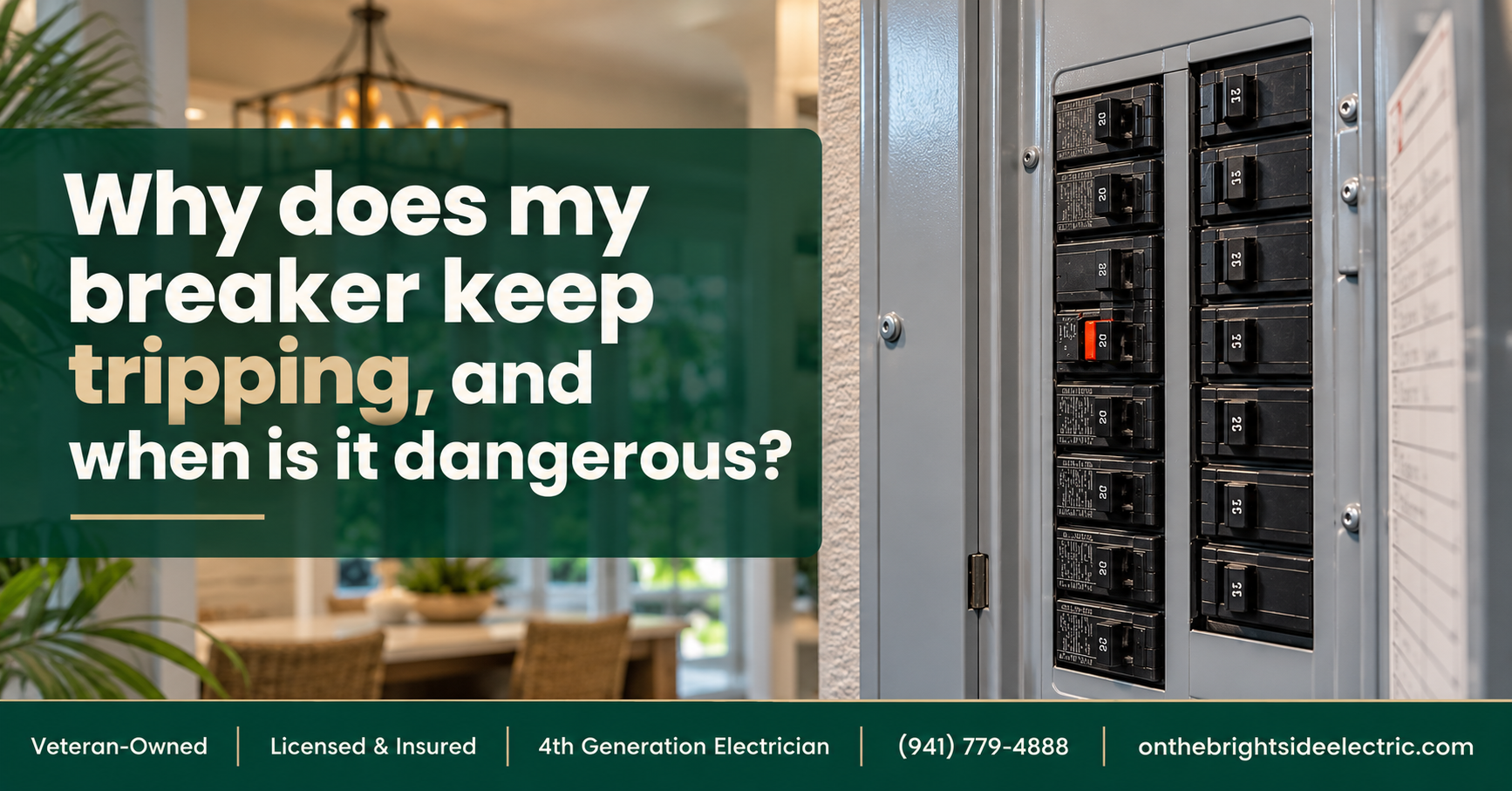
A circuit breaker is a safety device located in your home's electrical panel. Its primary job is to interrupt electricity when a circuit experiences more current than it can safely handle or when a short circuit occurs.
Some breakers also include additional protection that detects electrical faults associated with shock or fire hazards.
Think of your breaker as an automatic safety switch.
When something goes wrong, it shuts off electricity to the affected circuit rather than allowing the unsafe condition to continue.
A breaker that trips once may be responding to a temporary overload. A breaker that keeps tripping is telling you something needs attention.
Resetting it restores power, but it does not fix whatever caused the trip.
6 common reasons your circuit breaker keeps tripping
1. Your electrical circuit is overloaded
An overloaded circuit is one of the most common explanations for a tripped breaker.
Every household circuit has a limit on how much electrical current it can safely carry. When too many appliances or devices operate on the same circuit, their combined electrical demand may exceed that limit.
For example, imagine you are running a microwave while another high-powered kitchen appliance is operating on the same circuit.
Everything may work normally until the second appliance turns on. Suddenly, the breaker trips.
Other common combinations include:
- A space heater and another high-powered device running together.
- A hair dryer and other bathroom appliances operating simultaneously.
- Several appliances sharing outlets connected to the same circuit.
- A portable air conditioner operating alongside additional electrical equipment.
What the pattern tells you: If the breaker trips only when several appliances run together, an overloaded circuit may be responsible.
Reducing the number of devices operating at the same time can help identify the problem. However, frequent overloads may indicate that your home needs additional dedicated circuits or an electrical panel evaluation.
Never rely on extension cords or power strips as a permanent solution to overloaded household circuits.
2. There is a short circuit
A short circuit occurs when electrical current takes an unintended path that allows excessive current to flow.
This can happen when energized conductors come into direct contact with each other or with another conductive surface.
Potential causes include damaged wire insulation, faulty electrical connections, damaged cords, or an internal appliance failure.
Unlike an overload, which may develop as electrical demand increases, a short circuit can cause a breaker to trip almost immediately.
What the pattern tells you: If a breaker trips instantly when you try to reset it, even after you have unplugged accessible appliances, a short circuit or another electrical fault may be present.
Do not keep resetting it to see whether it will eventually stay on.
Leave the breaker off and contact a licensed electrician to investigate.
3. A ground fault is occurring
A ground fault happens when electrical current escapes its intended path and flows through an unintended route toward ground.
Ground faults can create serious electrical shock hazards.
They are particularly concerning in places where moisture may be present, including bathrooms, kitchens, garages, laundry areas, and outdoor spaces.
Here in Manatee and Sarasota Counties, outdoor outlets, pool equipment, and appliances exposed to Florida's frequent rain and humidity deserve particular attention.
Moisture can contribute to electrical faults when it reaches damaged equipment or compromised electrical connections.
What the pattern tells you: If a breaker or GFCI device trips when an outdoor appliance operates, when equipment gets wet, or when a particular device is connected, a ground fault may be involved.
Stop using the affected equipment until the cause has been identified.
4. Your GFCI or AFCI protection is detecting a problem
Not every breaker trips because a circuit is overloaded.
Some electrical protection devices are designed to recognize specific hazards that an ordinary circuit breaker may not detect.
GFCI protection: Preventing electrical shock
A Ground Fault Circuit Interrupter, or GFCI, monitors electrical current and quickly shuts off power when it detects an imbalance that may indicate current escaping along an unintended path.
You may recognize GFCI protection from outlets with TEST and RESET buttons. GFCI protection can also be built into a circuit breaker.
It is commonly used where electricity and moisture may come into contact.
AFCI protection: Detecting dangerous electrical arcing
An Arc Fault Circuit Interrupter, or AFCI, helps protect against certain dangerous electrical arcs.
Arcing can occur when electricity jumps across an unintended gap, potentially because of damaged wiring, deteriorated insulation, or poor electrical connections.
An AFCI is designed to recognize certain arcing conditions and interrupt the circuit.
If an AFCI breaker keeps tripping, the cause could involve damaged wiring, a connected appliance, an electrical connection, or a problem with the protective device itself.
What the pattern tells you: If a breaker labeled AFCI or GFCI keeps tripping, do not assume it is simply being overly sensitive.
The protection may be responding to a real hazard. A qualified electrician can determine whether the issue involves the circuit, connected equipment, or the breaker.
5. An appliance is failing
Sometimes the problem is not your electrical panel or the wiring inside your walls.
It may be an appliance.
An appliance with damaged internal wiring, a failing motor, compromised insulation, or another electrical defect can cause a breaker to trip when it operates.
Common examples include:
- Microwaves and other kitchen appliances.
- Refrigerators or freezers.
- Washing machines and dryers.
- Window air conditioning units.
- Portable heaters.
- Outdoor electrical equipment.
Suppose your breaker stays on throughout the day but trips whenever your microwave starts.
That pattern suggests the appliance, its electrical demand, or the circuit serving it deserves closer inspection.
It does not automatically mean the microwave is defective, but it provides a useful clue.
What the pattern tells you: When trips consistently coincide with one appliance, stop using that appliance until the cause is determined.
Never continue operating an appliance that repeatedly trips a breaker, produces unusual electrical smells, or shows signs of damage.
6. The circuit breaker itself is worn or failing
Circuit breakers do not necessarily last forever.
Over time, age, heat exposure, wear, or internal damage can affect their operation.
A breaker may become unreliable or fail to operate correctly.
However, a repeatedly tripping breaker should never automatically be diagnosed as a bad breaker.
It may be responding correctly to an overload or electrical fault elsewhere on the circuit.
Replacing the breaker without identifying the actual cause can leave the underlying hazard unresolved.
A licensed electrician can evaluate the breaker, its connections, and the affected circuit to determine what needs repair or replacement.
What does the timing of a breaker trip tell you?
One of the most useful things you can do is pay attention to exactly when the breaker trips.
The pattern can provide clues about what is happening.
| When the breaker trips | What it might indicate |
|---|---|
| When several appliances run together | An overloaded circuit |
| Every time one specific appliance starts | Appliance trouble, excessive startup demand, or a circuit issue |
| Immediately after being reset | A short circuit, ground fault, or another persistent electrical problem |
| When outdoor equipment gets wet or operates | Possible moisture-related ground fault |
| At unpredictable times | Intermittent wiring, connection, appliance, or breaker problems |
| Even after accessible devices are unplugged | A problem involving fixed equipment, wiring, or the breaker |
These patterns are clues, not a diagnosis.
An electrician may need to test the circuit and equipment to determine what is actually causing the interruption.
What should you do when a breaker trips?
If the breaker trips once and there are no signs of overheating, electrical damage, or another dangerous condition, there are a few simple steps you can take.
Step 1: Notice what was running
Before changing anything, think about what happened immediately before the power went out.
Were you using the microwave? Did the air conditioner start? Were several appliances running together?
Make a quick note of what was operating and which rooms or outlets lost power.
Step 2: Turn off or unplug devices on the affected circuit
If it is safe to do so, unplug accessible appliances connected to the circuit.
This reduces the electrical load and may help identify a connected device that is contributing to the problem.
Do not unplug equipment that is hot, smoking, sparking, damaged, or wet.
Step 3: Check for danger signs before approaching the panel
Do not attempt a reset if you notice burning odors, buzzing, scorch marks, sparks, smoke, excessive heat, or water around electrical equipment.
If the panel appears damaged or unsafe, do not touch it.
Step 4: Consider one reset only if conditions appear normal
If there are no warning signs, the panel is dry and undamaged, and the breaker has not been repeatedly tripping, a single normal reset may be appropriate.
Follow the panel manufacturer's instructions. Typically, this involves moving the breaker handle fully to OFF and then back to ON.
If the breaker immediately trips again, leave it off.
Step 5: Contact an electrician if the problem returns
A breaker that trips repeatedly needs professional evaluation.
Keep the circuit off and avoid reconnecting any appliance that appears to trigger the problem.
Your notes about when and how the breaker tripped can help the electrician narrow down possible causes.
When is a tripping circuit breaker dangerous?
A tripped breaker is not automatically an emergency. But certain symptoms suggest an electrical condition that requires prompt professional attention.
Stop using the affected circuit and contact an electrician promptly if you notice:
- A burning or melting-plastic smell near an outlet, appliance, or electrical panel.
- A panel or breaker that feels unusually hot or is noticeably radiating heat.
- Buzzing, crackling, or unusual sounds coming from the panel.
- Scorch marks, discoloration, or visible damage.
- Sparks coming from an outlet, appliance, or panel.
- A breaker that trips immediately after resetting.
- A breaker that will not reset or will not stay on.
- Repeated trips even when accessible appliances are unplugged.
If you notice smoke, flames, or signs of an active electrical fire, move everyone to safety and call 911. Do not approach or touch the affected electrical equipment.
Never keep resetting a breaker that trips right away.
Each trip may indicate that an unsafe electrical condition is still present.
For a broader look at common hazards in older Florida homes, see our guide to common electrical code violations found in older Florida homes.
Three things you should never do
Never install a larger breaker to stop the tripping. Breakers are selected to protect the wiring and equipment on their circuits. Installing a higher-amperage breaker without properly evaluating the circuit can create a dangerous overheating risk.
Never open the electrical panel or touch wiring. Removing the panel cover exposes components that may remain energized, even when a breaker is switched off.
Never bypass a breaker or protective device. A breaker that repeatedly trips is not an inconvenience to work around. It is a warning to investigate.
Does a frequently tripping breaker mean you need a panel upgrade?
Not necessarily.
A breaker that keeps tripping does not automatically mean your electrical panel is too small or needs replacement.
The cause might be as simple as too many appliances sharing one circuit, or it could be a faulty appliance, damaged wiring, or a failing breaker.
In some homes, adding a properly sized dedicated circuit may be a more appropriate solution than replacing the entire panel.
A panel upgrade may be worth evaluating if your home's overall electrical capacity is insufficient for its present needs, but that decision requires a professional assessment.
For homeowners in Palmetto, Bradenton, Lakewood Ranch, Sarasota, and surrounding communities, the best first step is identifying why the breaker trips before committing to a larger electrical project. If you are unsure about your panel's condition, an electrical inspection can help clarify what your home actually needs.
Frequently asked questions about tripping breakers
Is it normal for a breaker to trip occasionally?
An occasional trip can happen when a circuit becomes overloaded. However, even a single trip has a cause. If the same breaker repeatedly trips, the condition should be investigated rather than treated as normal.
Can a breaker trip without anything plugged in?
Yes. Fixed electrical equipment, wiring problems, ground faults, and breaker defects can cause trips even when you have unplugged portable devices. Leave a repeatedly tripping circuit off and have it inspected.
Why does my breaker trip when the air conditioner turns on?
Air conditioners can draw additional current during startup. A trip may involve the equipment, a motor or compressor problem, an overloaded circuit, or an electrical fault. Have the system evaluated rather than repeatedly resetting the breaker.
Can a bad breaker cause a fire?
A damaged or defective breaker may fail to provide the intended protection. However, a breaker that trips frequently is not necessarily defective. The important step is identifying the cause and ensuring the circuit remains properly protected.
Should I replace a breaker that keeps tripping?
Not without identifying the problem first. A properly functioning breaker may be responding to a dangerous condition elsewhere. A licensed electrician should determine whether the breaker, wiring, or connected equipment needs attention.
Get answers before a tripping breaker becomes a bigger problem
If your circuit breaker keeps tripping, do not ignore it and do not assume the solution is simply replacing the breaker.
The safest approach is to understand what is causing the interruption and correct the underlying issue.
At On The Bright Side Electric, we help homeowners throughout Manatee and Sarasota Counties with electrical troubleshooting, circuit breaker concerns, and residential electrical repairs and upgrades.
Whether your breaker trips when an appliance starts, will not stay reset, or keeps shutting off power unexpectedly, our team can help you determine the appropriate next steps.
If you are concerned about a repeatedly tripping breaker, contact On The Bright Side Electric to request a free estimate and discuss your electrical concerns.
Call (941) 779-4888 to get started.
On The Bright Side Electric | Serving Palmetto, Bradenton, Sarasota, and surrounding Manatee and Sarasota County communities.
Where You Never Get Left In The Dark.
For more safety guidance from recognized authorities, the Electrical Safety Foundation International and the National Fire Protection Association offer homeowner electrical safety resources. The U.S. Consumer Product Safety Commission also publishes information on recalled and hazardous electrical products.