October 21, 2026 | On The Bright Side Electric | Palmetto, FL
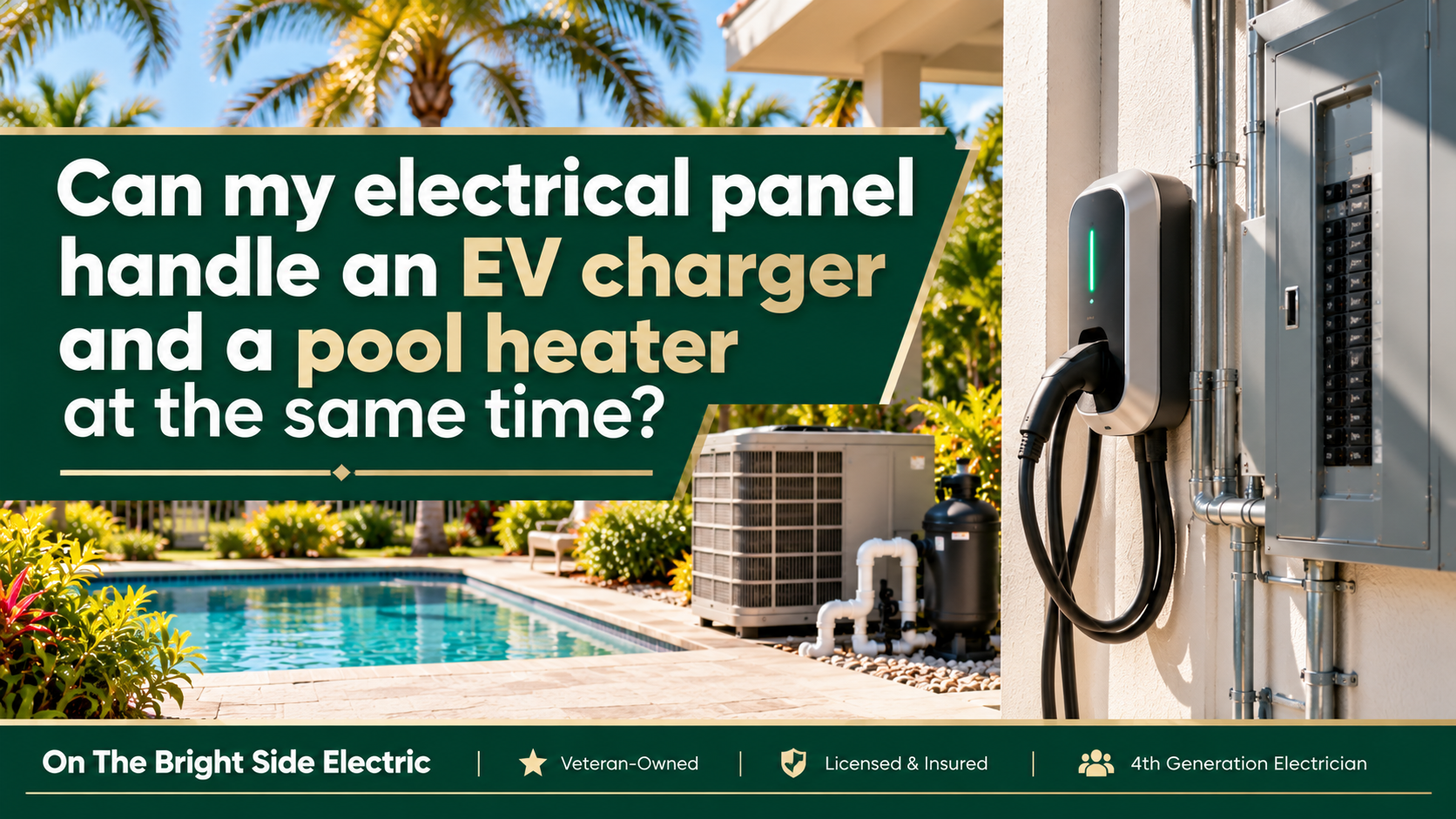
Yes, your electrical panel may be able to handle an EV charger and a pool heater running at the same time, but it depends on your home's total electrical load, available service capacity, and the specific equipment you use. Even a home with a 200-amp electrical service may need adjustments before safely operating both.
For homeowners in Palmetto, Bradenton, Sarasota, Lakewood Ranch, and surrounding Manatee and Sarasota County communities, this question often comes up when adding a Level 2 electric vehicle charger to a home that already has a swimming pool.
Florida homes frequently have multiple major electrical demands, including air conditioning, pool equipment, electric ranges, water heaters, and dryers. Adding EV charging to that combination requires more than finding an empty breaker space.
The good news? You may not need a complete electrical service upgrade.
A licensed electrician can perform an electrical load calculation to determine whether your existing system has enough capacity and whether adjustments, such as lower charging settings or automatic load management, could make the combination work safely.
Why Running an EV Charger and Pool Heater Together Matters
An EV charger and an electric pool heater can both draw substantial amounts of electricity, sometimes for several hours.
Unlike a microwave or other appliance that operates briefly, these systems may remain active for extended periods.
Imagine a typical evening at your Manatee County home:
- Your electric vehicle is charging in the garage.
- Your pool heat pump is maintaining the pool temperature.
- Your air conditioner is cooling the house.
- Someone is cooking dinner on an electric range.
- The clothes dryer is running.
Each piece of equipment places a demand on your home's electrical system.
The important question isn't simply whether the electrical panel can power each appliance individually.
It's whether the electrical service can safely support the combined demand under the applicable electrical load calculation rules.
A properly designed electrical system accounts for the home's existing loads, the added equipment, and the likelihood that certain appliances will operate simultaneously.
Does a 200-Amp Panel Have Enough Capacity?
A 200-amp electrical service can often support a Level 2 EV charger and electric pool heating equipment, but the service rating alone cannot confirm that it will.
Your home's available electrical capacity depends on several factors:
- The electrical service rating, such as 100, 150, or 200 amps
- The existing calculated electrical load
- The EV charger's configured maximum charging current
- The pool heater's electrical requirements
- Other major appliances and HVAC equipment
- The condition and rating of the existing electrical panel
For example, two homes with 200-amp electrical services may have very different available capacity.
One might have a gas range, gas water heater, and relatively modest air-conditioning demands.
Another might have an electric range, electric dryer, electric water heater, multiple air-conditioning systems, and extensive pool equipment.
Even though both homes have the same service rating, their electrical demands are not identical.
A 200-amp label is a starting point, not a guarantee that more electrical equipment can be added.
The same principle applies to homes with 100-amp or 150-amp service. Those homes are not automatically disqualified from adding EV charging, but their capacity deserves careful evaluation.
What Is an Electrical Load Calculation?
An electrical load calculation is a method electricians use to determine how much electrical capacity a home requires.
Rather than simply adding up the numbers printed on every circuit breaker, the calculation evaluates the home's electrical equipment and applies the appropriate electrical code requirements.
For an existing home, the electrician may use an approved calculation method based on equipment ratings or qualifying historical electrical demand data.
A proper evaluation considers:
- Existing household loads: Lighting, receptacles, kitchen appliances, laundry equipment, and other electrical uses.
- Heating and cooling equipment: Air conditioners, electric heating systems, and associated equipment.
- Pool equipment: The pool heater, circulation pump, and other relevant electrical loads.
- EV charging: The charger's maximum configured electrical demand.
- Applicable code requirements: Required load allowances, demand factors, and equipment limitations.
The electrician compares the calculated load with the capacity of the home's electrical service.
This helps determine whether the proposed combination is acceptable or whether changes are needed.
Why not just add up the breaker sizes?
Circuit breakers are designed to protect individual circuits against excessive current.
Their ratings do not necessarily represent how much electricity the connected equipment uses during normal operation.
For instance, a 40-amp breaker does not mean the appliance continuously draws 40 amps.
Similarly, several large circuit breakers can exist in a properly designed panel because electrical load calculations account for how different loads are expected to operate under applicable code rules.
However, those allowances cannot simply be assumed for every appliance.
EV charging has specific requirements because it is treated as a continuous electrical load.
That's why a professional load calculation is more reliable than guessing based on breaker sizes.
Why an Empty Breaker Space Does Not Mean Available Capacity
This is one of the most common misconceptions homeowners encounter.
You open your electrical panel, notice two unused breaker spaces, and assume there's room for an EV charger.
Physically, there might be.
Electrically, the situation could be very different.
An unused breaker position only indicates that the panel may have physical room for another circuit.
It does not establish that the electrical service has enough remaining capacity to supply that circuit.
Three separate questions need answers:
- Is there room for the appropriate breaker?
- Is the panel in suitable condition and approved for that breaker and configuration?
- Can the home's electrical service safely handle the additional calculated load?
All three matter.
A panel can have empty spaces while the electrical service is already near its allowable calculated capacity.
Conversely, a panel with no available breaker spaces may still have sufficient service capacity, provided a properly designed and code-compliant distribution solution is available.
Panel space and electrical service capacity are not the same thing.
How Much Power Does Your EV Charger Need?
Not all Level 2 EV chargers place the same demand on a home's electrical system.
The actual requirement depends on the charging equipment, its approved configuration, and the vehicle's charging capability.
Common Level 2 charging settings include:
| EV charging current | Approximate charging power at 240 volts |
|---|---|
| 16 amps | 3.8 kW |
| 24 amps | 5.8 kW |
| 32 amps | 7.7 kW |
| 40 amps | 9.6 kW |
| 48 amps | 11.5 kW |
These figures describe charging output, not the required circuit-breaker rating.
Because EV charging is considered a continuous load, the circuit and its protective equipment must be appropriately sized for the configured charging current.
For example, a charger delivering 40 amps continuously generally requires a properly designed 50-amp circuit.
A charger delivering 48 amps generally requires a 60-amp circuit.
The specific installation must also comply with the equipment manufacturer's instructions.
Could charging at a lower setting help?
Yes.
If your electrical service has limited available capacity, a lower charging setting may reduce the demand placed on the system.
For example, charging at 24 amps instead of 40 amps reduces the charger's electrical draw.
Charging may take longer, but overnight charging at a lower setting can still be practical for many homeowners.
The important distinction is that a charging limit used to establish a safe installation must be configured and maintained in a way permitted by the equipment instructions and applicable electrical code.
Simply adjusting a setting temporarily in a vehicle's app should not be treated as proof that the electrical installation meets capacity requirements.
Your Pool Heater Type Makes a Big Difference
When homeowners say they have an electric pool heater, they may be describing different technologies with different electrical requirements.
Electric pool heat pumps
Pool heat pumps are common in Southwest Florida.
They use electricity to operate equipment that transfers heat into the pool water rather than generating heat entirely through electric resistance elements.
Their electrical demand depends on the specific model, compressor, operating conditions, and manufacturer specifications.
Some heat pumps also have variable-speed components that change electrical consumption during operation.
The equipment nameplate and installation instructions are essential when evaluating the electrical load.
Electric resistance pool heaters
Electric resistance heaters use electric heating elements to warm the water directly.
Depending on their size and design, these systems can impose substantial electrical demands.
A large electric resistance heater may affect the home's available capacity quite differently from a pool heat pump.
Gas pool heaters
Natural gas and propane pool heaters primarily use fuel for heating.
However, they may still require electricity for controls, ignition, fans, pumps, or related equipment.
Their electrical requirements should not be ignored simply because the heat comes from gas.
Don't forget the pool pump
The pool heater is not necessarily the only electrical equipment operating when the pool is being heated.
Circulation pumps and other pool equipment can add to the total demand.
If your pool heater requires water circulation to operate, the associated pump may run at the same time.
A complete evaluation considers the relevant pool equipment together rather than examining the heater in isolation.
What Happens When the EV Charger, Pool Heater, and Air Conditioner Run Together?
In Manatee and Sarasota County, air conditioning is an important part of the electrical load calculation.
During warm weather, your home's AC may operate while your vehicle charges and your pool equipment runs.
Adding an electric range, dryer, or water heater can increase the combined demand.
That does not automatically mean the main breaker will trip.
A properly designed electrical service uses approved calculations and protective devices to account for the loads it supplies.
But if the installation is not properly evaluated, adding major equipment can create an overload risk.
Depending on the circumstances, an overloaded electrical system may experience breaker trips, overheating, or other hazardous conditions.
It's also important to understand that a main breaker that hasn't tripped is not proof that the installation has adequate capacity.
Electrical equipment should be evaluated before additional large loads are connected, not only after problems appear.
What If Your Electrical Panel Doesn't Have Enough Capacity?
A limited load calculation does not necessarily mean you must replace your electrical panel.
Several practical options may be available.
1. Install an approved EV load management system
An EV energy management system can automatically adjust charging current or temporarily pause charging when other household electrical demands increase.
For example, when the pool heater and air conditioner are operating, the system may reduce the amount of electricity available to the EV charger.
When household demand decreases, charging can increase again within the system's approved limits.
This approach can help homeowners make better use of existing electrical capacity.
The equipment must be suitable for the application, correctly configured, and installed according to applicable electrical code requirements.
2. Use a lower EV charging setting
A lower approved maximum charging current can reduce the load considered for an EV charging installation when the equipment and code-compliant configuration support it.
This may be especially practical if your vehicle remains parked overnight.
You may not need the charger's highest available output to meet your daily driving needs.
3. Schedule charging around pool heating
Scheduling can reduce the likelihood that the EV charger and pool heater operate simultaneously.
For example, you might set pool heating to occur primarily during the day and EV charging to begin later in the evening.
This may help manage everyday electricity use.
However, a basic timer or charging schedule does not automatically satisfy electrical service capacity requirements.
Someone could override the schedule, equipment could restart, or another appliance could operate unexpectedly.
Where capacity depends on preventing simultaneous operation, an appropriate automatic, code-compliant control system may be necessary.
4. Consider an electrical panel or service upgrade
If the electrical load calculation shows that the service cannot support the planned equipment, and load management is not suitable or desired, an upgrade may be the appropriate solution.
Depending on the existing system, this could involve replacing outdated panel equipment, increasing service capacity, or both.
An electrician should determine which changes are actually needed rather than assuming that every EV charger and pool heater combination requires a 200-amp service.
Will Adding a Subpanel Solve the Capacity Problem?
Not by itself.
A subpanel is an additional electrical distribution panel supplied by an existing electrical system.
It can create space for additional circuits and make it easier to organize equipment connections.
For instance, a subpanel might be useful when connecting garage equipment or several pool-related circuits.
However, a subpanel does not increase the total capacity of the electrical service supplying your home.
If your existing service is already at its allowable calculated limit, adding a subpanel will not create additional electrical capacity.
The service must still support the combined loads.
A subpanel addresses circuit distribution, not insufficient service capacity.
How Can You Tell Whether Your Home Is Ready?
Before installing a Level 2 EV charger or adding a new electric pool heater, gather a few basic details.
You don't need to perform electrical calculations yourself.
Having the information available simply makes the electrician's evaluation more efficient.
Useful details include:
- Your electrical service rating, if known
- The EV charger make, model, and intended charging setting
- The pool heater make and model
- Whether your pool uses a heat pump, resistance heater, or gas heater
- The presence of major electric appliances, such as a range, dryer, or water heater
- The number and type of air-conditioning systems
- Any history of breaker trips, electrical problems, or previous panel modifications
Your electrician can then inspect the equipment, confirm its ratings and condition, and determine the applicable load calculation.
Never remove an electrical panel cover or touch internal components to gather this information.
If you notice burning smells, buzzing, unusual heat, discoloration, or repeated breaker trips, arrange for a licensed electrician to investigate. Do not repeatedly reset a tripping breaker without identifying the cause.
Frequently Asked Questions
Can I charge my electric car while my pool heater is running?
Yes, if your home's electrical service and equipment are properly designed to support the combined load. A load calculation can establish whether simultaneous operation is acceptable or whether charging limits or automatic load management are needed.
Is a 200-amp electrical panel enough for an EV charger and a pool heat pump?
It may be. Many homes with 200-amp service can accommodate both, but the answer depends on the existing household loads, the EV charging setting, and the pool heat pump's actual electrical requirements. The panel's rating alone is not enough to confirm capacity.
Can I use a 100-amp service for both?
Possibly, although available capacity may be more restrictive. Lower-current charging or approved automatic load management may provide options. A licensed electrician needs to evaluate the entire electrical system before determining whether the combination is suitable.
Does charging my EV overnight prevent electrical overload?
Not necessarily. Your pool equipment, air conditioner, water heater, and other appliances may still run overnight. Scheduling can reduce overlapping demand, but it should not replace the required electrical capacity evaluation.
Do I need a panel upgrade if I already have a pool heater?
Not automatically. Some homes have sufficient capacity for additional EV charging. Others may benefit from a lower charging setting or an approved energy management system. A service upgrade becomes a consideration when the existing electrical capacity cannot safely support the planned loads.
The Bottom Line: Check the Combined Load Before Adding Equipment
Your home may be able to run a Level 2 EV charger and an electric pool heater at the same time without replacing the electrical service.
The only reliable way to determine that is to evaluate the complete electrical system.
Service size matters, but so do panel condition, pool heater type, EV charging settings, air conditioning, and other major household loads.
An unused breaker space does not guarantee electrical capacity, and adding a subpanel does not create more capacity.
For homeowners throughout Palmetto, Bradenton, Sarasota, Lakewood Ranch, and surrounding Manatee and Sarasota County communities, a professional electrical evaluation can help identify a safe and practical solution before installing additional equipment.
Need to Know If Your Electrical Panel Can Handle Both?
At On The Bright Side Electric, we help Southwest Florida homeowners evaluate their electrical systems and plan for changing household power needs.
Whether you're adding a Level 2 EV charger, considering new pool heating equipment, or wondering if your existing panel has enough capacity, we're happy to help you understand your options.
Request a free estimate from On The Bright Side Electric.
Call (941) 779-4888 or visit www.onthebrightsideelectric.com to get started.
On The Bright Side Electric | Veteran-Owned | 4th Generation Electrician
Where You Never Get Left In The Dark.