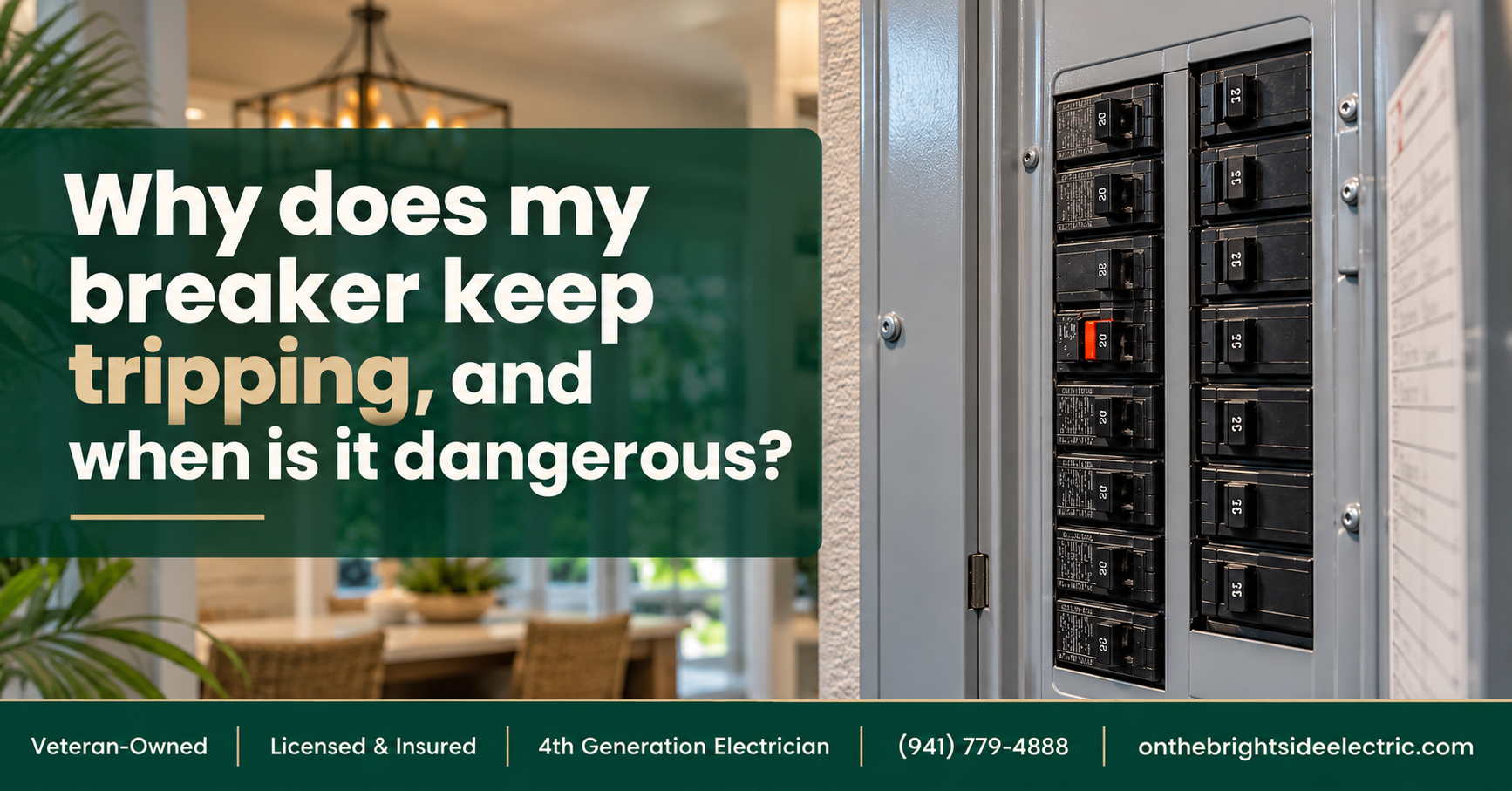
Breakers trip. That is what they are supposed to do — it means the breaker detected more current than the circuit was designed to carry, and it cut power to prevent the wiring from overheating.
Resetting a breaker once after an obvious cause — too many things plugged in, a vacuum cleaner on an overloaded circuit — is routine. The issue is when the same breaker trips repeatedly, or when a breaker trips without an obvious reason.
Repeated tripping is a signal. This guide explains the most common causes in Florida homes, what you can safely investigate yourself, and when the situation calls for a licensed electrician.
How to Reset a Tripped Breaker Safely
Before anything else: resetting a breaker is safe when done correctly.
- Identify the tripped breaker. It will be in the middle position — neither fully on nor fully off — or may have flipped to the off position.
- Turn off or unplug devices on that circuit.
- Push the breaker firmly to the OFF position first.
- Then push it to the ON position.
If it trips again immediately or shortly after resetting, do not keep resetting it. Repeated resets without addressing the underlying cause can damage the breaker or the wiring it protects.
Common Cause 1: Overloaded Circuit
The most common reason a breaker trips is a simple overload — too much electrical demand on a single circuit.
In Florida homes, this happens most often in:
- Kitchens, where multiple high-draw appliances (microwave, toaster oven, coffee maker) share circuits
- Garages, where power tools, refrigerators, and EV chargers compete for limited capacity
- Home offices, where computers, monitors, printers, and space heaters run simultaneously
What to do: Identify what was running when the breaker tripped. Distribute high-draw appliances across different circuits. If your kitchen or garage consistently overloads, a licensed electrician can add dedicated circuits to address the problem permanently.
Common Cause 2: Short Circuit
A short circuit occurs when a hot wire contacts a neutral wire — creating a low-resistance path that allows current to flow far beyond the circuit's rated capacity. The breaker trips immediately and forcefully.
Signs of a short circuit include:
- The breaker trips immediately when you restore power
- A burning smell near the panel or an outlet
- Visible burn marks or discoloration at an outlet or switch plate
A short circuit can occur inside wiring, inside an appliance, or inside an outlet or switch box. Unlike an overload, a short circuit is not something you troubleshoot by redistributing appliances. It requires investigation by a licensed electrician.
What to do: If you suspect a short circuit — especially if there is any sign of burning — do not reset the breaker. Call a licensed electrician.
Common Cause 3: Ground Fault
A ground fault occurs when a hot wire contacts a ground wire or a grounded surface — such as a wet floor, a damp wall, or metal plumbing. Ground faults are particularly common in Florida's humid environment and in areas near water: bathrooms, kitchens, outdoor outlets, pool equipment.
GFCI outlets and breakers are specifically designed to detect ground faults and cut power within milliseconds. If a GFCI outlet in your bathroom is tripping repeatedly, a ground fault in or near that circuit is the likely cause.
What to do: A repeatedly tripping GFCI outlet or breaker in a wet area warrants inspection by a licensed electrician. Ground faults in wet environments are a genuine safety concern — not a nuisance to be reset indefinitely.
Common Cause 4: Worn or Failing Breaker
Breakers are electrical devices with a mechanical lifespan. In Florida's heat and humidity, breakers can wear out faster than in milder climates. An aging breaker may begin to trip at loads well below its rated capacity — or may trip inconsistently under the same conditions.
If a breaker trips repeatedly and you cannot identify an overload, short, or ground fault as the cause, the breaker itself may need replacement.
What to do: Breaker replacement is licensed electrical work. A licensed electrician can test the breaker under load and confirm whether it is the source of the problem.
Common Cause 5: Arc Fault
Arc faults occur when electricity jumps — arcs — between loose, damaged, or deteriorated conductors. Arc faults can occur inside walls, inside appliances, or at connection points in outlets and switches. They generate heat and are a leading cause of residential electrical fires.
AFCI (Arc Fault Circuit Interrupter) breakers are designed to detect arc faults and trip the circuit. If your home has AFCI breakers and one is tripping repeatedly, an arc fault somewhere on that circuit warrants immediate attention.
What to do: Do not ignore a repeatedly tripping AFCI breaker. Contact a licensed electrician.
Florida-Specific Factors That Contribute to Breaker Problems
- Heat: Florida's year-round heat increases the operating temperature of electrical components. High ambient temperatures can cause breakers to trip at lower loads than their rated capacity — a phenomenon called thermal derating.
- Humidity: Moisture infiltration in older panels and wiring can contribute to ground faults and corrosion that affect breaker performance.
- Air conditioning load: Florida AC systems are among the highest electrical loads in a home. A system running in a high-temperature environment draws significant current, and any inefficiency or malfunction can push a circuit toward its limits.
- Aging wiring: Sarasota and Manatee Counties include many homes built in the 1960s through 1980s with wiring and panels that are now 40 to 60 years old. Aging components are more prone to intermittent problems that present as unexplained breaker trips.
When to Call a Licensed Electrician
Call a licensed electrician — do not keep resetting the breaker — when:
- The breaker trips immediately upon reset
- There is any sign of burning smell, burn marks, or discoloration
- The breaker trips in a bathroom, kitchen, outdoor outlet, or near any water source
- The breaker trips without an obvious overload cause
- The same breaker has tripped more than twice under normal use
- The breaker feels warm or hot to the touch
- Lights flicker on the circuit before or after the trip
These are signals that something beyond a simple overload is happening, and continued resets without diagnosis can make the underlying problem worse.
We Can Help You Diagnose It
If a breaker in your Sarasota or Manatee County home keeps tripping and you are not sure why, a licensed electrician can diagnose the cause accurately and give you a clear answer — not a guess.
Schedule an Electrical Service Call →Or call us directly at (941) 779-4888.
Daniel Spears — Master Electrician, 4th-generation electrician, veteran-owned business owner.
EC#13014677 | Licensed & Insured | Serving Sarasota & Manatee County