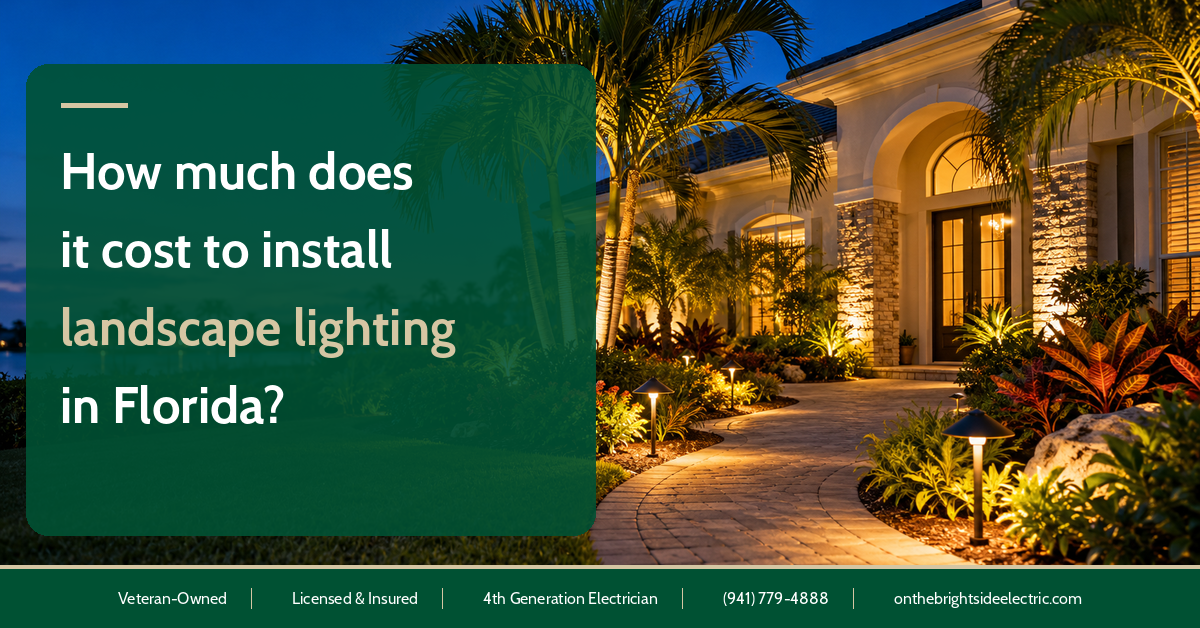
A home that looks warm and welcoming during the day can look just as inviting after sunset. Thoughtful landscape lighting can highlight a front walkway, soften the look of a garden, and make an entry feel calm and cared for.
If you are considering landscape lighting, cost is often the first question. The answer depends on the size of your property, the number and type of fixtures, the electrical work needed, and the overall design. For homeowners in Manatee County and Sarasota County, Florida, coastal moisture and salt air also shape the choices that make sense.
Understanding the main cost drivers can help you plan a project that looks beautiful, performs reliably, and fits your budget.
How much does landscape lighting installation cost in Florida?
For general budgeting, professionally installed residential landscape lighting often falls within the broad ranges below. These are general market ranges, not a quote, and they are not On The Bright Side Electric prices. Actual costs depend on your property, the equipment selected, and the work required.
| Project scope | Typical market range |
|---|---|
| Small pathway or accent lighting project | $800 to $2,000 |
| Complete front-yard landscape lighting | $2,000 to $5,000 |
| Larger front-yard and backyard lighting design | $4,500 to $10,000 |
| Large estate or custom multi-zone installation | $10,000 to $15,000 or more |
These ranges may overlap. A project that needs new electrical work, long wire runs, or specialized fixtures can move toward the higher end of a range, while a compact project with straightforward access can stay toward the lower end.
Small pathway or accent lighting projects
A smaller installation might include several lights along a front walkway, a few accent lights beneath palm trees, or gentle lighting near an entry. These projects generally use fewer fixtures and shorter wiring runs, which makes them a practical starting point for many homeowners.
Even a small project may still need a transformer, suitable outdoor connections, and professional installation. Those elements help the system operate safely and consistently, and they are part of the reason a small project still represents a real investment.
Complete front-yard lighting designs
A complete front-yard design usually combines several lighting techniques. Pathway fixtures can define walking areas, uplights can highlight trees or architectural features, and careful placement can create depth without harsh glare.
The total cost depends on the number of lighting zones, the distance between fixtures, and the quality of the materials selected. For many Florida homes, this level of installation offers a balanced combination of function and visual appeal.
Large properties and custom landscape lighting
Larger homes, waterfront properties, and estate-style landscapes can involve considerably more planning. A comprehensive design might illuminate multiple walkways, trees, outdoor seating areas, garden features, and portions of a backyard.
Longer wiring runs, multiple transformers, specialized fixtures, and integrated controls can increase installation time and cost. For these projects, an individualized design and a detailed estimate are especially important.
What factors affect landscape lighting installation costs?
Two homes with similar front yards can have very different installation costs. The final price depends on more than the number of lights installed.
1. Number and type of fixtures
Fixture quantity is one of the most significant pricing factors. Common options include path lights for walkways and garden borders, uplights for palm trees and architectural details, accent lights for specific landscape features, downlights for softer illumination from elevated locations, and step or hardscape lights for outdoor living areas.
Basic fixtures may cost less than heavy-duty architectural lighting designed for long-term outdoor exposure. The appropriate fixture depends on the intended effect, the installation location, and the durability required.
2. Fixture quality and materials
Landscape lighting fixtures are available in different materials and construction styles. Less expensive products may use lightweight materials, while higher-end fixtures often incorporate more durable housings, finishes, and seals.
For Florida homeowners, selecting fixtures designed for humidity, rain, and the installation environment can be particularly important. A quality fixture may have a higher initial price but can offer better long-term value when properly selected and maintained.
3. Transformer size and electrical infrastructure
Many residential landscape lighting systems use low-voltage equipment. A transformer reduces standard household voltage to the lower voltage required by the landscape lighting system, and it must be appropriately sized for the connected fixtures.
Depending on your existing electrical setup, the project may also require a suitable outdoor power source, additional circuit work, or other electrical improvements. These requirements can affect the overall installation price.
4. Wiring distance and trenching
Landscape lighting usually requires wiring to connect fixtures to their power source. A compact front-yard installation may require relatively short runs, while larger properties can involve considerably more cable and labor.
Additional labor may be needed when wiring must pass beneath or around established landscaping, driveways, patios, or walkways. Professional installation also considers proper burial methods, cable protection, and the requirements applicable to the site. The goal is a reliable installation that preserves the appearance of your outdoor space.
5. Smart controls and automation
Modern landscape lighting can include controls that allow homeowners to manage when and how outdoor lights operate. Options may include timers, photocells, motion activation, dimming, or compatible smart-home controls.
Simple automatic controls may provide everything a homeowner needs, while more advanced multi-zone systems offer greater flexibility. Additional control equipment and installation time can increase the project budget.
Low-voltage vs. line-voltage landscape lighting
Understanding the difference between these two systems helps explain why installation costs vary.
Low-voltage landscape lighting
Low-voltage systems are common for residential pathways, garden beds, trees, and decorative accent lighting. They typically use a transformer to supply fixtures at a lower voltage than standard household circuits, and they offer flexibility in fixture placement.
Low voltage does not mean that every installation is suitable for unlicensed work. Florida has specific licensing requirements for low-voltage landscape lighting, with limited exemptions, so a qualified professional should review the scope before work begins.
Line-voltage outdoor lighting
Line-voltage lighting uses standard household electrical voltage and may be appropriate for certain permanently installed outdoor lighting. Installation requirements can involve additional wiring protection, approved enclosures, appropriate grounding, and related electrical work.
Because of these requirements, line-voltage projects may carry different labor and material costs than low-voltage projects. A qualified electrician can help determine which approach makes sense for your property.
Why Florida's coastal conditions matter
Florida's climate makes outdoor lighting equipment selection especially important. Homes in Palmetto, Bradenton, Lakewood Ranch, Parrish, Longboat Key, Siesta Key, and surrounding communities experience heat, humidity, rain, and, in coastal areas, salt air.
Properties closer to the Gulf and other saltwater environments may face increased corrosion concerns. That does not mean landscape lighting should be avoided near the coast. It means materials, finishes, and connections deserve thoughtful attention during design.
Salt air and corrosion resistance
Salt-laden air can accelerate corrosion on susceptible metals, fasteners, electrical connections, and fixture components. For coastal properties, homeowners should discuss corrosion-resistant materials and equipment suitable for the actual exposure.
The lowest-priced fixture may not always be the most appropriate choice for a waterfront installation. A slightly higher investment in suitable materials can support a cleaner appearance and more dependable operation over time.
Rain, moisture, and irrigation
Florida landscapes regularly encounter rain, irrigation systems, and damp soil. Outdoor lighting equipment should be rated and installed for its intended environment, with suitable connectors and thoughtful wiring placement.
Areas subject to standing water or irrigation spray may require particular attention during design. Proper placement and protection help support reliable operation and reduce the need for early repairs.
Landscaping and future maintenance
Florida vegetation can grow quickly, potentially changing how lighting interacts with trees, shrubs, and garden beds. An effective design accounts for mature plant size, maintenance access, and future landscaping changes.
This helps prevent fixtures from becoming obstructed or difficult to service. It also helps the lighting continue to look intentional as the landscape matures.
Does landscape lighting require a permit in Florida?
Permit requirements depend on the type of installation and the rules enforced by the local building authority. Some projects involving new electrical circuits, changes to existing wiring, or permanently installed line-voltage lighting may require permitting or inspection.
The requirements for a low-voltage installation can differ depending on the equipment and the work involved. Homeowners in Manatee County and Sarasota County should have the applicable requirements confirmed before installation begins.
A professional estimate should identify whether permitting or inspection is expected and who will be responsible for that process. Homeowners should also verify any applicable homeowners association restrictions or exterior lighting guidelines.
How can you get the best value from your landscape lighting budget?
A successful lighting design does not necessarily require illuminating every tree, plant, or exterior wall. In many cases, a more selective approach creates a more refined result.
Prioritize the areas you use most
Start with the locations where lighting will make the greatest difference. For example, you might prioritize your front walkway, entry landscaping, driveway approach, or outdoor seating area. Identifying these areas early helps establish a practical starting scope.
Choose lighting effects before choosing fixtures
Rather than focusing only on fixture quantity, consider what you want the lighting to accomplish. Would you like to emphasize a large palm tree, softly illuminate a pathway, or highlight architectural details? The desired effect can guide fixture placement and equipment selection.
Consider future expansion
If your budget does not allow for a complete property-wide installation, ask whether the initial system can accommodate future additions. Transformer capacity, cable routing, and control options can all influence expansion possibilities. Planning ahead may help avoid unnecessary replacement or rework later.
Coordinate indoor and outdoor improvements
Landscape lighting can also complement improvements to your home's interior lighting. If you are considering lighting upgrades throughout your property, you may also want to explore How much does recessed lighting cost to install in a Florida home? to better understand your indoor lighting options. A coordinated plan can help create a consistent lighting atmosphere from the entryway to your outdoor living spaces.
What should a professional landscape lighting estimate include?
A detailed estimate helps homeowners understand both the installation cost and the proposed work. Before approving a project, ask whether the estimate identifies the proposed lighting areas and overall scope, fixture types and quantities, transformer requirements, wiring and trenching labor, lighting controls, permit and inspection responsibilities when applicable, any exclusions or allowances, and warranty and maintenance guidance.
It is also helpful to discuss how the lighting will appear after dark. Fixture positioning, beam direction, brightness, and glare control all influence the final appearance. For coastal Florida homes, ask how the proposed materials and connections are suited to the environment. A thoughtful estimate should help you understand what is being installed and why those choices make sense for your property.
Protecting your outdoor lighting investment
Landscape lighting is an extension of your home's electrical system, so electrical protection and maintenance deserve attention. Outdoor transformers, timers, and electronic controls can be affected by weather exposure and electrical disturbances.
Appropriate equipment selection, proper installation, and periodic inspections help support dependable operation. Because Florida homes frequently experience thunderstorms, it is also worth understanding Do whole-home surge protectors wear out? and how surge protection fits into your home's electrical maintenance plan. Surge protection can reduce certain electrical risks, but no device guarantees protection against every surge or lightning event.
Homeowners should also periodically check outdoor fixtures for visible damage, corrosion, loose components, or changes in performance. Electrical repairs and wiring concerns should be evaluated by a qualified professional.
Frequently asked questions about landscape lighting installation
1. What is the average cost to install landscape lighting in Florida?
General market estimates commonly place residential landscape lighting projects around $2,000 to $6,000, although smaller projects can cost less and larger or custom projects can cost more. These are general ranges, not a quote, and the final price depends on scope, fixtures, wiring, and electrical work.
2. Is low-voltage landscape lighting cheaper to install?
Low-voltage lighting can be a cost-effective option for many residential projects. However, the total price still depends on fixture quality, transformer sizing, wiring distance, controls, and any electrical improvements needed.
3. How long does professional landscape lighting installation take?
Smaller projects may be completed relatively quickly, while larger designs can require additional time for planning, trenching, wiring, fixture placement, and final adjustment after dark. Your installer can outline a realistic timeline after reviewing the property.
4. Can landscape lighting be added to an existing system?
Often, yes. Expansion depends on the existing transformer's capacity, wiring condition, available controls, and equipment compatibility. A professional review can confirm whether the current system can support additional fixtures.
5. What type of landscape lighting is best for coastal Florida homes?
Outdoor-rated fixtures with suitable corrosion resistance, durable construction, and appropriate moisture protection are generally a good starting point. The best choice depends on exposure, placement, and the specific landscape conditions at your home.
6. Does landscape lighting increase electricity costs?
Landscape lighting uses electricity, but the operating cost varies with fixture wattage, quantity, and operating hours. Low-voltage fixtures and automatic controls can help manage use, and your installer can discuss options that fit your preferences.
Ready to illuminate your Florida home?
Landscape lighting is about more than installing outdoor fixtures. A thoughtful design can improve the atmosphere of your home, highlight the features you enjoy most, and make outdoor spaces more usable in the evening.
Whether you are considering a few pathway lights or a complete landscape lighting design, professional guidance helps you compare options and plan with confidence. On The Bright Side Electric is a fourth-generation veteran-owned family company in Palmetto, FL, serving homeowners across Manatee and Sarasota County.
Beautifully designed landscape lighting can transform your Florida home's outdoor spaces, and a professional estimate can help you plan with confidence. Comment QUOTE on our Facebook or Instagram post, or call/text (941) 779-4888 for a free estimate on landscape lighting installation.