October 25, 2026 | On The Bright Side Electric
Yes, whole-home surge protectors wear out. They are designed to protect your home's electrical system from sudden voltage spikes, but the internal components that handle those surges do not last forever. Over time, repeated surges can reduce a device's protective capacity. One particularly powerful surge may even cause it to stop protecting your home.
For homeowners in Palmetto, Bradenton, Sarasota, and surrounding communities, this is worth understanding. Florida's frequent thunderstorms, lightning activity, and storm-related power interruptions make surge protection an important consideration for local homes.
The tricky part? A whole-home surge protector can lose its protective ability without showing obvious signs of damage. Your lights may work normally, your appliances may keep running, and you might never realize your surge protector needs attention.
Knowing how these devices wear out, what their indicator lights mean, and when to have them checked can help you avoid relying on protection that is no longer working as intended.
How does a whole-home surge protector wear out?
Think of a whole-home surge protector as a device that takes electrical stress so your home's equipment doesn't have to.
Many residential surge protective devices contain components called metal oxide varistors, or MOVs. During normal electrical conditions, these components remain largely inactive. When a sudden voltage spike occurs, they respond by limiting the excess voltage and diverting surge current away from the circuits and equipment they are protecting.
That protective action puts stress on the device.
Small surges can gradually degrade its internal components. Larger surges can cause more substantial damage, sometimes exhausting a device's protective capacity in a single event.
This is why surge protection is often described as sacrificial protection.
The device is designed to take the electrical punishment that might otherwise reach sensitive appliances and electronics. However, every significant surge adds to the wear its components experience.
Not every surge causes the same amount of wear. A small, brief voltage spike places different demands on the protector than a powerful surge associated with nearby lightning.
Over time, a surge protector may reach a point where its internal components can no longer provide the intended level of protection.
Depending on its design, the device may disconnect its worn protective components and display a warning or indicate that protection has been lost.
The important distinction is that a whole-home surge protector doesn't necessarily stop working simply because it has been installed for a long time. Its condition depends on the electrical stress it has experienced.
How long does a whole-home surge protector last?
There is no single guaranteed lifespan for every whole-home surge protector.
Some devices may operate for many years under relatively mild electrical conditions. Others may need replacement much sooner after repeated surges or one unusually severe electrical event.
Even manufacturers recognize this uncertainty. Schneider Electric's guidance on surge protector life expectancy explains that real-world surge exposure is unpredictable, making it difficult to assign a universal lifespan.
Several factors influence how long a whole-home surge protector remains effective.
1. The number and severity of electrical surges
Repeated smaller surges can gradually wear down protective components.
A major surge may consume a substantial amount of the device's remaining protective capacity at once.
A homeowner who has experienced several significant electrical events may have a different replacement timeline than someone whose electrical system has experienced relatively little surge activity.
2. The surge protector's design and capacity
Whole-home surge protectors are not identical.
They vary in their internal construction, surge-handling capabilities, monitoring features, and manufacturer instructions. A device's ability to withstand repeated electrical events depends partly on how it was designed and the conditions it encounters.
This is why an electrician should consider the specific device rather than recommend replacement based only on its age.
3. Installation and electrical conditions
Proper installation affects how effectively a surge protector performs.
The condition of the electrical system, grounding and bonding, connections, and the way the device is installed can influence its performance.
A protector that appears to be failing may also have a power supply or connection issue that requires investigation.
4. Local storm and power conditions
In Manatee and Sarasota Counties, thunderstorms are a regular part of life.
Nearby lightning activity, utility switching, and electrical disturbances associated with outages or power restoration can expose a home's surge protector to additional stress.
That doesn't mean every storm damages the device. It means local homeowners have good reason to pay attention to its condition, especially after a significant electrical event.
What do the indicator lights on a whole-home surge protector mean?
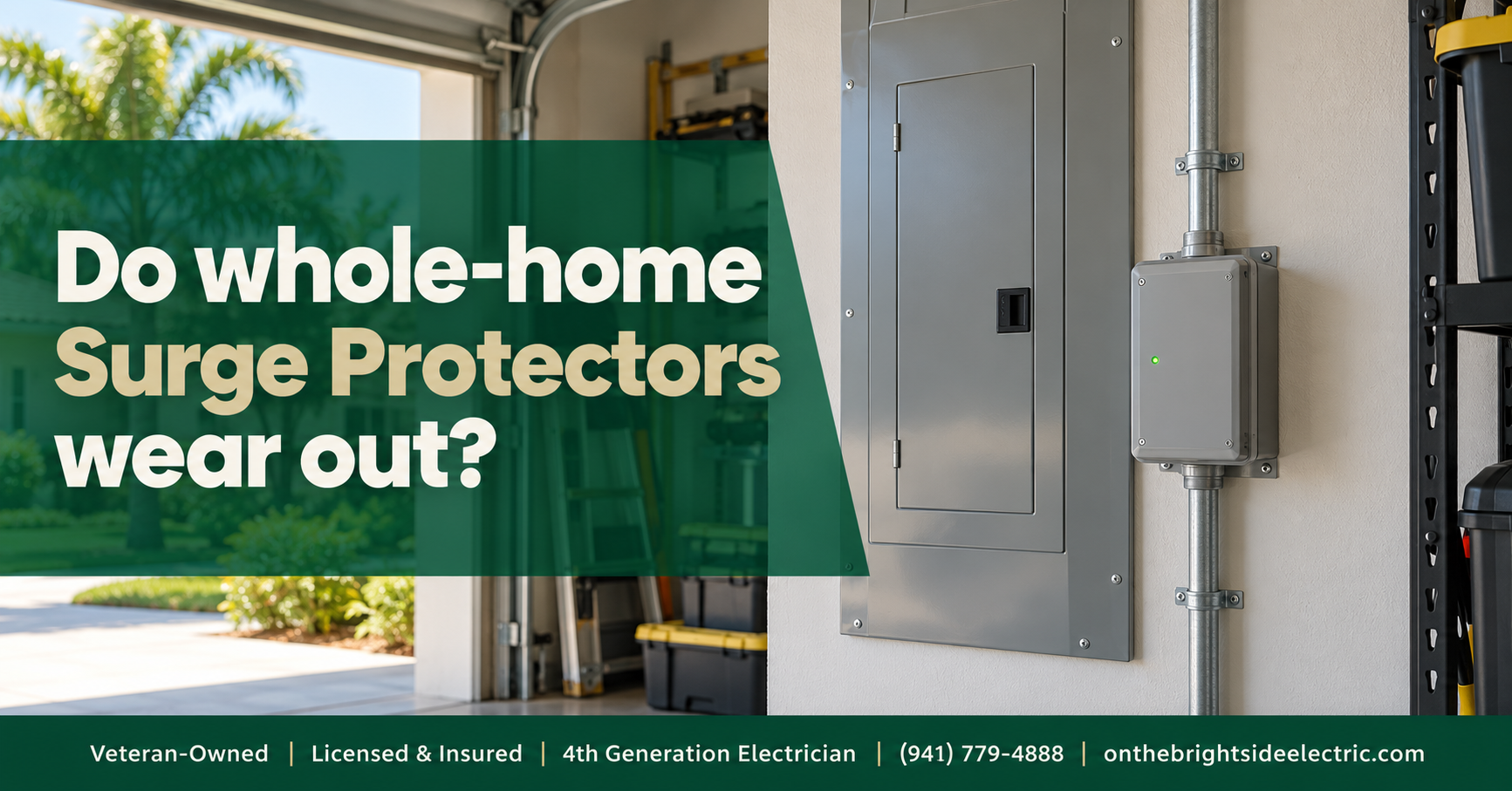
One of the easiest ways to monitor many whole-home surge protectors is by checking their status indicator lights.
Depending on the model, these lights may be visible on a device mounted near your electrical panel or on a surge protective device incorporated into the panel itself.
The indicators provide a quick way to recognize whether the device is reporting normal operation or a possible problem.
However, indicator colors and meanings vary by manufacturer and model.
Green light: Usually indicates normal protection status
On many devices, an illuminated green light means the surge protector's monitoring system indicates that its protective components are functioning.
This is generally a good sign.
However, a green indicator does not necessarily tell you how much remaining surge capacity the device has.
Think of it as a status check, not a battery-style gauge showing exactly how much protective life remains.
Red light or warning indicator: A problem may need attention
Some models use a red light, a warning symbol, or an audible alarm to signal that protection has been reduced or lost.
A warning may indicate that internal protective components have reached the end of their service life.
Other models use different colors or indicators.
If a warning appears, consult the device's instructions and contact a licensed electrician rather than assuming the unit is still providing protection.
Indicator light off: Don't automatically assume everything is fine
On some surge protectors, an indicator that was previously illuminated may turn off when protection has been lost.
However, a dark indicator can also result from a power supply issue, a tripped breaker, or another electrical problem.
For example, Schneider Electric's guidance for one residential surge protector model identifies an illuminated status light as normal operation and an unlit indicator as a reason to check the protective function, breakers, and connections.
If a previously illuminated protection-status light goes out, have the device evaluated.
Important: Don't confuse a power indicator with a protection-status indicator. A light showing that a device has power does not necessarily confirm that its surge protection is still functioning.
What are the signs that a whole-home surge protector may need replacement?
Surge protectors often wear out quietly. You may not hear anything, notice anything unusual, or experience an obvious change in your home's electrical service.
Still, several warning signs deserve attention.
1. The protection-status indicator has changed.
A light that was previously green is now off, a warning light has appeared, or the unit reports a fault.
This is one of the most useful signs that your protector needs professional evaluation.
2. The device displays a replacement or end-of-life warning.
Some models are designed to notify homeowners when their protective components are no longer functioning as intended.
Follow the manufacturer's instructions and arrange for an electrician to inspect the unit.
3. There is visible physical damage.
Discoloration, melting, cracking, or other visible damage can indicate a serious problem.
If you notice smoke, unusual heat, or a burning smell near your electrical panel or surge protector, keep your distance and seek immediate professional assistance. Do not open or touch the equipment.
4. Your home recently experienced a major surge event.
A nearby lightning strike, a significant electrical disturbance, or a storm-related event that damaged appliances may justify an inspection even when the surge protector appears normal.
5. You don't know how old the device is or whether it has ever been checked.
An unknown installation date does not automatically mean the protector has failed.
However, if you've moved into an older home or inherited a surge protector with no documentation, having an electrician identify and evaluate it is a sensible precaution.
Should you check your surge protector after a nearby lightning strike?
Yes. A major electrical event is a good reason to check your whole-home surge protector.
This is particularly relevant for homeowners in coastal and inland communities throughout Manatee and Sarasota Counties, where strong thunderstorms can bring frequent lightning activity.
A nearby lightning strike can create a significant electrical surge even when lightning does not directly hit your home.
Your surge protector may successfully handle the event, but doing so can place considerable stress on its internal components.
In some situations, the device may continue operating normally. In others, its protection may be reduced or exhausted.
What about after a storm-related power outage?
A power outage by itself does not mean your surge protector has been damaged.
However, electrical disturbances around a storm, utility switching, or restoration of power may involve voltage spikes that place additional stress on surge protection equipment.
After a significant storm or outage, homeowners can take a few practical precautions:
- Look for obvious electrical problems. If you notice smoke, burning odors, damaged equipment, or other signs of an electrical hazard, do not approach or handle the affected equipment.
- Check the indicator if it is safely visible. Read the status light from a normal, accessible position without opening the electrical panel or removing any covers.
- Pay attention to changes. Note whether the protection indicator looks different than it did before the storm.
- Arrange an inspection when warranted. If you suspect a major surge, notice damaged electronics or appliances, or see an indicator warning, contact a licensed electrician.
A normal-looking status light is reassuring, but it cannot guarantee that a device has suffered no wear or that it will withstand the next major surge.
If lightning directly strikes your home or you suspect electrical-system damage, professional inspection is especially important.
Can a whole-home surge protector still work after absorbing a major surge?
Yes, it can.
Surge protectors are designed to handle electrical surges, and experiencing one does not automatically mean the device must be replaced.
What matters is the severity of the event and the condition of the protective components afterward.
A properly functioning device may withstand many electrical disturbances while continuing to provide protection.
On the other hand, a powerful event can cause an internal protective component to fail or disconnect.
The difficulty is that homeowners generally cannot determine the remaining protective capacity just by looking at the unit.
Some devices provide useful operating or fault indicators, but most do not display a precise measurement of remaining life.
That is why checking the device after a major event is more useful than guessing whether it survived based on whether your appliances still work.
How can you tell when replacement is actually necessary?
Replacement is typically determined by the device's condition, manufacturer instructions, and findings from an electrical inspection.
An electrician may recommend replacement when:
- The device indicates that protection has been lost or its internal components have failed.
- The manufacturer specifies replacement for the condition or fault being reported.
- The unit has suffered electrical or physical damage.
- A major surge event has occurred and evaluation indicates that the device is no longer serviceable.
- The device is defective, unsuitable for continued use, or cannot be confirmed to operate as intended.
Age can also be part of the discussion, especially when the device's history is unknown or the manufacturer provides specific maintenance or replacement guidance.
However, there is an important difference between replacing something simply because it is old and replacing it because it is no longer providing reliable protection.
A whole-home surge protector should not be assumed effective forever, but it also should not be assigned an arbitrary expiration date.
Can you replace a whole-home surge protector yourself?
A whole-home surge protector is typically connected at or near your main electrical panel.
Unlike a plug-in surge protector, replacement can involve electrical wiring, breakers, and equipment that may contain dangerous voltage.
For that reason, installation, troubleshooting, and replacement should be handled by a licensed electrician.
Homeowners can safely perform a basic visual check when the indicator is accessible without touching or opening electrical equipment.
Do not remove panel covers, disconnect wiring, or attempt to reset or repair internal surge protection components yourself.
Even switching off a main breaker may not remove voltage from every part of an electrical panel.
A licensed electrician can identify the device, check the manufacturer's status information, evaluate relevant electrical conditions, and determine whether replacement is appropriate.
How often should homeowners check their whole-home surge protector?
Checking your surge protector's visible status indicator periodically is a simple habit worth developing.
You do not need to inspect its internal components or perform electrical testing.
Instead, consider these practical steps:
- Check the visible status indicator periodically, following the manufacturer's recommendations.
- Check again after a major thunderstorm, nearby lightning event, or significant electrical disturbance when it is safe to do so.
- Keep a record of the installation date and model information if available.
- Ask your electrician to evaluate the device during electrical panel service or when you have concerns about its condition.
If the unit is installed in a location that is difficult or unsafe to access, leave the inspection to an electrician.
A quick visual check can help identify an obvious warning, while professional evaluation can address questions that a status light alone cannot answer.
Frequently asked questions
Do whole-home surge protectors eventually stop protecting?
Yes. Their internal protective components can degrade from repeated electrical surges or fail after a major event, Some devices indicate when protection has been lost, but that failure may not cause an obvious interruption to household power.
Does a green light mean my surge protector is still good?
On many models, green indicates normal protection status. However, the meaning depends on the device, and a green light does not tell you exactly how much protective capacity remains, Refer to the manufacturer's instructions.
Should I replace my surge protector after every lightning storm?
No. A thunderstorm does not automatically mean the device has failed. After a major nearby lightning event, check the visible status indicator when safe and arrange professional evaluation if there are warning signs, suspected surge damage, or other electrical concerns.
Can a surge protector wear out even if nothing in my home was damaged?
Yes. A surge protector may absorb or divert electrical surge energy without any noticeable damage to your appliances. The absence of appliance damage does not mean the device has experienced no wear.
Will my electricity stop working if my whole-home surge protector fails?
Not necessarily. Depending on the device's design and failure mode, your home's electrical system may continue supplying power even after the surge protector loses its protective function, Normal household power does not confirm that surge protection is active.
Is there a way to test how much life is left in my surge protector?
Most residential whole-home surge protectors do not provide homeowners with an exact remaining-life measurement. Their status indicators can identify certain operating or failure conditions, while an electrician can check installation and electrical conditions. The device's remaining ability to withstand future surges may not be precisely measurable in the field.
Keep your home's surge protection ready for the next storm
Whole-home surge protection is easy to forget about because, when everything is working normally, there is often nothing to see or hear.
But the protective components inside these devices can wear down as they handle electrical surges.
For homeowners in Palmetto, Bradenton, Sarasota, and throughout Manatee and Sarasota Counties, knowing what to look for is a practical part of maintaining your home's electrical system.
Check your device's status indicator, pay attention after significant electrical events, and don't assume an older surge protector is still effective simply because your electricity works.
Not sure whether your whole-home surge protector is still protecting your home?
On The Bright Side Electric can help you evaluate your existing surge protection and determine whether replacement makes sense for your home's electrical system.
Request a free estimate from On The Bright Side Electric, your local residential electrician serving Manatee and Sarasota Counties.
Call (941) 779-4888 or visit www.onthebrightsideelectric.com.
On The Bright Side Electric. Where You Never Get Left In The Dark.