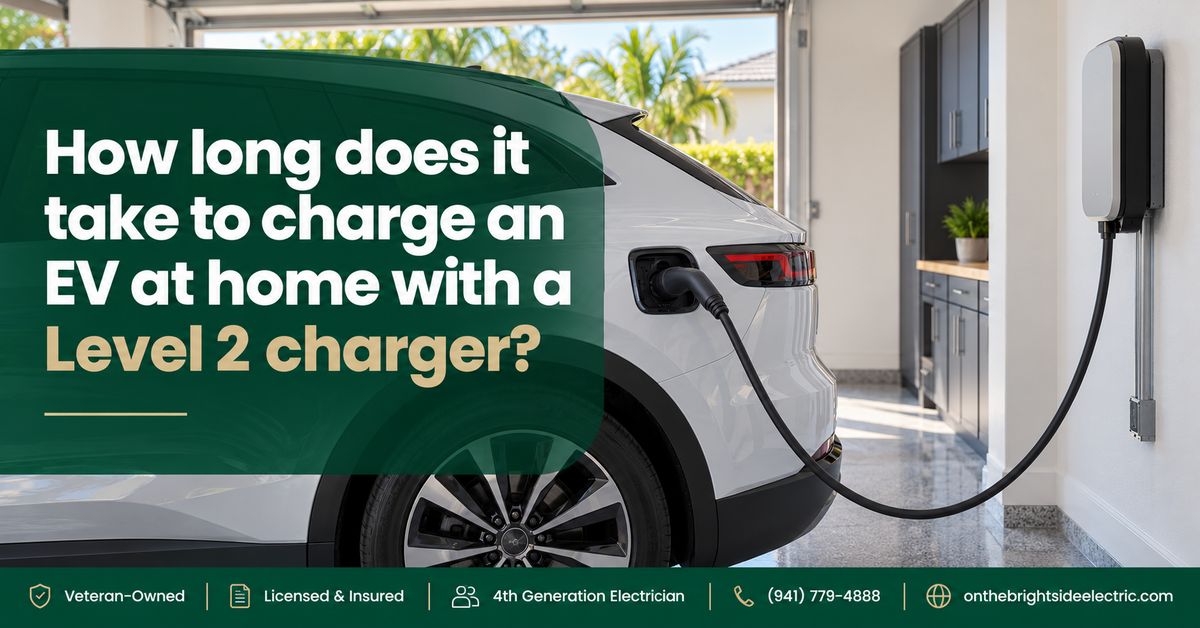
One of the most common questions homeowners have about electric vehicles is simple: How long will my EV take to charge at home?
The answer depends on your vehicle, how much battery power you've used, and how quickly your home charging equipment can deliver electricity.
For many EV owners in Palmetto, Bradenton, Sarasota, and surrounding communities, a Level 2 home charger makes overnight charging practical. Instead of waiting for a nearly empty battery to recharge, you can plug in after your daily commute and start the next morning with the charge you need.
But not every Level 2 charger delivers the same charging speed, and not every electric vehicle can accept the same amount of power.
The good news? You don't need to be an electrical expert to estimate your charging time.
With a few numbers and some simple math, you can calculate approximately how long your EV needs to stay plugged in.
The short answer: How many hours does Level 2 charging take?
A Level 2 home charger can often recharge an electric vehicle overnight, but the actual time can vary significantly.
A relatively small daily recharge might take just two or three hours. Recharging a much larger portion of the battery could require eight hours or longer, depending on your vehicle and charging equipment.
The most important thing to understand is that you usually aren't charging an empty battery.
Most EV owners simply replace the electricity they used throughout the day.
For example, a homeowner who drives from Palmetto to Sarasota and back may arrive home with plenty of battery capacity remaining. Their charging session will likely be much shorter than the time required to recharge a completely depleted battery.
Three factors determine your estimated charging time:
- How much energy your battery needs: Measured in kilowatt-hours (kWh).
- How much power your home charger can deliver: Measured in kilowatts (kW).
- How much charging power your vehicle can accept: Limited by its onboard charging system.
Once you know these numbers, estimating charging time becomes much easier.
Step 1: Figure out how much battery energy you need to replace
Your electric vehicle's battery stores energy, measured in kilowatt-hours, commonly abbreviated as kWh.
Think of kilowatt-hours as the amount of electricity stored in your battery.
A larger battery generally holds more energy, but that doesn't automatically mean every charging session will take longer. What matters is how much energy you need to add.
Start by finding three numbers:
- Your vehicle's usable battery capacity in kWh.
- Your current battery percentage.
- Your desired battery percentage.
Your battery percentage is called its state of charge, or SOC.
You can usually find this information on your vehicle's dashboard, touchscreen, or mobile app. Your owner's manual may also list the battery's usable capacity.
Example: Charging from 40% to 80%
Imagine you own an EV with a usable battery capacity of 75 kWh.
You arrive home with 40% remaining and want to charge to 80%.
First, calculate how much of the battery you need to refill.
80% minus 40% equals 40%.
Next, multiply your usable battery capacity by that percentage.
75 kWh times 0.40 equals 30 kWh.
You need to replace approximately 30 kWh of battery energy.
That's the number you'll use to estimate charging time.
Notice that you're not trying to replace all 75 kWh. You're only adding the energy needed to reach your desired charging level.
This distinction makes a big difference when planning overnight charging.
Step 2: Find your Level 2 charger's actual power output
Your next step is determining how quickly your charging equipment can supply electricity.
Charging power is measured in kilowatts, or kW.
A higher kW output generally means faster charging, provided your vehicle can accept that power.
Your Level 2 charger may have an amperage rating or configured charging-current setting listed in its documentation or companion app.
For a typical residential 240-volt charging setup, you can estimate power using this formula:
Volts times Amps divided by 1,000 equals Kilowatts
Here are several illustrative examples.
| Charging current | Approximate power at 240V |
|---|---|
| 16 amps | 3.84 kW |
| 24 amps | 5.76 kW |
| 32 amps | 7.68 kW |
| 40 amps | 9.6 kW |
| 48 amps | 11.52 kW |
These are mathematical examples of electrical power, not promises of actual charging performance.
The charging-current setting must also be appropriate for the electrical circuit supplying the equipment.
EV charging is generally treated as a continuous electrical load. That means the allowable charging current is commonly limited to 80% of the circuit's rating under applicable electrical requirements.
For example, a properly configured 50-amp circuit may support charging at 40 amps.
However, a 50-amp circuit does not mean the vehicle should charge at 50 amps.
Never increase a charger's amperage setting simply to shorten charging time without confirming that the electrical circuit, wiring, equipment, and configuration safely support it.
If you're unsure about your charger's current setting, a qualified electrician can help verify the equipment's operating limits. For a broader look at the work involved, see our home EV charger installation page.
Step 3: Check your vehicle's onboard charging limit
Here's something that surprises many first-time EV owners.
Even if your home charger can deliver 11.5 kW, your vehicle might not be able to accept that much power.
That's because your EV has an onboard charger that converts the alternating-current electricity supplied by your home into the direct-current electricity stored in its battery.
The onboard charger has its own maximum charging rate.
For example, imagine your home charging equipment can deliver 11.5 kW, but your vehicle's onboard charger accepts only 7.2 kW.
Your actual charging power will be limited to approximately 7.2 kW or less.
Installing a higher-output charging unit does not override the vehicle's built-in charging limitations.
You can usually find your EV's maximum AC charging rate in the owner's manual or manufacturer specifications.
When estimating charging time, use the lower of your available home charging power and your vehicle's onboard charging limit.
That's the most useful number for your calculation.
Step 4: Calculate your estimated charging time
Now you have the two numbers you need:
- The amount of energy you want to replace, in kWh.
- Your available charging power, in kW.
Use this formula:
Estimated charging time (hours) equals Energy needed (kWh) divided by Charging power (kW)
Let's return to our earlier example.
Your EV needs 30 kWh to charge from 40% to 80%.
Your effective charging power is 7.2 kW.
30 divided by 7.2 equals 4.17 hours.
That's approximately 4 hours and 10 minutes of idealized charging time.
Real charging may take somewhat longer because some electricity is lost during charging, and vehicles don't always maintain the same charging rate throughout the session.
Still, this calculation gives you a useful starting estimate.
Compare different charging speeds
Using the same illustrative 30 kWh recharge, here's how the arithmetic changes.
| Effective charging power | Ideal charging time |
|---|---|
| 3.84 kW | 7 hr 49 min |
| 5.76 kW | 5 hr 13 min |
| 7.2 kW | 4 hr 10 min |
| 9.6 kW | 3 hr 8 min |
| 11.52 kW | 2 hr 36 min |
These calculations assume constant charging power and exclude charging losses or other delays.
Your actual results will depend on your vehicle and charging conditions.
Try it yourself: Estimate your overnight charging time
Use the interactive calculator below to estimate your EV charging time.
Enter your vehicle's usable battery capacity, current battery percentage, target battery percentage, and effective Level 2 charging power.
The calculator will estimate how much energy you need to replace and approximately how long charging would take at a constant power level.
Remember that the result is a planning estimate, not a guaranteed charging completion time.
Why charging can slow down as your battery gets full
The formula above assumes your EV maintains a consistent charging rate.
In practice, charging doesn't always work that way.
Your vehicle's battery management system controls charging to help protect the battery and manage temperature.
As the battery approaches a full charge, the vehicle may reduce the charging rate. The exact behavior varies by vehicle, battery condition, and charging equipment.
This is one reason charging from 80% to 100% may take longer than simple arithmetic suggests.
The slowdown is generally much more noticeable with DC fast charging, but it can also affect home charging.
For everyday use, many vehicle manufacturers recommend charging to a particular percentage rather than charging to 100% every day. However, recommendations differ by battery chemistry and vehicle.
Always follow your vehicle manufacturer's guidance when setting your daily charging target.
Full battery charging versus your normal daily commute
One of the biggest misconceptions about EV charging is that owners must recharge the entire battery every night.
That's usually unnecessary.
Imagine two different situations involving the same vehicle.
Scenario A: A nearly empty battery
You return from an extended trip with 10% battery remaining and want to charge to 90%.
If your EV has a usable 75 kWh battery:
75 times 0.80 equals 60 kWh.
At an effective charging rate of 7.2 kW:
60 divided by 7.2 equals approximately 8 hours and 20 minutes.
That's the idealized charging time before accounting for charging losses and possible charging slowdowns.
Scenario B: Your regular commute
Now imagine you return home after work with 60% battery remaining and want to recharge to 80%.
75 times 0.20 equals 15 kWh.
15 divided by 7.2 equals approximately 2 hours and 5 minutes.
Same vehicle. Same charging equipment. Very different charging time.
These are illustrative examples, not typical commuting statistics or guaranteed charging results.
For homeowners who drive predictable routes around Manatee and Sarasota Counties, daily charging needs may be considerably smaller than the vehicle's full battery capacity.
Overnight EV charging tips for Manatee and Sarasota County commuters
If you're commuting between Palmetto, Bradenton, Sarasota, Lakewood Ranch, or surrounding areas, a consistent overnight charging routine can simplify your mornings.
Here are a few practical habits.
1. Check your battery percentage when you arrive home.
Rather than guessing, look at your remaining charge after your commute. This helps you understand how much electricity your regular driving uses.
2. Set a realistic daily charging target.
Follow your vehicle manufacturer's battery recommendations. You may not need a full battery for your next day's driving.
3. Plan around your departure time.
If your calculations suggest three hours of charging and you'll be parked overnight for nine hours, you have a comfortable planning window.
Remember to allow extra time for charging losses and any scheduled charging delays.
4. Use your vehicle's charging schedule when available.
Many EVs let you choose when charging begins or when the vehicle should be ready. This can make overnight charging more convenient without requiring you to manually start and stop each session.
5. Consider Florida's warm weather.
Battery temperature affects charging behavior. During hot weather, your EV may use energy to cool its battery or reduce charging power when necessary.
A shaded or covered parking space may help with heat exposure, but always follow the vehicle and charging-equipment manufacturer's instructions.
6. Keep charging equipment in good condition.
Before connecting your vehicle, check the charging cable and connector for visible damage, overheating, or unusual wear.
Never use damaged charging equipment. If you notice repeated charging interruptions, a burning smell, unusual heat, or electrical problems, stop using the equipment and have it evaluated by a qualified electrician.
What if your EV takes longer to charge than expected?
If your charging time is consistently longer than your estimate, that doesn't automatically mean something is wrong.
Several factors may explain the difference.
Your vehicle may have a lower onboard charging limit than you assumed.
Your charging equipment may also be configured to deliver less current than its maximum advertised capability.
Some vehicles allow the charging current to be reduced through dashboard or app settings.
Battery temperature, charging losses, and changes in charging speed can also affect the time.
Check your vehicle's displayed charging power, if available, and compare it with the specifications for your equipment.
If the charging speed suddenly drops, charging repeatedly stops, or your electrical equipment shows warning signs, don't try to correct the problem by increasing amperage settings or modifying electrical components.
A qualified electrician can evaluate the electrical equipment, while vehicle-specific charging faults may require assistance from the vehicle manufacturer or service provider.
Frequently asked questions about Level 2 home charging time
Can a Level 2 charger fully charge an EV overnight?
Often, yes. However, it depends on your battery capacity, starting charge, charging power, and vehicle limitations. A large recharge at a lower charging rate may take longer than one night.
How long does it take to charge an EV from 20% to 80%?
As an example, a vehicle with a usable 75 kWh battery needs approximately 45 kWh to move from 20% to 80%. At an effective 7.2 kW charging rate, the ideal calculation is 45 divided by 7.2, or approximately 6 hours and 15 minutes. Actual charging may take longer.
Does a higher-amp Level 2 charger always charge faster?
No. Higher current can provide more charging power, but only when the circuit and equipment safely support it and the vehicle's onboard charger can accept it.
Should I charge my electric vehicle to 100% every night?
Not necessarily. Daily charging recommendations vary by manufacturer and battery chemistry. Follow your vehicle's guidance for its recommended charging limit.
Can I leave my EV plugged in overnight?
Generally, yes, when using properly configured, compatible charging equipment in good condition and following the manufacturer's instructions. Modern EVs manage their own charging and normally stop charging the battery when the selected target is reached.
Make overnight EV charging work for your routine
Charging your electric vehicle at home doesn't have to involve guesswork.
Once you understand your battery capacity, the percentage you need to replace, and your available charging power, you can make a reasonable estimate of how long each charging session should take.
For most day-to-day planning, the key isn't how quickly you can charge from empty to full. It's whether your home charging setup can comfortably replace the energy you use before your next trip.
And for many homeowners throughout Palmetto, Bradenton, Sarasota, and the surrounding Manatee and Sarasota County communities, that's what makes overnight charging so convenient.
If you have questions about whether your home's electrical system can safely support your EV charging needs, On The Bright Side Electric is here to help. For a related read, see our guide to hardwired vs. plug-in Level 2 EV chargers and our breakdown of what a home EV charger installation costs in Florida.
Our residential electrical team serves homeowners throughout Manatee and Sarasota Counties with practical guidance and professional electrical services.
Ready to make home EV charging easier?
Request a free estimate from On The Bright Side Electric or call (941) 779-4888 to discuss your home's EV charging needs.
Make Home EV Charging Easier
Have questions about your home's electrical system and EV charging needs? On The Bright Side Electric helps homeowners throughout Manatee and Sarasota Counties with safe, practical residential electrical solutions.
On The Bright Side Electric | Where You Never Get Left In The Dark.