If a home inspector has told you that your electrical panel has a double-tapped breaker, you might be unsure what that means. The phrase sounds technical, and the report may not explain whether the condition is simple, serious, or somewhere in between.
The good news is that a double-tapped breaker does not automatically mean your entire electrical panel must be replaced. However, the right solution depends on how the breaker is designed, how the wiring is connected, and what your panel can safely accommodate.
For homeowners in Manatee County and Sarasota County, Florida, double-tapped breakers are a concern worth understanding calmly and clearly. Here is what you should know before scheduling a repair.
What is a double-tapped breaker?
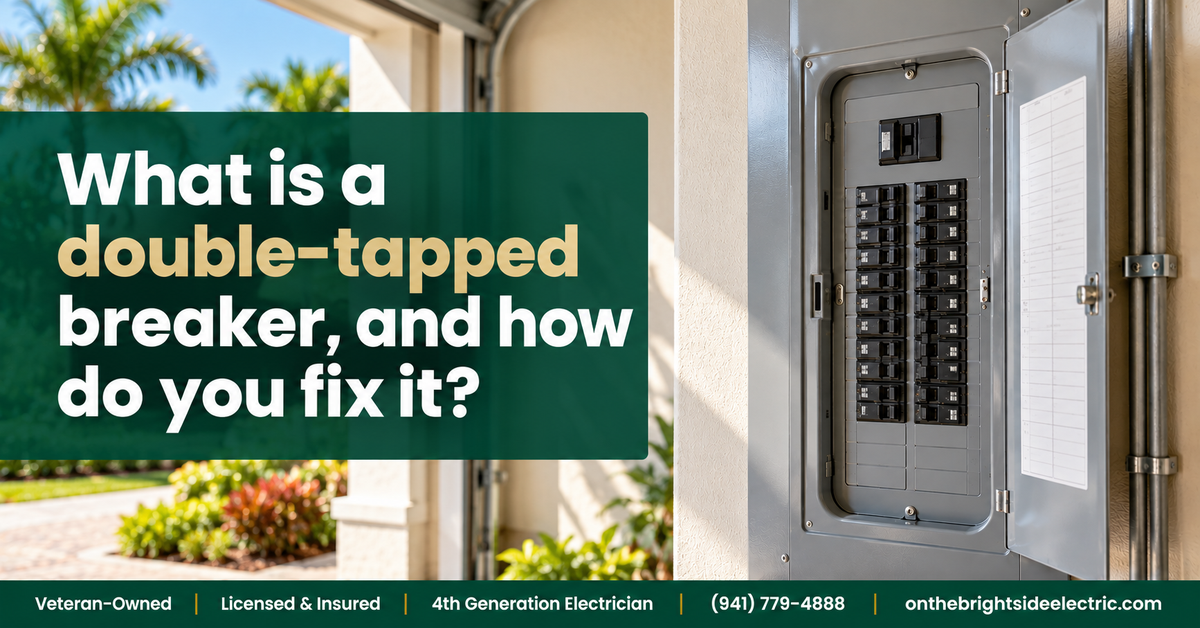
A double-tapped breaker is a circuit breaker that has two electrical wires connected beneath a single breaker terminal. Inside your electrical panel, circuit breakers distribute electricity to the circuits serving your home, and each breaker has terminals where electrical conductors connect.
Most residential circuit breaker terminals are designed to accept one conductor at a designated connection point. When two wires are inserted beneath a terminal intended for only one, the connection may not secure both wires evenly. That condition is commonly called a double tap or double-tapped breaker.
Are all breakers with two wires considered unsafe?
No. This distinction is important. Some circuit breakers have terminals specifically listed and identified for connecting two conductors. When those connections meet the equipment instructions and applicable electrical requirements, two wires at one breaker may be acceptable.
The issue is not simply the number of visible wires. The issue is whether the breaker terminal is approved for the actual connection. A licensed electrician can identify the installed breaker, verify its terminal specifications, and determine whether a correction is needed.
This is one reason homeowners should avoid assuming that every photograph showing two wires at a breaker shows the same problem. The equipment listing and the installation details matter.
Why does a double-tapped breaker matter?
Electrical connections depend on secure contact between conductors and their terminals. A breaker terminal designed for one wire may not apply even pressure when two wires are placed beneath it, and if one conductor is not held firmly, the connection may become unreliable over time.
Potential consequences include loose electrical connections, intermittent electrical operation, excessive heat at the termination, electrical arcing at a poor connection, and damage to the wire or breaker terminal. These concerns do not mean that every double-tapped connection is actively overheating. They explain why electricians and home inspectors pay attention to the condition.
Can a double-tapped breaker cause a fire?
An improperly secured electrical connection can create heat or arcing, and those conditions may contribute to damage if left uncorrected. However, the risk depends on the actual connection, its condition, and the electrical equipment involved.
A double-tapped breaker is best viewed as a condition that needs professional evaluation rather than a reason for alarm. If you notice burning odors, visible heat damage, crackling, or other signs of an active electrical problem, contact a licensed electrician promptly and avoid opening the panel yourself.
Why do home inspectors flag double-tapped breakers?
Double-tapped breakers may be discovered during a routine home inspection, an electrical inspection, or a real estate transaction. During a residential property inspection, an inspector may identify electrical conditions that warrant further evaluation by a licensed electrician.
An apparent double tap is often documented because the inspector may not be able to verify that the breaker terminal is listed for two conductors. The report may recommend evaluation by a licensed electrician, which is a sensible next step even when the correction turns out to be straightforward.
Double-tapped breakers and Florida four-point inspections
A four-point inspection typically reviews four major systems in a home: electrical, plumbing, heating and cooling, and roofing. The electrical portion considers the condition and characteristics of the home's electrical system, including the panel and its connections.
For homeowners in Bradenton, Palmetto, Parrish, Lakewood Ranch, Sarasota, and surrounding communities, an inspector may document a double-tapped breaker as a potential electrical deficiency. If a correction is required, your insurance company may request documentation showing that the condition was evaluated and corrected. Requirements vary by insurance company and property, and a documented repair can help you respond to the inspection finding, although the insurer makes the final decision.
What if the double tap was found before selling your home?
A buyer's home inspection may identify a double-tapped breaker during the sale process. The buyer may ask for the condition to be corrected before closing or request further evaluation.
In many situations, obtaining an electrician's assessment early can help clarify whether the issue is simple or part of a larger panel concern. It can also prevent unnecessary assumptions about the cost or complexity of the repair.
Regular electrical evaluations are useful even when you are not preparing to sell. Our guide, What does an annual electrical safety check actually include?, explains other common electrical conditions worth reviewing.
How do electricians fix a double-tapped breaker?
There is no single correction that works for every electrical panel. The appropriate fix depends on the panel's available breaker spaces, electrical capacity, equipment compatibility, and the condition of the existing wiring.
A licensed electrician should evaluate these conditions before recommending a solution. That evaluation helps avoid a correction that looks tidy but does not address the underlying panel or capacity issue.
Option 1: Add a separate circuit breaker
If the electrical panel has available space and capacity, the electrician may be able to relocate one of the circuits to a separate breaker. This allows each applicable circuit to have its own approved breaker termination.
The electrician must verify that the new breaker is compatible with the panel and that the wiring and circuit protection are appropriate. This is often one of the simpler correction options when the existing panel is in good condition and has room to grow.
Option 2: Install an approved tandem breaker
A tandem breaker allows two separate branch circuits to occupy the physical space of one standard breaker. However, tandem breakers are not approved for every electrical panel, and a tandem breaker may be used only when the panel's listing and instructions specifically permit that configuration.
The electrician must also confirm that the circuit configuration, electrical protection, and available panel positions are appropriate. Installing a tandem breaker simply because it fits physically is not an acceptable approach.
It is also important to understand that a tandem breaker does not increase the electrical capacity of the panel. It provides a different arrangement of breaker positions in a panel that is designed to accommodate that arrangement.
Option 3: Install a subpanel when additional circuit space is needed
Sometimes the main electrical panel has no available breaker spaces, but the electrical system has sufficient capacity for the existing loads. In that situation, a subpanel may be an appropriate solution.
A subpanel provides additional locations for circuit breakers and can help organize circuits when installation space is limited. The electrician must evaluate the existing service, feeder requirements, circuit loads, and installation location.
A subpanel adds distribution space, but it does not automatically increase the amount of power available to the home. That distinction matters when planning future additions.
Option 4: Upgrade the electrical panel when capacity is the real problem
A complete panel upgrade may be appropriate when a double-tapped breaker is only one part of a larger panel concern. For example, the panel may have inadequate capacity for planned electrical loads, deteriorated components, or a history of modifications that have crowded the available space.
In some homes, multiple additions or electrical modifications over the years have created a need for a more capable panel. If the existing equipment cannot safely or appropriately accommodate the required circuits, a panel upgrade may be the correct long-term solution.
This is a larger project that may involve permitting, inspections, and coordination with the electric utility. Our guide, How long does a panel upgrade take from start to finish?, explains what homeowners can expect if that level of work becomes necessary. The important point is that a double-tapped breaker alone does not establish that a panel upgrade is required.
What should you never do to fix a double-tapped breaker?
A double-tapped breaker should not be treated as a do-it-yourself repair. Electrical panels contain equipment that can remain energized even when the main breaker is turned off, and opening a panel and moving conductors without appropriate training can expose you to serious electrical risk.
Homeowners should never attempt to remove the panel cover to inspect live wiring, loosen breaker terminals and reposition wires, twist two wires together to force them beneath one breaker terminal, install an incompatible breaker to create extra space, replace a breaker with a larger amperage rating just to stop a problem, or modify electrical connections without understanding the circuit requirements.
A professional may sometimes use an approved splicing connector and properly sized pigtail as part of a compliant correction. That is different from twisting wires together or placing an improper splice inside the panel. The suitability of any splice depends on the circuit, connector, enclosure space, and applicable electrical requirements. The safest approach is to have a licensed electrician determine the correct method.
What happens during a double-tapped breaker repair visit?
When an electrician arrives to evaluate a reported double tap, the first step is understanding the equipment and the inspection finding. The visit may include several parts, and a clear explanation should come before any work begins.
1. Review the inspection finding
If the condition was identified during a home inspection or four-point inspection, the electrician can review the report and the panel location noted in it. This helps identify the specific breaker or connection that needs attention.
2. Evaluate the breaker and electrical panel
The electrician will assess the relevant equipment using appropriate electrical safety procedures. This includes determining whether the terminal is approved for multiple conductors and examining the condition of the breaker, wiring, and panel.
The electrician may also check available breaker spaces, circuit protection, compatibility, and related panel conditions that could affect the correction.
3. Recommend the appropriate correction
If the connection is improper, the electrician can explain whether a separate breaker, approved tandem breaker, subpanel, or panel upgrade is appropriate. If there are broader electrical concerns, those should be explained separately rather than automatically bundled into the same recommendation.
4. Complete and verify the work
Once the proper repair is approved, the electrician can make the correction using compatible equipment. The affected circuits should then be checked for proper operation.
If the work is associated with an insurance inspection or real estate transaction, ask what repair documentation will be provided. Clear documentation can help you respond to an inspector or insurer with confidence.
How much does it cost to fix a double-tapped breaker?
The cost depends on what is required to make the connection compliant and safe. A simple correction in a panel with available space is generally less expensive than adding a subpanel or replacing a panel.
The following are broad residential market planning ranges, not On The Bright Side Electric prices or a quote. Actual costs can vary with circuit conditions, equipment compatibility, labor, access, permit requirements, and panel condition.
- Simple breaker correction or addition: Approximately $150 to $350
- More involved minor breaker or wiring correction: Approximately $250 to $600
- Subpanel installation: Approximately $700 to $2,000 or more
- Full electrical panel replacement: Approximately $1,500 to $5,000 or more
These ranges are general estimates only, and actual Florida pricing may fall outside them. A service-capacity upgrade involving utility coordination may cost more than a straightforward panel replacement. The best way to understand your actual cost is to have the existing panel evaluated before choosing a correction.
How can homeowners prevent future double-tapped breaker problems?
Double-tapped breakers sometimes appear after electrical changes or additions have been made without available panel space. A homeowner may add new appliances, remodel a room, or expand electrical equipment over time, and each change can place new demands on the panel.
Before making changes that require additional circuits, ask a licensed electrician to evaluate the available space and capacity. This is especially helpful when planning kitchen remodeling, new major appliances, garage electrical improvements, home additions, electric vehicle charging equipment, or other projects requiring new circuits.
In Florida, periodic electrical evaluations are also useful because humidity, moisture exposure, and aging equipment can affect panel condition over time. A properly planned electrical modification helps avoid crowded panels, incompatible equipment, and unnecessary rework.
Frequently asked questions about double-tapped breakers
1. Is a double-tapped breaker always a code violation?
No. Some breaker terminals are specifically listed for two conductors. If the installed wires and connection meet the equipment listing and applicable requirements, the connection may be acceptable. A licensed electrician can verify the specific breaker.
2. Can a double-tapped breaker be fixed without replacing the panel?
Yes. Many improper double-tapped connections can be corrected by adding an appropriate breaker or using another approved correction, provided the panel has suitable space, capacity, and compatible equipment.
3. Will a double-tapped breaker fail a four-point inspection in Florida?
A double-tapped breaker may be documented as an electrical concern during a four-point inspection. Whether it affects insurance depends on the insurer, the inspection findings, and whether the condition is corrected and documented.
4. Can I fix a double-tapped breaker myself?
No. Homeowners should not open their electrical panels or attempt to move breaker conductors. The work involves energized equipment and requires appropriate training, safety procedures, and knowledge of panel listings.
5. Does a double-tapped breaker mean my electrical panel is overloaded?
Not necessarily. A double-tapped breaker is primarily a concern about how conductors are connected. Overloading is a separate concern about total load, and an electrician can evaluate both conditions.
6. How long does it take to correct a double-tapped breaker?
A straightforward correction may be completed during a relatively short electrical service visit once the panel has been evaluated. Subpanel work or a full panel upgrade will take longer and may involve permitting and inspection.
Get a professional double-tapped breaker evaluation in Manatee or Sarasota County
Finding a double-tapped breaker during an inspection does not have to become a complicated electrical project. The most important step is identifying whether the connection is actually improper and choosing a correction that fits your panel.
Whether you are responding to a home inspection report, preparing for an insurance inspection, or reviewing your panel during a routine electrical check, a clear evaluation can save time and avoid unnecessary work. On The Bright Side Electric is a fourth-generation veteran-owned family company in Palmetto, FL, serving homeowners across Manatee and Sarasota County.
Get a Professional Double-Tapped Breaker Evaluation
A double-tapped breaker does not always mean you need a new electrical panel, but it does deserve a professional review and a clear correction plan. Ready to get it handled? Request your free estimate here, or call/text (941) 779-4888.