October 26, 2026 | On The Bright Side Electric
If you are planning an electrical panel upgrade for your home, one of your first questions is probably: How long is this going to take?
The good news is that the actual installation is often completed in a single day. However, the full process involves more than replacing your electrical panel. Before work begins, your electrician may need to evaluate your home's electrical needs, obtain permits, coordinate with the utility company, and arrange inspections.
For a straightforward residential electrical panel upgrade, the physical installation often takes approximately 4 to 8 hours. The complete process, from your first call to final approval, may take roughly 2 to 6 weeks. Some projects move faster, while others take longer depending on permits, utility scheduling, and the condition of your existing electrical system.
For homeowners in Palmetto, Bradenton, Sarasota, and surrounding Manatee and Sarasota County communities, understanding these steps can make the experience much less stressful.
Here is what to expect at every stage.
Step 1: Initial Electrical Evaluation and Load Assessment
Typical timeframe: 1 to 7 business days to schedule, with approximately 30 to 90 minutes for the visit.
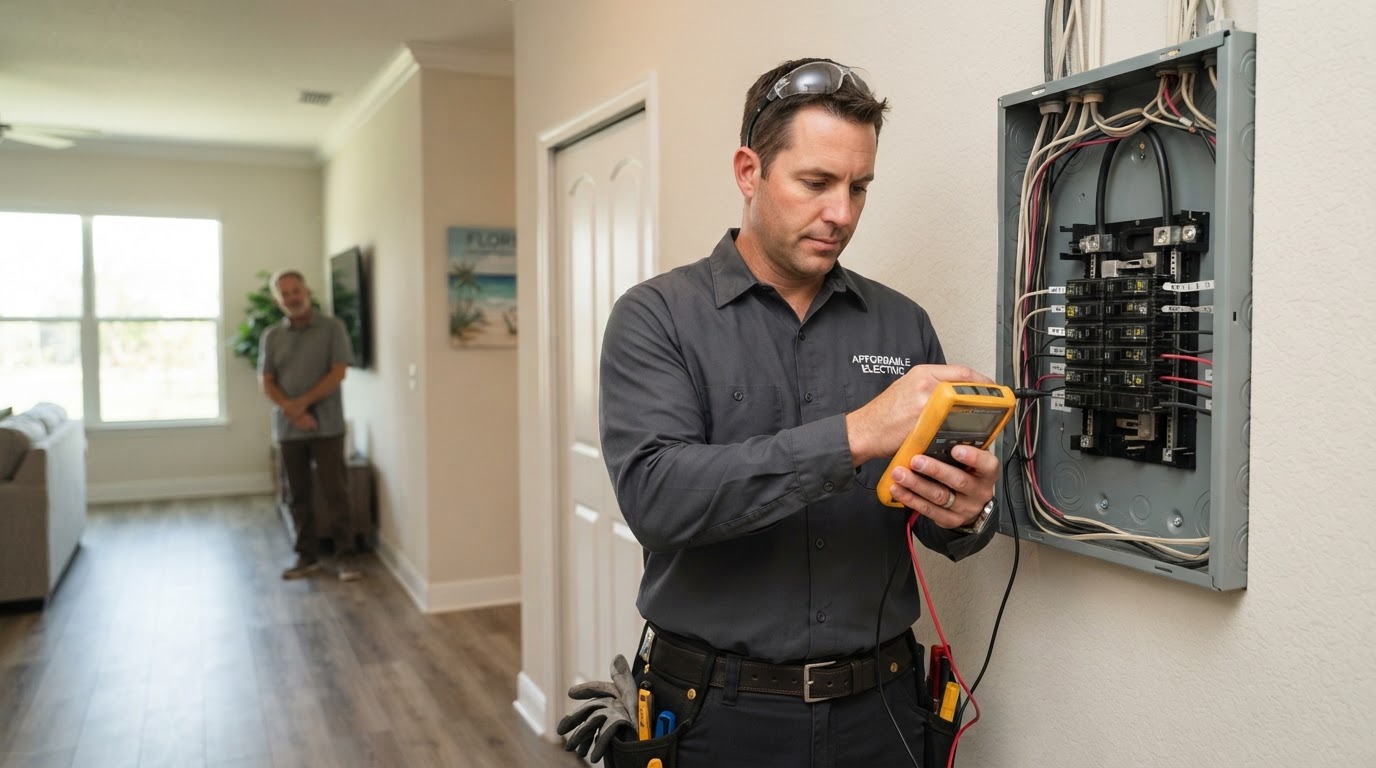
The first step is having a qualified electrician evaluate your existing electrical panel and determine what your home actually needs.
During this visit, the electrician may inspect:
- Your existing panel's condition, age, and amperage rating.
- Available breaker spaces and signs of overheating or deterioration.
- Your home's electrical demand, including major appliances and equipment.
- The condition of the service entrance, meter enclosure, and grounding system.
- Whether the existing panel location meets applicable requirements.
- Any planned additions, such as an EV charger, larger HVAC system, or other electrical equipment.
A load calculation may also be necessary to determine whether your home's existing electrical service can safely support its electrical needs.
Not every homeowner needs a larger electrical service. Sometimes the appropriate solution is replacing an outdated or damaged panel while maintaining the existing service capacity.
The evaluation helps establish the correct scope before permits are requested or installation is scheduled.
Step 2: Receiving Your Written Estimate and Scheduling the Project
Typical timeframe: 1 to 5 business days after the evaluation for a straightforward project, followed by scheduling based on availability.
Once your electrician understands the existing conditions, the next step is preparing a written estimate.
For a straightforward panel replacement, this may be completed relatively quickly. More complicated projects can require additional measurements, a detailed load calculation, equipment verification, or communication with the utility company.
Your written estimate should explain what work is proposed, including whether the project involves only the electrical panel or additional components such as the meter enclosure, service entrance conductors, or grounding system.
After you authorize the work, your electrician can begin coordinating the necessary approvals and scheduling.
One important detail: Choosing an installation date is not always as simple as selecting an available day on the electrician's calendar.
Panel upgrades that require a utility disconnect must be coordinated with the utility provider. Permit approvals and inspection availability can also affect the installation date.
Your electrician should explain which steps must be completed before the work can begin.
Step 3: Permit Application and Approval
Typical planning range: Several business days to approximately 2 weeks, depending on the permitting authority and project scope.
Residential electrical panel upgrades generally require an electrical permit. The exact requirements depend on the work being performed and the authority responsible for the property.
In Manatee and Sarasota Counties, permitting procedures can differ depending on whether your home is located within an incorporated municipality or an unincorporated county area. For example, a home in Palmetto may fall under a different permitting jurisdiction than a home in unincorporated Manatee County. Your electrical contractor should determine the appropriate permitting authority and submit the required information.
The permit process helps ensure the proposed work is reviewed under applicable electrical and building requirements.
Some straightforward permit applications may be processed quickly. Others require additional documentation, clarification, or plan review.
Why does this matter for your timeline?
Your electrician generally cannot move forward with permitted installation work until the necessary authorization is in place.
Permit office workload, holidays, incomplete applications, and project complexity can all affect how quickly approval is received.
Step 4: Coordinating the Utility Disconnect and Reconnect
Typical planning range: Approximately 1 to 2 weeks for a routine utility appointment, with longer periods possible for complex service upgrades.
This is one of the most important scheduling steps.
When an electrical panel upgrade requires disconnecting the incoming electrical service, the work must be coordinated with the utility provider.
Many homes in Manatee and Sarasota Counties receive electric service from Florida Power & Light (FPL). FPL's published guidance explains that routine residential disconnect/reconnect appointments require advance coordination. Availability depends on the type of service work and utility scheduling. More involved projects may require a separate project application and additional review.
The utility provider and electrical contractor must coordinate when the power will be disconnected, when the electrician can safely begin work, and what must happen before service is restored.
If the work includes modifications to the meter enclosure or electrical service equipment, inspection approval may be required before the utility can reconnect power.
This is why a panel upgrade should never be planned around an assumed power restoration time.
Your electrician should confirm the actual disconnect and reconnect arrangements before installation day.
Important safety note: Homeowners should never attempt to remove the utility meter, disconnect incoming service conductors, or perform panel replacement work themselves. These activities present serious shock, arc-flash, and fire hazards and require properly qualified personnel and utility authorization.
Step 5: What Happens on Electrical Panel Upgrade Day?
Typical installation time: Approximately 4 to 8 hours for a straightforward replacement.
For many homeowners, this is the most visible part of the entire process.
Although several weeks of planning may go into the project, the actual panel replacement can often be completed within one working day.
Here is what generally happens.
Preparing the Work Area and Disconnecting Power
Your electrician begins by confirming the work area is accessible, reviewing safety procedures, and coordinating the authorized electrical disconnect.
Once the service has been safely disconnected and verified, the electrician can begin removing the existing equipment.
Removing the Old Electrical Panel
The existing panel is carefully disconnected and removed.
The electrician evaluates the condition and length of the existing conductors, along with any issues that may not have been fully visible during the initial evaluation.
Unexpected damage, deteriorated wiring, or other hidden conditions can extend the work.
Installing the New Panel
The electrician installs the replacement panel, makes the required electrical connections, and completes applicable grounding and bonding work.
Existing circuits are reconnected as appropriate, and the panel's breakers and circuit identification are addressed.
If the project includes service entrance repairs, a meter enclosure replacement, or relocation, the installation may require substantially more time.
Testing and Preparing for Reconnection
Once the installation is complete, the electrician performs appropriate checks and prepares the equipment for inspection and re-energization.
Power restoration depends on the specific work performed, the required inspection authorization, and utility procedures.
After power is restored, the electrician can complete operational checks that require the electrical system to be energized.
How Long Will Your Power Be Off During a Panel Upgrade?
For planning purposes, allow approximately 4 to 8 hours without electricity for a straightforward replacement, but prepare for a longer interruption if inspection or utility reconnection takes additional time.
This is often the biggest concern for homeowners.
The power outage may begin when the utility disconnects the electrical service and continue through installation, required inspection, and reconnection.
The outage does not necessarily end the moment the electrician finishes installing the panel.
If inspection approval or utility reconnection is delayed, your home may remain without electricity longer than the installation itself takes.
Utility appointments may have specific time limits. For certain FPL disconnect/reconnect arrangements, a longer work window can affect whether same-day reconnection is available.
For that reason, same-day power restoration should be treated as a coordinated goal, not an unconditional guarantee.
Before installation day, ask your electrician:
- When is the power expected to be disconnected?
- How long should we realistically plan to be without electricity?
- Is an inspection required before reconnection?
- Has the utility reconnection been coordinated?
- What happens if power cannot be restored that afternoon?
Clear communication ahead of time makes planning much easier.
Step 6: Electrical Inspection and Final Sign-Off
Typical timeframe: Same day to several business days after installation, depending on inspection availability and the work involved.
A permitted electrical panel upgrade generally requires inspection by the appropriate building or electrical authority.
The inspector reviews the installation for compliance with applicable requirements.
Depending on the project, inspection approval may be required before the utility can restore electrical service, particularly when the meter enclosure or service equipment has been modified.
For work requiring utility reconnection authorization, the approval must be communicated through the required process.
A final administrative permit closeout may occur after the installation and power restoration.
If an inspector identifies an issue requiring correction, the electrician must address it and arrange any necessary follow-up inspection.
That can add days to the overall timeline.
Before considering the project fully complete, confirm that the required inspections have passed and that the permit has been properly closed.
How Long Does the Entire Panel Upgrade Process Take?
For planning purposes, here is how a straightforward residential panel upgrade might progress.
| Project stage | Approximate timeframe |
|---|---|
| Initial evaluation and load assessment | 1 to 7 business days to schedule |
| Written estimate and scheduling | 1 to 5 business days for the estimate, plus scheduling |
| Permit application and approval | Several business days to 2 weeks |
| Utility coordination | Approximately 1 to 2 weeks |
| Panel installation | Approximately 4 to 8 hours |
| Inspection and final sign-off | Same day to several business days, or longer if corrections are needed |
| Total estimated elapsed time | Roughly 2 to 6 weeks for many straightforward projects |
These are general planning ranges, not guaranteed completion times. Several steps can overlap, so adding each estimate together does not necessarily reflect the total elapsed time.
A simple replacement with favorable permit and utility availability could finish sooner. A complex electrical service upgrade can take several weeks longer.
What Can Delay an Electrical Panel Upgrade?
Even a carefully planned project can encounter delays.
- Permit office backlogs: High application volumes, holidays, or requests for additional information can slow approvals.
- Utility scheduling: Available disconnect/reconnect appointments may not align with the electrician's earliest opening. Projects requiring utility engineering or equipment changes can take longer.
- Panel or meter relocation: Moving equipment to a different location can require additional planning, service modifications, and approvals.
- Service entrance repairs: Damaged conductors, deteriorated equipment, or grounding issues discovered during installation can increase the scope of work.
- Inspection corrections: If changes are required after an inspection, the electrician may need additional time to complete them and obtain reapproval.
- Florida weather: Lightning, heavy rain, tropical weather, and utility storm-response demands can affect outdoor electrical work and utility scheduling.
The best way to reduce surprises is to identify potential complications during the initial evaluation and maintain communication throughout the process.
How to Prepare Your Home for Panel Upgrade Day
A little preparation can make the power interruption easier to manage.
- Protect refrigerated food. Keep refrigerator and freezer doors closed as much as possible. According to FDA food safety guidance, an unopened refrigerator generally keeps food cold for about 4 hours, while a full freezer may maintain its temperature for approximately 48 hours if unopened. Make alternate arrangements for longer interruptions.
- Plan around working from home. Your Wi-Fi router, computer, monitors, and other equipment may be unavailable. Consider working from another location if you need dependable internet access.
- Prepare for medical devices. If anyone in your household relies on electrically powered medical equipment, contact their healthcare provider or equipment supplier in advance to establish a safe backup plan. Do not rely on an estimated reconnection time for essential medical needs.
- Charge important devices. Fully charge phones, laptops, and portable battery packs beforehand.
- Clear the work area. Make sure your electrician can safely access the panel, meter, and surrounding equipment.
- Consider your pets and household routine. Electrical work may involve noise, open access areas, and technicians moving through the property.
- Avoid scheduling important appointments around the expected finish time. Allow flexibility in case the work or reconnection takes longer.
If you use a generator or backup power source, discuss the plan with your electrician beforehand. Never connect a portable generator directly to home wiring without approved transfer equipment, and never operate fuel-powered generators indoors or near openings into the home.
Frequently asked questions
Can an electrical panel upgrade be completed in one day?
Yes. Many straightforward residential panel replacements can be physically completed in one day. However, permits, utility coordination, inspections, and other preparations generally happen before or around the installation date.
Will I have electricity the same evening?
Same-day restoration may be possible when installation, inspection requirements, and utility reconnection are successfully coordinated. It is not guaranteed. Ask your electrician to explain the specific reconnection plan before work begins.
Do I need to be home during the installation?
You may need to provide access at the beginning of the project and be available for questions. Whether you must remain home depends on the work, access requirements, and arrangements made with your electrician.
Does upgrading from 100 amps to 200 amps take longer?
It can. Increasing electrical service capacity may require more than replacing the panel. Depending on the existing equipment and utility requirements, additional service components or utility upgrades may be necessary.
Can weather delay my panel upgrade in Florida?
Yes. Thunderstorms, lightning, heavy rain, and severe weather can make outdoor service work unsafe or disrupt scheduled utility work. Your electrician should advise you if conditions require rescheduling.
Planning an Electrical Panel Upgrade in Manatee or Sarasota County?
An electrical panel upgrade does not necessarily mean weeks of construction or multiple days without power.
For many homes, the actual installation can be completed in a single day. Most of the elapsed time involves evaluating the electrical system, preparing the project, securing permits, coordinating with the utility, and completing inspections.
Understanding those steps helps you plan around the work and avoid unnecessary surprises.
If you are considering an electrical panel upgrade in Palmetto, Bradenton, Sarasota, or a surrounding Manatee or Sarasota County community, On The Bright Side Electric can help you understand your home's electrical needs and the steps involved.
Request a free estimate from On The Bright Side Electric or call (941) 779-4888 to discuss your project.
www.onthebrightsideelectric.com
On The Bright Side Electric. Where You Never Get Left In The Dark.