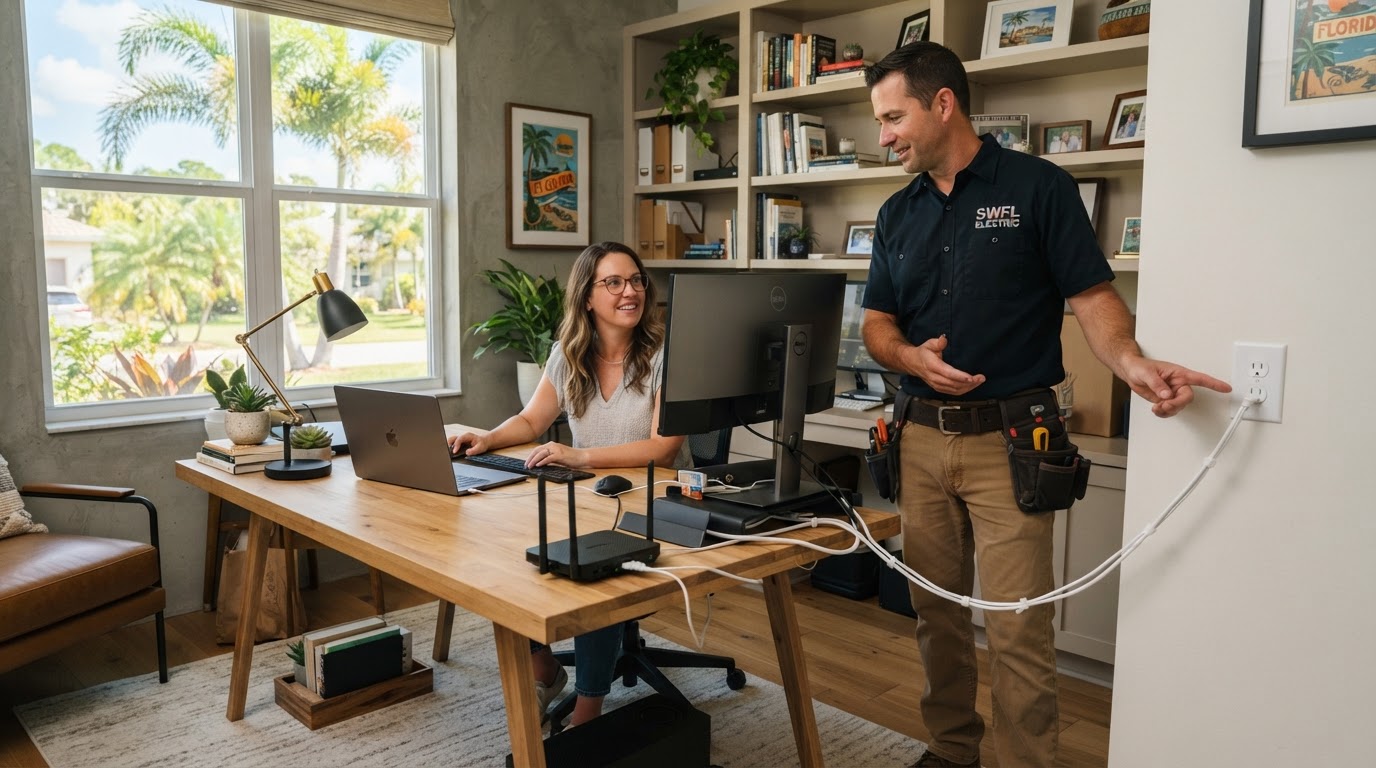
Every time you plug in your air fryer and the kitchen lights flicker — or your dryer trips the breaker mid-cycle — you are experiencing what happens when high-demand appliances share circuits they were not designed to share.
The solution is almost always the same: a dedicated circuit.
Florida homeowners add dedicated circuits for a growing list of reasons — EV chargers, upgraded HVAC systems, pool equipment, remodeled kitchens, and whole-home generators. Understanding what a dedicated circuit is, which appliances require one, and what the installation involves can save you from overloaded circuits, tripped breakers, and costly appliance damage.
On The Bright Side Electric LLC serves homeowners throughout Sarasota County and Manatee County. Owner Daniel Spears is a licensed Florida electrician (EC#13014677) and veteran who installs dedicated circuits for appliances, EV chargers, pool equipment, and more across Sarasota, Bradenton, Palmetto, and surrounding areas. Here is everything you need to know.
What Is a Dedicated Circuit?
A dedicated circuit is an electrical circuit that serves only one appliance or device. It has its own breaker in your panel, its own wire run from that breaker to the outlet or connection point, and nothing else shares it.
This matters because every circuit has a maximum load capacity. When multiple devices share a circuit and their combined draw exceeds that capacity, the breaker trips — or worse, the wiring overheats. For high-draw appliances like HVAC systems, electric dryers, and EV chargers, sharing a circuit is not just inconvenient. It is a safety issue.
A dedicated circuit means that appliance always has the power it needs, with no competition from other devices and no risk of overloading shared wiring.
How Dedicated Circuits Differ from General Circuits
Most outlets in your home are on general purpose circuits — 15-amp or 20-amp circuits shared across multiple outlets in a room. These work fine for lamps, TVs, phone chargers, and other low-draw devices.
Dedicated circuits are different in three key ways:
- Devices served: General circuits serve multiple outlets; dedicated circuits serve one appliance only
- Typical amperage: General circuits are 15A or 20A; dedicated circuits are 20A, 30A, 40A, 50A+ depending on the appliance
- Breaker: General circuits share a breaker; dedicated circuits have their own breaker in the panel
- Wiring: General circuits use standard room gauge; dedicated circuits use wire sized specifically for the appliance load
Plugging a high-draw appliance into a general circuit means you are constantly at risk of tripping the breaker — or, more seriously, exceeding the safe load of the wiring itself, which is a fire hazard over time.
What Florida's Electrical Code Requires
The National Electrical Code (NEC), which Florida adopts and enforces, mandates dedicated circuits for a specific set of appliances. These are code requirements — not suggestions — and any properly permitted electrical installation must include them.
NEC-required dedicated circuits include:
- HVAC systems (central air conditioning units and air handlers)
- Electric water heaters
- Electric dryers (240V)
- Electric ranges and ovens (240V)
- Dishwashers
- Garbage disposals
- Refrigerators (required in new construction; strongly recommended in older homes)
- Microwave ovens (required in new construction)
Florida also has specific requirements around pool and spa equipment, EV charger installations, and whole-home generator circuits that go beyond basic NEC requirements. Your local jurisdiction — Sarasota County, Manatee County, or City of Sarasota — may have additional provisions.
Appliances That Require a Dedicated Circuit
Here is a practical breakdown of the most common dedicated circuit requirements Florida homeowners encounter:
HVAC Systems
Central air conditioning is one of the highest electrical draws in any Florida home. Air handlers and compressors each require their own dedicated circuits, sized for the unit's amperage rating. Running AC on a shared circuit is a code violation — and one of the most common causes of nuisance tripping.
Electric Water Heaters
Standard residential electric water heaters draw 3,000–4,500 watts — enough to trip a shared breaker within minutes. A dedicated 240V, 30-amp circuit is required.
Electric Dryers
Dryers require a dedicated 240V, 30-amp circuit with a four-wire connection in modern installations. Many older Florida homes have outdated three-wire dryer connections that need to be updated during a panel or service upgrade.
Electric Ranges and Ovens
A full electric range draws 40–50 amps. This requires a dedicated 240V, 50-amp circuit — one of the heaviest residential loads short of an EV charger.
EV Chargers (Level 2)
A Level 2 EV charger requires a dedicated 240V circuit, typically 40–50 amps. This is the most common dedicated circuit install we perform for Sarasota homeowners today — and it almost always requires a panel evaluation first to confirm available capacity.
Pool and Spa Equipment
Pool pumps, spa heaters, and related equipment each require dedicated circuits sized for the equipment. Florida pool code is specific about GFCI protection, bonding, and circuit separation.
Whole-Home Generators
A standby generator requires a transfer switch and dedicated circuits. It connects directly to your panel — not a wall outlet — with a transfer switch that prevents dangerous backfeed to the utility line.
Garbage Disposals and Dishwashers
Required by code in new construction. Older Florida homes often have these on shared circuits, which frequently gets flagged during four-point inspections.
Signs You Are Missing a Dedicated Circuit
You may already have dedicated circuit issues without realizing it. Watch for:
- Breakers tripping when you run specific appliances — your dryer, dishwasher, or microwave triggering a trip is a classic sign of an overloaded shared circuit
- Lights flickering when a large appliance starts — motors drawing startup current on a shared circuit cause voltage dips across everything on it
- Warm or discolored outlet covers — heat at an outlet indicates an overloaded circuit and should be inspected immediately
- Appliances wearing out faster than expected — motors and compressors running on underpowered circuits have shorter lifespans
- A home inspector or insurer flags your electrical — four-point inspections in Florida routinely identify missing dedicated circuits in older homes
EV Charger Installations: The Dedicated Circuit Florida Homeowners Are Adding Most
The fastest-growing dedicated circuit request we receive is for Level 2 EV charger installation. As EV adoption accelerates across Sarasota and Manatee Counties, more homeowners are moving past the slow 120V Level 1 outlet (8–24 hours for a full charge) to a proper Level 2 station (4–8 hours).
A Level 2 charger requires:
- A dedicated 240V circuit
- Typically 40–50 amps of capacity, sized to the charger
- Available capacity in your existing panel
- Proper outlet or hardwired connection depending on the charger
In some homes — especially those still on 100-amp service — adding an EV charger circuit requires a service upgrade first. We assess this during your free remote consultation so there are no surprises on installation day.
Pool and Spa Equipment: Dedicated Circuits Done Right
Florida has more residential pools per capita than almost any other state — and pool electrical work is among the most regulated under both the NEC and Florida Building Code. Dedicated circuits for pool and spa equipment must include:
- GFCI protection on all pool-adjacent circuits
- Proper bonding of all metal pool components (separate from grounding)
- Separation of lighting circuits from pump and heater circuits
- Compliance with Sarasota County or Manatee County inspection requirements
Pool electrical work must be done by a licensed electrical contractor. This is one area where unlicensed work creates serious safety and liability exposure — and it will fail inspection.
What the Installation Process Involves
Installing a dedicated circuit is straightforward for a licensed electrician, but it does require a permit in Florida for most circuit additions. Here is what to expect:
- Load evaluation — confirm your panel has available capacity for the new circuit
- Circuit sizing — determine the correct wire gauge, breaker size, and outlet type for your appliance
- Permit pulled (required for most dedicated circuit additions in Sarasota and Manatee Counties)
- Wire run — new wire pulled from your panel to the appliance location
- Breaker installed — new breaker added to your panel
- Outlet or connection point installed at the appliance location
- Inspection if required by the permit
Most dedicated circuit installs are completed in a single visit. More complex runs — through finished walls, long distances, or crawlspace and attic routing — may take longer.
What Does a Dedicated Circuit Cost in Sarasota?
Cost varies based on:
- Circuit amperage (a 20-amp kitchen circuit costs less than a 50-amp EV charger circuit)
- Distance from panel to appliance location
- Panel capacity (if your panel is full or at a 100-amp service limit, additional work may be needed)
- Permit and inspection fees
As a general range, a dedicated circuit installation in Sarasota and Manatee Counties runs $200–$800 per circuit, depending on complexity. Heavy-load 240V circuits for EV chargers, dryers, and ranges will be on the higher end.
We provide free remote consultations to assess your specific setup and give you an honest, itemized estimate. Our dispatch fee for in-person visits is $59.99.
Florida-Specific Considerations
Four-Point Inspections
Missing dedicated circuits — particularly for dishwashers, garbage disposals, and HVAC — are commonly flagged on Florida four-point inspections. Addressing them before you are required to by an insurance company or home sale timeline is always less expensive and less stressful.
Homeowners Insurance
Some Florida insurers flag homes with improperly loaded circuits as higher risk. If you have received electrical-related notices from your insurer, a dedicated circuit assessment is a practical first step.
Hurricane Preparedness
Adding a generator circuit with a proper transfer switch is not optional in Florida — it is required to prevent backfeed to the utility line, which is a life-safety issue for utility workers restoring power after storms. There is no safe shortcut here.
Ready to Add a Dedicated Circuit?
Whether you are installing an EV charger, upgrading your kitchen, adding pool equipment, or simply tired of tripping breakers — we can evaluate your panel and install the dedicated circuits your home needs, properly permitted and inspected.
Request a Free Estimate →Call or text: (941) 779-4888
Licensed Florida Electrical Contractor | EC#13014677 | Veteran-Owned | Serving Sarasota, Bradenton, Palmetto, Venice, and surrounding areas