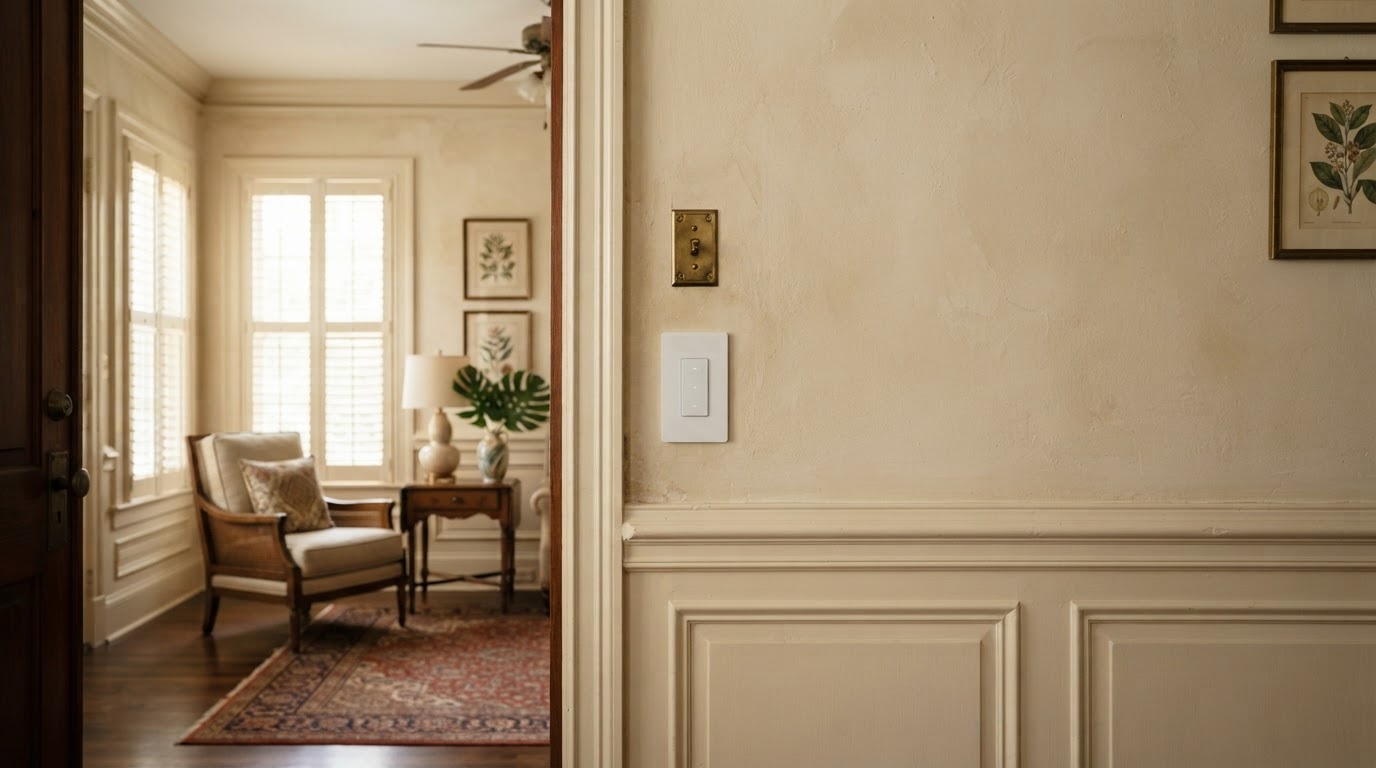
Smart switches can add scheduling, remote control, scenes, dimming, and voice-assistant integration without replacing every light fixture in the house.
But older homes can make smart-switch upgrades less straightforward than a simple one-for-one device swap.
The question is not just whether a smart switch fits in the wall.
The electrician may need to check the wiring available in the box, grounding, box depth, the type of lighting load, and how the light is controlled from multiple locations.
The Neutral Wire Is Often the First Question
Many smart switches need a neutral connection because the electronics inside the switch require continuous power even when the light itself is off.
In some older homes, the switch box may not contain a neutral conductor.
That does not automatically mean smart lighting is impossible.
Manufacturers now offer several device families designed for certain no-neutral retrofit situations, while other models still require a neutral. For a useful overview, see Leviton's guidance on neutral wire requirements for in-wall smart devices.
The important point is that the product must match the actual wiring in the wall.
Do not assume a white wire in the box is a neutral simply because of its color. Older switching methods can use conductors differently, and the wiring should be identified correctly before a device is selected.
Grounding Can Matter Too
Some no-neutral smart devices require an equipment grounding connection to operate as designed.
Older homes may have:
- grounded cable and boxes
- metal raceway or cable systems that provide a grounding path
- older wiring without an equipment grounding conductor
- a mix of wiring from different renovation periods
That is one reason older-home smart-switch projects should begin with evaluation rather than buying several devices first.
A product that is compatible with one room may not be compatible with another switch box in the same house.
Older Switch Boxes May Be Too Shallow or Crowded
Smart switches are often deeper than traditional mechanical switches because they contain electronics, radios, and larger terminals.
An older electrical box may already be crowded with conductors and splices.
The electrician may need to determine whether there is adequate box volume and physical space for the new device and wiring arrangement.
Forcing a large smart device into an undersized or overcrowded box is not a good installation strategy.
The Type of Light Matters
Not every smart dimmer or switch is compatible with every lighting load.
Before choosing a device, identify what it will control.
Examples include:
- standard LED bulbs
- integrated LED fixtures
- incandescent or halogen lamps
- low-voltage lighting
- ceiling fans
- exhaust fans
- fluorescent fixtures
Dimmers are especially sensitive to compatibility.
A dimmer that works beautifully with one LED lamp may flicker, buzz, fail to dim properly, or have limited range with another product.
Use the smart-control manufacturer's compatibility information and the lighting manufacturer's requirements when available. Model-specific guidance, such as Lutron Caseta switch compatibility information, can help confirm whether a particular control fits the load.
Three-Way and Multi-Location Switching Needs Extra Planning
If one light can be controlled from two or more locations, you have a multi-location switching setup.
Smart controls can often work in these locations, but the device combination matters.
Some systems use:
- a primary smart switch plus an accessory switch
- a primary smart dimmer plus a wireless companion
- rewired existing traveler conductors
- a specific smart device at the line or load location
Do not buy two identical smart switches and assume they will replace both ends of a three-way circuit.
Check the product system first.
What an Electrician May Check Before Recommending Smart Switches
The checklist below summarizes the key items an electrician may evaluate before recommending smart controls in an older Florida home.
Smart-Switch Compatibility Checklist
- Neutral available?
- Grounding present?
- Box depth adequate?
- Load type compatible?
- Single-pole or multi-way?
- Wi-Fi or hub ecosystem chosen?
| Existing Condition | Why It Matters |
|---|---|
| Neutral conductors in the wallbox | Many smart devices require a neutral, while some models are designed for no-neutral applications |
| Equipment grounding | Certain devices require a ground connection and older homes vary |
| Box depth and fill | Smart switches can be deeper than traditional switches |
| Lighting load type | Switch and dimmer compatibility varies by LED, low-voltage, fan, and other loads |
| Three-way or multi-way control | The correct primary, accessory, or companion device must be selected |
| Wi-Fi or smart-home ecosystem | Device choice can affect app, hub, Matter, Alexa, Google, or Apple compatibility |
A short evaluation can save a lot of trial and error.
Do You Need to Rewire the House for Smart Switches?
Usually not.
Many smart-lighting upgrades can use existing branch-circuit wiring when the existing installation and selected devices are compatible.
In some locations, however, adding a neutral, changing a box, correcting older wiring, or choosing a different smart-control system may be appropriate.
The answer can vary room by room. For a broader look at preparing wiring for automation, see our guide to smart home electrical upgrades and wiring for automation.
Are No-Neutral Smart Switches a Shortcut Around Old Wiring Problems?
No.
A no-neutral product is a device designed for a specific wiring application. It does not make damaged, unsafe, or improperly grounded wiring acceptable.
If the electrician finds deteriorated insulation, loose connections, questionable splices, damaged boxes, or other concerns, those conditions should be addressed separately.
Smart-home technology should be added to a sound electrical installation, not used to cover up an electrical problem.
Should You Buy the Smart Switches Before Calling an Electrician?
You can research your preferred ecosystem first, but it is often smarter to verify the wiring before purchasing a houseful of devices.
If you already bought them, send the exact model numbers.
For a remote estimate or planning review, useful information can include:
- number of switches you want to replace
- which lights are controlled from more than one location
- smart-home ecosystem preference
- photos of the switch locations and wall plates
- age of the home if known
- fixture or bulb type
- device model numbers if already purchased
Do not remove switches or open electrical boxes just to take estimate photos.
Smart Lighting Upgrades in Sarasota and Manatee County
On The Bright Side Electric helps homeowners plan lighting and smart-control upgrades throughout Sarasota and Manatee County, including Sarasota, Bradenton, Parrish, Palmetto, Ellenton, Lakewood Ranch, Siesta Key, and Longboat Key.
The right project may be as simple as replacing compatible controls or may involve targeted electrical updates in certain locations.
The first step is understanding what wiring and loads are actually present. If new fixtures are also part of the plan, see our guide to recessed lighting for a Florida remodel for related planning considerations.
Frequently Asked Questions
Do all smart switches need a neutral wire?
No. Many popular models require a neutral, but some product lines are designed for certain no-neutral retrofit applications. The correct device depends on the wiring and load.
Can smart switches work in a house built before the 1980s?
Often yes. The age of the house alone does not determine compatibility. The electrician needs to evaluate the wiring in the specific switch locations and match the device to that installation.
What if there is no ground wire in the switch box?
That can affect device selection, especially for products that require an equipment grounding connection. Older wiring systems vary, so the box and wiring should be evaluated before choosing the control.
Can a smart dimmer cause LED lights to flicker?
Incompatible combinations can produce poor dimming performance, flicker, or limited range. Check both the dimmer and lighting compatibility information.
Can I use smart switches on three-way lights?
Yes, many systems support multi-location control, but the correct primary and accessory devices must be selected for the specific system.
Planning a Smart-Switch Upgrade?
Send On The Bright Side Electric the number of switches, photos of the locations, and any smart-control models you are considering. We can review the project and help determine the appropriate next step without asking you to open electrical boxes or troubleshoot energized wiring yourself.
Request a Free Remote Estimate →