Florida outdoor outlets have a harder life than the receptacles inside your house.
They face heat, humidity, wind-driven rain, irrigation, salt air in coastal areas, insects, landscaping activity and the occasional pressure washer.
That is why a weather-ready outdoor outlet is not just an ordinary receptacle with a plastic flap over it.
Several parts of the installation work together to provide protection.
In short: A weather-ready outdoor outlet is more than a receptacle with a plastic cover. Outdoor dwelling receptacles need the protection appropriate to their location, including GFCI protection and equipment suitable for damp or wet conditions. Current NEC wet-location rules also address weatherproof enclosures and weather-resistant receptacles. The exact installation depends on whether the location is damp, wet, exposed and in use while a cord is connected.
Outdoor GFCI Protection Is Only One Part of the System
Ground-fault circuit-interrupter protection is essential for outdoor dwelling receptacles under the NEC framework used in Florida. Background on the National Electrical Code (NFPA 70) is available from the NFPA.
A GFCI is designed to reduce shock risk by opening the circuit when it detects an imbalance consistent with current leaking from the intended path.
But a GFCI device does not make an otherwise unsuitable outdoor installation weather-ready by itself.
You also need the right receptacle, box, cover, fittings and wiring method for the location.
What Does a Weather-Resistant Receptacle Do?
Outdoor receptacles exposed to the weather are built for conditions that ordinary indoor devices are not intended to handle.
Current NEC wet-location provisions identify weather-resistant receptacle types for the covered 15- and 20-amp, 125- and 250-volt nonlocking receptacles.
You may see "WR" marked on the face of a weather-resistant receptacle.
That marking matters because the device itself is part of the outdoor protection strategy.
It is not a substitute for a proper enclosure or cover.
Why the Cover Matters, Especially When a Cord Is Plugged In
A common failure point is the cover.
Some older covers protect the receptacle reasonably well only when nothing is plugged in.
That is not enough for many wet-location installations where the receptacle is used while exposed to weather.
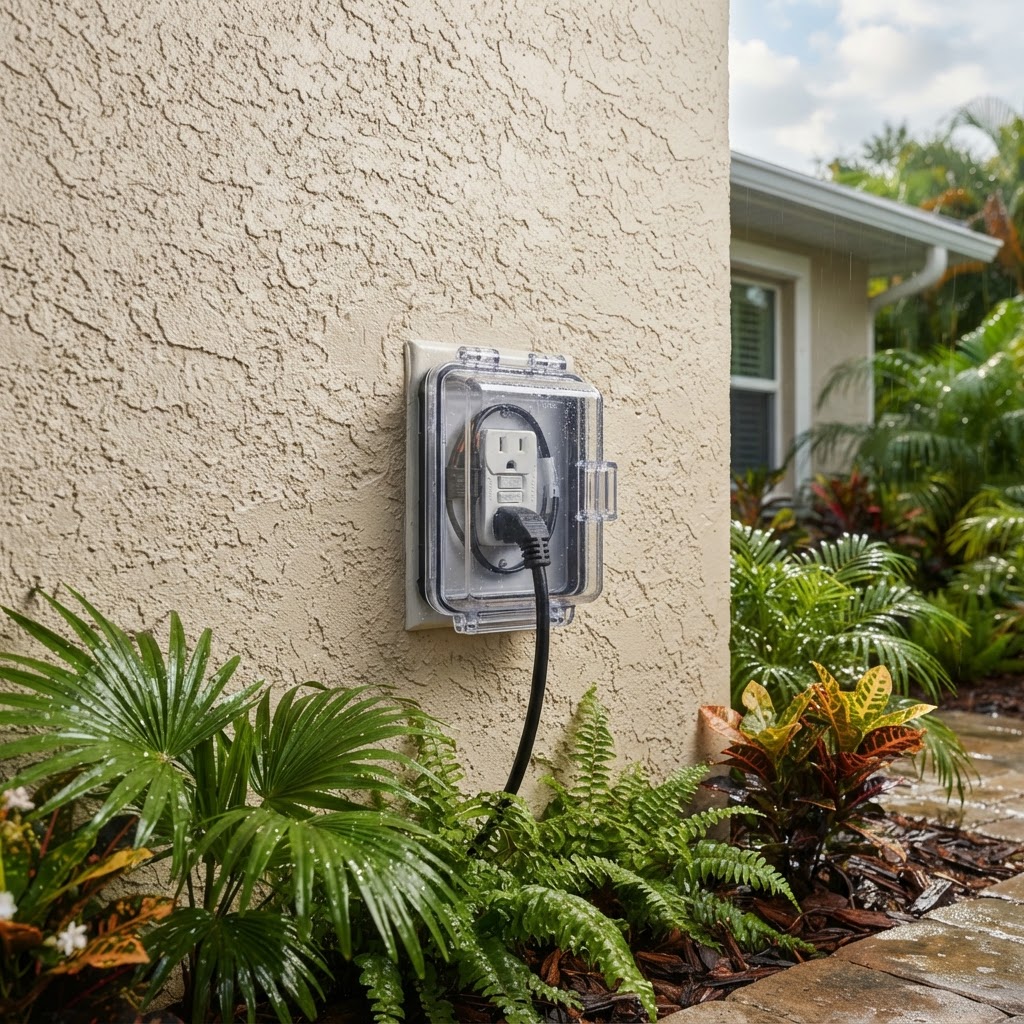
NEC wet-location rules address weatherproof enclosures while a plug is inserted, including listed outlet-box hoods identified for the purpose.
This is why you often see larger clear or opaque "in-use" covers on modern outdoor receptacles.
The shape is functional. It creates room for the cord connection while maintaining weather protection.
Damp Location and Wet Location Are Not the Same Thing
A receptacle under a deep covered lanai can experience different exposure than one mounted on an uncovered exterior wall.
The electrical design should reflect the actual location.
Factors include:
- direct rain exposure
- wind-driven rain
- irrigation spray
- wash-down exposure
- mounting orientation
- enclosure type
- whether cords remain plugged in
- coastal conditions
Do not assume "under a roof" automatically means indoor equipment is appropriate.
Florida Weather Can Find Small Weaknesses
Water does not need a dramatic storm to cause trouble.
Outdoor electrical problems can begin with:
- a cracked cover
- a missing gasket
- a loose box
- a damaged conduit fitting
- a receptacle that no longer holds a plug firmly
- deteriorated caulk around the box
- corrosion
- insects or debris inside a damaged enclosure
Then a normal rain event reveals the weakness.
If an outdoor GFCI repeatedly trips after rain, the useful question is not, "How do I keep it from tripping?"
The useful question is, "Where is the moisture or fault getting into the system?"
Why Your Outdoor Outlet May Keep Tripping After Rain
Possible causes include:
- water intrusion into the receptacle or box
- a damaged weather cover
- moisture in downstream wiring or equipment
- a wet extension cord or connected appliance
- a deteriorated GFCI device
- landscape-lighting or other downstream faults
A protective device that trips is doing something important.
Do not replace it with an ordinary receptacle just to stop the inconvenience.
Instead, remove connected loads where appropriate and have recurring problems diagnosed. For a deeper explanation of that process, see our guide on electrical diagnostic vs. estimate.
Outdoor Outlets for Lanais, Kitchens and Entertainment Areas
Outdoor living spaces often need more power than the original home provided.
A modern lanai may include:
- televisions
- beverage refrigerators
- grills or cooking equipment
- fans
- lighting
- speakers
- motorized shades
- chargers
- holiday lighting
Adding several devices to one old convenience outlet can lead to power strips, extension cords and overloaded layouts.
If you are remodeling an outdoor living area, plan permanent receptacles around the actual equipment instead of around the nearest existing outlet. For related exterior work, see our guide on outdoor electrical work in Sarasota.
Do Not Forget Landscaping and Maintenance
The outlet also has to survive normal property maintenance.
Think about:
- lawn equipment
- pressure washing
- irrigation heads
- mulch and soil height
- shrubs growing into the cover
- furniture blocking access
- cords crossing walkways
A technically functional outlet can still be poorly located for real life.
What to Look for During a Visual Check
You can inspect the outside of the installation without opening electrical equipment.
Look for:
- cracked or missing covers
- covers that will not close
- loose boxes or faceplates
- corrosion
- burn marks or discoloration
- plugs that sag or fall out
- a GFCI that will not reset or test normally
- water inside a clear cover
- damaged conduit or fittings
If you see burning, melting, arcing or serious physical damage, stop using the outlet and have it evaluated promptly.
What to Send for an Outdoor Outlet Estimate
For a defined installation, photos can be very helpful.
Send:
- the exterior location where you want the outlet
- nearby existing outlets
- the electrical panel and breaker labeling where safe
- the approximate route or distance from the panel
- what equipment you plan to plug in
- whether the location is covered or directly exposed
- whether irrigation or wash-down affects the area
If the problem is unknown, such as a GFCI that keeps tripping after rain, the job may require diagnostic testing rather than a fixed remote repair estimate.
Outdoor Electrical Work in Sarasota and Manatee County
On The Bright Side Electric helps homeowners with outdoor receptacles, lighting, circuits and troubleshooting across Sarasota and Manatee Counties, including Bradenton, Parrish, Palmetto, Ellenton, Lakewood Ranch, Sarasota, Siesta Key and Longboat Key. Learn more about our residential electrical services.
Florida outdoor electrical work needs to be selected and installed for the environment it actually faces.
The goal is not to make an indoor outlet look weatherproof.
It is to build the whole installation for outdoor use.
Plan Outdoor Power the Right Way
Whether you are adding a new outdoor receptacle or diagnosing a GFCI that keeps tripping after rain, the right next step depends on whether the scope is defined or the cause is unknown. Send us your photos and project details, or reach out for diagnostic help.
On The Bright Side Electric LLC
Veteran-Owned | 4th Generation Electrician | Licensed & Insured | EC#13014677